Leading members of the Lithuanian Musar movement loved Rabbi Menahem Mendel Lefin of Satanów’s method of character refinement. But did they know where it came from?

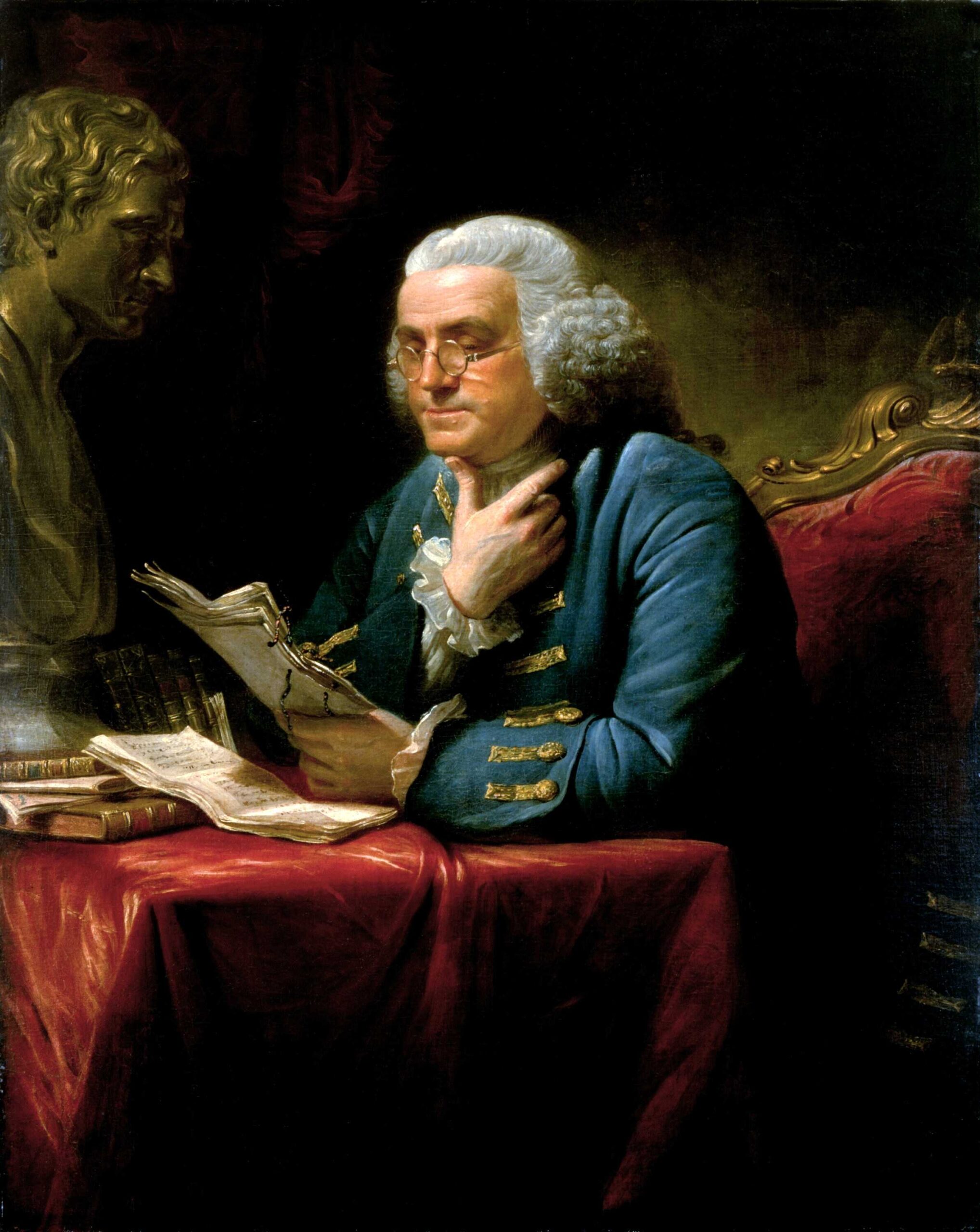
In part 2 of his famous autobiography, American founding father Benjamin Franklin (1706– 1790) recounts how, as a younger man of about twenty-five, he sought to break all his bad habits and acquire and establish good ones. He quickly discovered, though – as do all people who want to improve themselves – that wanting to change is not enough:
As I knew, or thought I knew, what was right and wrong, I did not see why I might not always do the one and avoid the other. But I soon found I had undertaken a Task of more Difficulty than I had imagined.
…] I concluded at length, that the mere speculative Conviction that it was in our Interest to be completely virtuous, was not sufficient to prevent our Slipping. […] For this purpose I therefore contriv’d the following Method. (The Autobiography of Benjamin Franklin, ed. L. W. Labaree et al. [New Haven: Yale University, 2003], p. 148)
The future revolutionary’s year-long, quarterly repeated self-reform program centered on thirteen virtues, each of which received a week’s close attention four times a year.
Franklin focused on the following:
TEMPERANCE. Eat not to Dullness. Drink not to Elevation.
SILENCE. Speak not but what may benefit others or yourself. Avoid trifling conversation.
ORDER. Let all your Things have their Places. Let each Part of your Business have its Time.
RESOLUTION. Resolve to perform what you ought. Perform without fail what you resolve.
FRUGALITY. Make no Expense but to do good to others or yourself: i.e., Waste nothing.
INDUSTRY. Lose no Time. Be always employ’d in something useful. Cut off all unnecessary Actions.
SINCERITY. Use no hurtful Deceit. Think innocently and justly; and, if you speak, speak accordingly.
JUSTICE. Wrong none, by doing Injuries or omitting the Benefits that are your Duty.
MODERATION. Avoid Extremes. Forbear resenting Injuries so much as you think they deserve.
CLEANLINESS. Tolerate no Uncleanness in Body, Clothes or Habitation.
TRANQUILITY. Be not disturbed at Trifles, or at Accidents common or unavoidable.
CHASTITY. Rarely use Venery but for Health or Offspring; Never to Dullness, Weakness, or the Injury of your own or another’s Peace or Reputation.
HUMILITY. Imitate Jesus and Socrates. (ibid., pp. 149–50)
Progress and setbacks in acquiring these virtues were monitored through grid charts in which the seven days of the week ran horizontally and the thirteen desired traits ran vertically. At the end of each day, Franklin carefully considered how he had upheld that week’s virtue, as well as the other twelve. He then marked each daily lapse. After thirteen weeks, he repeated this cycle, thereby devoting four full weeks a year to each trait.
Franklin ordered his virtues in a way he deemed most conducive to mastering them. Controlling his intake of food and alcohol could help him “procure that Coolness and Clearness of Head” necessary to break bad habits, regulate his speech, and so on, concluding with the most challenging virtue: humility. In his list, frugality and industry precede sincerity and justice. Though Franklin’s writings – including his autobiography and its method of moral perfection – have often been disparaged for their apparent emphasis on economic success, he believed that the financial stability and self-sufficiency attained through thrift and focused work could make “the Practice of Sincerity and Justice” easier (ibid., pp. 150–51). He saw prosperity as securing virtue, for “it is hard for an empty Sack to stand upright” (ibid., p. 164).
Early on, Franklin recognized that his approach could aid others seeking to improve themselves, and he had intended to elaborate upon it in a book to be titled “the ART of Virtue.” He also planned to form a secret international fraternity, a “united Party for Virtue,” whose scattered members – having committed to his method – would support one another and work together for the betterment of humanity (ibid., pp. 157–61).
Despite his many other achievements, Franklin accomplished neither of these ambitious tasks. Nevertheless, his technique was publicized through his posthumously published autobiography.

Lefin’s version of Franklin’s chart, from the Kneses Isroel edition of Sefer Heshbon Hanefesh (Leidzia,1936), p. 55

Marked-up example of Franklin’s personal development chart suggests that order was a challenge for him. Reproduced from The Autobiography of Benjamin Franklin, ed. John Bigelow (Philadelphia: J. B. Lippincott & Co., 1868), p. 220
FRANKLIN’S FORTUNES: Humble Beginnings
Born in Boston in 1706 to an English candle and soap maker of modest means, Benjamin Franklin became, by the time of his death in 1790, the era’s most famous American.
The youngest of his father’s seventeen children, Franklin was apprenticed at age twelve to an older brother who worked as a printer. At seventeen, Franklin ran away to Philadelphia, the small town he would soon help transform into an “Athens in America.”
Continental Shift
One reader of this text was a Jewish Enlightenment proponent (maskil in Hebrew; plural, maskilim), Rabbi Menahem Mendel Lefin (1749–1826) of Satanów, in eastern Europe, who decided to situate Franklin’s method in a Jewish context.
Though the Haskala (Jewish Enlightenment) movement later became almost synonymous in Orthodox Jewish consciousness with abandonment of or opposition to traditional Judaism, Rabbi Lefin and other early, moderate adherents were Torah-observant Jews. Maskilim, as Immanuel Etkes explains, were “centrally concerned with Jews’ political status and their relationship to European culture” and “sought to exploit the new possibilities of economic, social, and cultural integration that appeared to become available to Jews in the late 18th century with the removal of legal discrimination” (The YIVO Encyclopedia of Jews in Eastern Europe, http://www .yivoencyclopedia.org/article.aspx/ Haskalah). Its less radical advocates saw no contradiction between this goal and devoted Jewish practice. In his writings, Rabbi Lefin aimed to reinforce Judaism as well as expose Jews to the potential benefits of European medical, scientific, and philosophical thought.
Rabbi Lefin traveled to Berlin in 1780, perhaps in part to cure his eye ailments. There he met and studied with Moses Mendelssohn and began translating Samuel Auguste André David Tissot’s French medical text into Hebrew.
After returning from Berlin, Rabbi Lefin was introduced to Prince Adam Kazimierz Czartoryski (1734–1823), an influential Polish aristocrat and proponent of the Enlightenment. Czartoryski was determined to modernize his country, and gathered a group of like-minded, able individuals to assist him in this task. Rabbi Lefin tutored the prince’s children, was allotted an annual stipend, and received support for publishing his works.
In 1792, encouraged by Czartoryski, Rabbi Lefin published a French pamphlet outlining a plan to integrate Jews into modern Polish society through general education, opposition to Hasidism, and a restructuring of the rabbinate. Though none of these proposals were accepted by the wider Jewish community or implemented by Polish authorities, Jewish schools inspired by his model were established two decades later in Galicia.
Most maskilim vehemently opposed the popular Hasidic movement, which arose in the first half of the 18th century around the teachings of Rabbi Yisrael Ba’al Shem Tov and his disciples and quickly spread throughout eastern Europe. As rationalists, maskilim regarded Hasidism’s mysticism (or superstition, as they saw it), adoration of spiritual leaders, and insularity as impediments to Jewish progress.
One of Rabbi Lefin’s interests was Musar – practical Jewish ethics – which began solidifying as a literary genre in the 11th century. His Sefer Heshbon Ha-nefesh (Book of Spiritual Accounting), published anonymously in 1808, introduced Franklin’s character-improvement technique to Hebrew readers and facilitated its incorporation into the Musar tradition, which Rabbi Lefin saw as an alternative to Hasidism.
It is unclear when Rabbi Lefin first discovered Franklin’s writings. Nancy Sinkoff has suggested that even if the rabbi was familiar with them prior to meeting Prince Czartoryski, his patron’s “esteem for the American natural philosopher no doubt sealed Lefin’s interest.” Franklin and Czartoryski knew each other and both were Freemasons, belonging to the Parisian Masonic Lodge of the Nine Sisters (“Benjamin Franklin in Jewish Eastern Europe: Cultural Appropriation in the Age of the Enlightenment,” Journal of the History of Ideas 61, no. 1 [2000], p. 140).
In Heshbon Ha-nefesh, Rabbi Lefin essentially reproduced the autobiography’s thirteen virtues, though he removed Jesus and Socrates from his definition of humility and made other adjustments. Overall, Heshbon Ha-nefesh offered a more malleable and individualized method than Franklin had outlined. Franklin had envisioned his program as universally applicable and as forming the basis of an international fraternity, so he wanted a fixed set of virtues on which all members could focus, regardless of their religion. Rabbi Lefin did not share these concerns, instead urging his Jewish readers to concentrate on characteristics relevant to their unique circumstances and personalities. He emphasizes that the traits enumerated in Heshbon Ha-nefesh are only examples and that, as readers master certain behaviors and become ready for new challenges, they are to adjust their own lists.
Within a generation of Rabbi Lefin, a new movement competing with Hasidism for the hearts and minds of young men eager to remain faithful to Judaism would coalesce around the charismatic figure of Rabbi Yisrael Lipkin Salanter (1810–1883, educated in the Lithuanian town of Salant). Known as the Musar movement for its emphasis on character refinement, its network of Talmudic academies spanned Lithuania and Poland, peaking in 1939 at three thousand students in sixty yeshivot (Yehuda Mirsky, YIVO Encyclopedia, https://yivoencyclopedia.org/ article.aspx/Musar_Movement). Approved by twelve rabbis in its first edition, Heshbon Ha-nefesh – including Franklin’s system – would eventually become a standard study text in Musar institutions.

Lefin’s patron, Prince Adam Kazimierz Czartoryski. Portrait by Jozef Peszka, 1791

Frontispiece of Heshbon Ha-nefesh, referring to Rabbi Lefin as “the Maskil,” published in Vilna in 1844
FRANKLIN’S FORTUNES: Mr. Virtuous
Franklin had an affinity for exclusive groups and loved secret societies. In 1727, he set up the Junto, a Philadelphia-based discussion and mutual aid society originally limited to twelve male members. After becoming a Freemason in 1731, the future statesman began envisioning a “united Party for Virtue” – a fraternity much larger than the Junto, with a wider global impact than the Freemasons – but his plan never materialized. He was elected Grand Master of Freemasons in Pennsylvania in 1734, just a few years after joining the Masonic fraternity.
An expert networker, Franklin used his fraternal connections to further his business ventures and advance public projects. Though an extremely successful entrepreneur, first as a printer and newspaper publisher, he was not concerned primarily with becoming wealthy. Retired at forty-two, Franklin “devoted the remainder of his life to serving his city, his colony, his empire, and then, after [American] independence in 1776, his state and the United States” (Gordon Wood, The Americanization of Benjamin Franklin [Penguin Press, 2004], p. 9).
Franklin’s contributions to his city include founding or cofounding the Library Company of Philadelphia (1731), the Union Fire Company (1736), the American Philosophical Society (1743), the University of Pennsylvania (1749), and Pennsylvania Hospital (1751). He sought to make living less dangerous and more pleasant, inventing the life- and property-saving lightning rod, an improved fireplace known as the Franklin stove, and a musical instrument, the glass armonica.
The Book Franklin Never Wrote
Rabbi Lefin wrote the character improvement book Franklin had contemplated, though the work was directed at a Hebrew-reading Jewish audience rather than, as Franklin had hoped in his autobiography, “People in all Religions” (p. 157). However, while Rabbi Lefin affirmed outright in Heshbon Ha-nefesh that its innovative method was not his own invention, he did not credit Franklin there. Rather, he wrote simply that “a few years ago a new technique was discovered, and it is a wonderful invention in this task [of character improvement], and it seems this innovation will spread quickly, God willing, as with the invention of the printing press, which brought light to the world” (Sefer Heshbon Ha-nefesh [Jerusalem: Merkaz Ha-sefer, 1988], p. 31).
Jewish academics – including Rabbi Hillel Levine, Immanuel Etkes, David Shahar, and Nancy Sinkoff – have generally considered this omission deliberate. In any case, due to Rabbi Lefin’s veiled reference to Franklin’s technique, Judaic scholars and Musar students alike have often been unaware of, confused about, or uncomfortable acknowledging his influence. Even Franklin specialists remain mostly oblivious to it.
In a 1969 Hebrew essay, Rabbi Nissan Waxman describes his surprise at learning that Heshbon Ha-nefesh – which he had studied extensively at the Musar yeshivot of Mir and Slobodka – was linked to Franklin. None of the editions he had come across connected the two, nor had his rabbis.
Rabbi Waxman emphasizes that
The book would not have been devalued even had [the Musar rabbis] known of and revealed its foreign source, just as the value has not been diminished for […] other books whose origin was elsewhere, and that have been accepted into the covenant of the tradition with affection and admiration, standing proudly on the shelves of the [Jewish] nation’s holy books. (“An Overlooked Book [On ‘Heshbon Ha-nefesh’ and Its Author],” Shana Be-shana [1969], pp. 303–4)
Rabbi Waxman also clarifies the relationship between Franklin’s autobiography and Heshbon Ha-nefesh:
[Franklin’s] method is truly extraordinarily wonderful in its approach to and appreciation of human character traits and capabilities. Therefore, it appealed to R[abbi] Mendel Lefin, and he based his book “Heshbon Ha-nefesh,” which he wrote about matters of character perfection, on it. (ibid., p. 307)
Rabbi Waxman needed to stress that Heshbon Ha-nefesh was not simply a translation of an existing text, because there was already tremendous confusion in Jewish scholarship related to Rabbi Lefin’s book, even (or especially) among those with some awareness of its link to Franklin. For example, a Hebrew article about Rabbi Salanter from the early 1960s states that “through his efforts Mendel Lefin of Satanów adapted the American writer Benjamin Franklin’s book on ‘Character Improvement,’ and it was published with a new title: ‘Heshbon Ha-nefesh’” (Yisrael Karnieli, “Rabbi Yisrael Lipkin of Salant and His Musar Approach,” Sinai 51 [1961/2], p. 145). Rabbi Salanter, however, was born after the writing of Heshbon Ha-nefesh and was a teenager when Rabbi Lefin passed away! The error may derive from a note found in post-1844 editions of Heshbon Ha-nefesh, mentioning Rabbi Salanter’s encouragement of the book’s printing and seemingly suggesting that this support resulted in its publication for the first time in 1844.

The Stain of Haskala
The Orthodox world has largely denounced the Haskala as an entirely negative phenomenon in European Jewish history. Rabbi Waxman’s essay thus glosses over Rabbi Lefin’s affiliation with the movement. Instead, in between lengthy quotes from Heshbon Ha-nefesh, he obliquely comments that “if we did not know their source, we might attribute them to the biting language aimed by ‘the princes of the Galician Haskala’ at the Hasidim of the author’s generation” (Waxman, pp. 309–10). But Rabbi Lefin was indeed connected with the early leaders of the Haskala in Galicia, and he sharply opposed the Hasidic movement.
In recent years, some Orthodox Jews have found it increasingly difficult to accept Rabbi Lefin, the author of a seminal Musar work, as a maskil. Others are uncomfortable with the fact that a book based upon a non-Jew’s writings could serve as a canonical text of Jewish ethics. Therefore, these Jews have effectively written either Franklin or Lefin out of Musar history, or amended the rabbi’s biography.
The 1995 Hebrew-English edition of Heshbon Ha-nefesh put out by Feldheim Publishers, for example, is wholly silent about Franklin. Its back cover also claims – contrary to Rabbi Lefin’s own words – that the book’s characterimprovement system originated with him and was formulated specifically for Jews:
CHESHBON HANEFESH, first published in Lemberg in 1812 [sic], presents a unique system for selfimprovement and the development of positive character traits. Employing sophisticated psychological techniques and charts to monitor one’s progress, this method was designed specifically for bnei Torah [i.e., those intensively engaged in Torah study] and is as applicable today as it was when it was first formulated, nearly 200 years ago.
The Feldheim edition’s biographical information on Rabbi Lefin likewise ignores his Haskala affiliation.
Heshbon Ha-nefesh has been republished many times and in many places. However, to the best of my knowledge, only the 2015 edition published by Jerusalem’s Mossad Harav Kook acknowledges Franklin’s influence. In his Hebrew preface, editor Rabbi Mordekhai Shmuel Edelstein discusses “the gentile sage […] Benjamin Franklin [in whom] there arose a powerful yearning to reach moral perfection,” as well as the method presented in Franklin’s popular autobiography. As for why Rabbi Lefin was not more open about who invented the technique at the core of his book, Rabbi Edelstein offers simply that “he had his reasons” (p. 5).
Nonetheless, Rabbi Edelstein never identifies Rabbi Lefin as a maskil. Rather, Edelstein states: “I do not want to get into a broad discussion of the author’s biography, views, and circle of friends […]. I have avoided doing so for several reasons, and perhaps the time will come” (p. 1). Yet his footnotes suggest that he is not necessarily open to the possibility that Rabbi Lefin was connected with the Haskala.

FRANKLIN’S FORTUNES: A Model of Tolerance
In his autobiography, Franklin professed an interest in projects “serviceable to People in all Religions.” He saw a positive societal role for faith and public worship and generally advocated religious tolerance and inclusivity, though he was not always without prejudice and on a few occasions used offensive language about Jews in private correspondence.
Franklin owned slaves and featured enslaved people for sale in his newspaper, but later in life he became an antislavery activist, accepting the ceremonial presidency of the Pennsylvania Abolition Society in 1787.
In 1788, after synagogue construction and difficult economic conditions plunged Philadelphia’s Congregation Mikveh Israel into debt, members turned to their neighbors, “worthy fellow Citizens of every religious Denomination,” for assistance. Franklin donated five pounds to help ensure a continued Jewish presence in the city (“Subscription List for Congregation Mikveh Israel [unpublished],” April 30, 1788, in The Papers of Benjamin Franklin [unpub. 1787–88]).
Fittingly, when Franklin passed away two years later, at age eighty-four, the press reported that his funeral procession in Philadelphia was led by “All the Clergy of the city, including the Ministers of the Hebrew congregation” (W. J. Bruce, “The Death and Funeral of Franklin,” American Historical Record 3, no. 25 [1874], p. 13).
Religious Amnesia
In a stark illustration of the tendency to overlook both Franklin and Rabbi Lefin when it comes to character refinement in Jewish contexts, a poster produced by Torah Umesorah (the National Society for Hebrew Day Schools) recognizes neither in connection with what it terms the “13 MIDDOS.”
Instead, the traits in this poster (as well as in decorative wall hangings sometimes found in Orthodox Jewish homes) are attributed solely to Rabbi Yisrael Salanter, the father of the Musar movement. This is also how they are presented to students at the Orthodox Jewish day school in Providence, Rhode Island, where I live.

In fact, some Hebrew lists of these thirteen virtues are unattributed to any source at all. See, for example, the bat mitzva booklet reproduced on the facing page, published in Jerusalem by Hedva Printing.
Such oversights are not limited to Orthodox Judaism. In the United States, the Union for Reform Judaism, together with New York’s 92Y cultural and community center and Central Synagogue, recently created a toolkit of resources related to Franklin’s virtues and meant “to facilitate a unique and powerful dialogue about Jewish and American values.” In the resulting publication, “Ben Franklin meets Pirkei Avot [Ethics of the Fathers]: A Jewish Interpretation of Franklin’s 13 Virtues” (https://benfranklincircles.org/jewishtoolkit), Musar merits but a single mention. Franklin’s impact on Heshbon Ha-nefesh is forgotten, as are Rabbis Lefin and Salanter.
In forgetting Franklin’s influence on Judaism, a powerful example of the intersection of Jewish and non-Jewish culture and ideas has also been forgotten. And by reducing the methods of self improvement described by the American founding father and the eastern European rabbi to mere lists, creative ways of actually working on those traits have been lost too.
Further reading:
Shai Afsai, “Benjamin Franklin’s Influence on Mussar Thought and Practice: a Chronicle of Misapprehension,” The Review of Rabbinic Judaism 22, no. 2 (2019), pp. 228–76; Hillel Levine, “Between Hasidism and Haskala: On a Disguised Anti-Hasidic Polemic,” in Studies in the History of Jewish Society in the Middle Ages and in the Modern Period, ed. I. Etkes and J. Salmon (Jerusalem: Magnes Press, 1980), pp. 182–91 [Hebrew]; Yisrael Weinlos, “R. Menahem Mendel Lefin of Satanów,” Ha-olam 13, nos. 39–42 (1925), pp. 778–9, 799-800, 819–20, and 889 [Hebrew].
Feel free to share