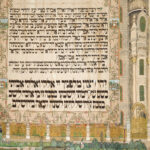

Despite their leaders’ current vitriol against army service, Vizhnitz Hasidim once provided living proof that today’s efforts to engage the Haredi community with national priorities are by no means unprecedented. As early as 1959, Vizhnitz Hasidim envisioned a communal settlement protected by their own IDF conscripts

On October 14, 2023 – the first Shabbat following the Simhat Torah massacre in southern Israel on October 7 – the Hasidic rebbe of Vizhnitz, Rabbi Yisrael Hager (b. 1945), stood up in the sect’s Bnei Brak synagogue and recited a prayer for Israel’s soldiers and hostages. This gesture was highly unexpected, since Vizhnitz Hasidim – like other mainstream Hasidic groups – do not serve in the Israel Defense Forces (IDF) or actively support soldiers, nor do they regularly pray for the troops’ safety.
The event was widely reported in both the Haredi and the religious-Zionist press. The excitement was justified, as the rebbe’s action seemed unprecedented.
His prayer was not the standard one for IDF soldiers recited in religious-Zionist circles, however, nor did it mention the Israeli army outright. Predating the familiar text, Hager’s version was composed by Rabbi Menahem Mendl Reuven Gefner (1905–1988), best known for instituting the mass priestly blessing at the Western Wall on Pesach and Sukkot. The prayer reads as follows:
May He who blessed our forefathers, Abraham, Isaac, and Jacob, bless, protect, aid, shield, and save all our brethren, the house of Israel, who stand in battle against those who hate Israel, since the entire congregation blesses and prays for them. May the Holy One Blessed Be He watch over them, deliver them from all harm, and subdue peoples before them, with five of them setting one hundred to flight, and one hundred of them pursuing ten thousand [paraphrasing Leviticus 26:8]. Wherever they turn, may they be successful, may our enemies fall to the sword before them, and may they return in peace to their tents.
Heal them, make them well, strengthen and revive them; send them, together with all the sick of Israel, a complete cure for all their limbs and sinews, a healing of soul and body, now, and speedily in our days. And let us say amen.
May the Holy One Blessed Be He be filled with mercy on those who have fallen captive. May He make their captors take pity on them and “release the prisoner from confinement” [Isaiah 42:7]. May the captives’ liberty be proclaimed and the chains of the bound be loosed [ibid. 61:1], and may He bring them home swiftly and in peace. Amen. (Baruch Yisrael Binyamin Gefner, The World of a Hasid [Bnei Brak, 2001], vol. 2, pp. 626–7 [Hebrew])
An Old Prayer Revived
Penned during Israel’s War of Independence, the prayer suggests that the Hasidic rabbi both identified and empathized with his soldier “brethren.” Yet a 2001 hagiography of Gefner – authored by his grandson, Baruch – scorns military service. Armed fighting against the Arabs is depicted as futile, with prayer the only guarantee of Jewish survival:
It was clear to everyone that, logically speaking, the handful of fighters did not have a chance of holding out against the enemy armies […]. Only one path remained […]: prayer. Rabbi Mendl presented himself as commander in chief of this front, undertaking a historic battle to stand in constant attack against the enemy, with units upon units fighting around the clock, watch after watch […]. While people wandered around looking for sandbags to block their windows for fear of bombing, he stood in the middle of the street by the prayer houses (shteiblach) and shouted: “Psalms, gentlemen! Psalms alone will help us!” Rabbi Mendl and his men stood praying and reciting psalms for a hundred days straight, without respite. (ibid., pp. 620–22)
The message was clear: Battles are won with prayers. The narrative continues in this vein with the crackle of artillery fire competing with the resounding entreaties of Rabbi Mendl Gefner and his “troops,” who repeatedly completed the book of Psalms, blew the shofar, and recited supplications. At the end of each shift, Gefner would add the aforementioned prayer. The chapter concludes with victory over the Arab armies credited without hesitation to these efforts. Baruch Gefner, it should be noted, is a follower of the same Rabbi Yisrael Hager of Vizhnitz who chose to declaim this prayer in his synagogue.
While the Vizhnitzer Rebbe’s addition on that first Sabbath after the massacre attracted much media attention, no such reports were forthcoming a week later. Evidently, his was a one-time reaction to the trauma and tragedy as well as the gravity of the military situation. By the second Shabbat, the prayer was already fading from memory.
Nonetheless, the Vizhnitzer Rebbe had recognized the enormity of the moment. Seeking an appropriate response drawn from the wealth of Jewish experience, he had personally and publicly prayed for those “who stand in battle against those who hate Israel.”
A Rebbe in the Army
Rabbi Yisrael Hager’s prayer for IDF soldiers was noteworthy considering his previous stance on the army. Ten years earlier – in the winter of 2013 – the very same Vizhnitzer Rebbe had publicly condemned any form of Israeli military service, even opining that Israel’s treatment of his community was perhaps even worse than that of foreign rulers throughout the Jewish people’s long exile. Affirming what he characterized as Vizhnitz’s traditional defiance of the military, he assured his students: “We will not stray even a tad from our path, which has been our heritage for many generations.” (Hayim Lev, “Grand Rabbi of Vizhnitz: Don’t Report to the Recruitment Bureau,” Israel National News, November 30, 2013 [Hebrew]).
Given this uncompromising opposition to a Haredi draft, it’s hard to imagine that a Vizhnitz leader’s son would serve in the Israeli army. Yet that’s exactly what happened to the rebbe’s great uncle, Rabbi Baruch Hager (1895–1963).
From 1936, Rabbi Hager served as the rabbi of Siret, in the Bukovina region of northeastern Romania. After the Holocaust, he made his way to the Holy Land, arriving on the shores of British Mandate Palestine in 1947 and settling in Haifa. His son Eliezer (1924–2015), then a yeshiva student, enlisted in the pre-state Hagana militia’s religious unit, fought in Haifa, and was wounded in the battle for Kibbutz Ramat Yohanan.
According to his commander, “Eliezer Hager participated in the battles and demonstrated enthusiasm, courage, and self-sacrifice” (Tzadok Eshel, The Hagana Battle over Haifa [1998], p. 398 [Hebrew]).
Eliezer apparently enjoyed his father’s approval, for when a group of religious recruits from Haifa was inducted into the army that summer, the Hasidic master of Seret-Vizhnitz spoke at the ceremony.
On his father’s death, Eliezer succeeded him as leader of Seret-Vizhnitz Hasidism in Haifa, a position he held for the rest of his life. Thus, Eliezer served in the very armed forces that other Vizhnitz rabbinic leaders would later deride.
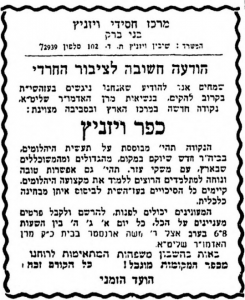
Yet this was only the start of the Vizhnitz trajectory. Unlikely as it may seem, a Vizhnitz contingent actually joined the IDF in 1959 – with the blessing of current rebbe Yisrael Hager’s grandfather.
Not yet a Segula subscriber?
Access our full archive online, have print issues delivered to your door, and moreFeel free to share