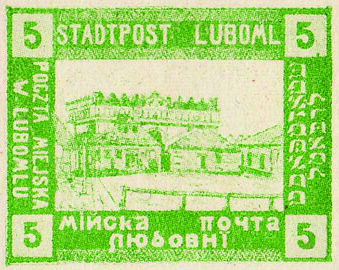
The first place ever to issue stamps showing a synagogue and marked with Hebrew lettering was, surprisingly enough, the Polish town of Luboml. The stamps were strange for other reasons too

Though few have heard of it, Luboml was one of Poland’s most ancient Jewish communities, once rivaling that of Lublin in size. Poland before World War II was home to dozens of such shtetls – small towns with thriving Jewish communities. A bustling market town and commercial center in the Belz-Chelm district, close to the border with Ukraine and Russia, Luboml has had a Jewish presence since the early Middle Ages. In 1564, Poland’s King Zygmunt Augustus II granted the community a bill of rights, and Jews soon became the majority population. By the 16th century, Luboml had produced a cadre of rabbis, who held broad administrative authority in the town and were also often appointed to key municipal positions in Poland’s main centers.
Despite the appalling casualties it suffered in the 1648 Khmelnytsky massacres (one account claims that nearly all six hundred Jewish residents were killed), the community bounced back so successfully that the poll tax imposed on Luboml by the Council of Four Lands in 1667 was more than quintuple the one collected from nearby Jewish towns. This period saw the construction of the Luboml Great Synagogue, a massive architectural landmark, and one of the oldest Jewish houses of worship in Poland.
Due to its location, Luboml comprised Jews, Germans, Poles, and Ukrainians. Jewish merchants in particular were attracted to the town, and by the beginning of the 20th century, more than ninety percent of the locals were Jewish.
According to the population register, the vast majority of Luboml’s Jews spoke Yiddish or Hebrew as their first language. Many had migrated from Poland’s larger cities and boasted a broad, traditional Jewish education. Newfangled movements such as the Enlightenment, Zionism, and the Bund (the socialist Jewish Workers’ Union) gradually penetrated the community during the second half of the 19th century.

Cosmopolitan Stamps
With borders constantly shifting during World War I, Luboml changed hands several times. After the war broke out, it was occupied by the Austro-Hungarian Empire, and the Austrian army provided basic postal service. Following the defeat of the Austrians at war’s end, the area fell under Polish jurisdiction.
The post offices in this now Polish district had few if any stamps. Preoccupied with reinstating their authority, the Poles had no time or resources to print them. Wherever Austrian stamps were still available, they were simply overprinted with the words “Polish Postage.” Many towns issued their own stamps, each identifying its town of origin, until late 1919, when Poland began issuing national stamps.
In September 1918, the Luboml authorities issued five stamps of different denominations, in six colors. The series showed views of Luboml and its main buildings: the commercial center, the town square, the Catholic and Orthodox churches, and – surprisingly – the Great Synagogue. The illustrations reflect the town leaders’ cosmopolitan hopes of fostering ethnic diversity and religious and political freedom. But the Jews of Luboml were proudest of the fact that the town’s name appeared in Yiddish down one side of the stamps, with Polish, German, and Ukrainian along the other three sides, respectively – representing all four local languages. The Yiddish version, in Hebrew letters, was Shtot Post Luboml (Luboml City Post).


Not yet a Segula subscriber?
Access our full archive online, have print issues delivered to your door, and moreFeel free to share