

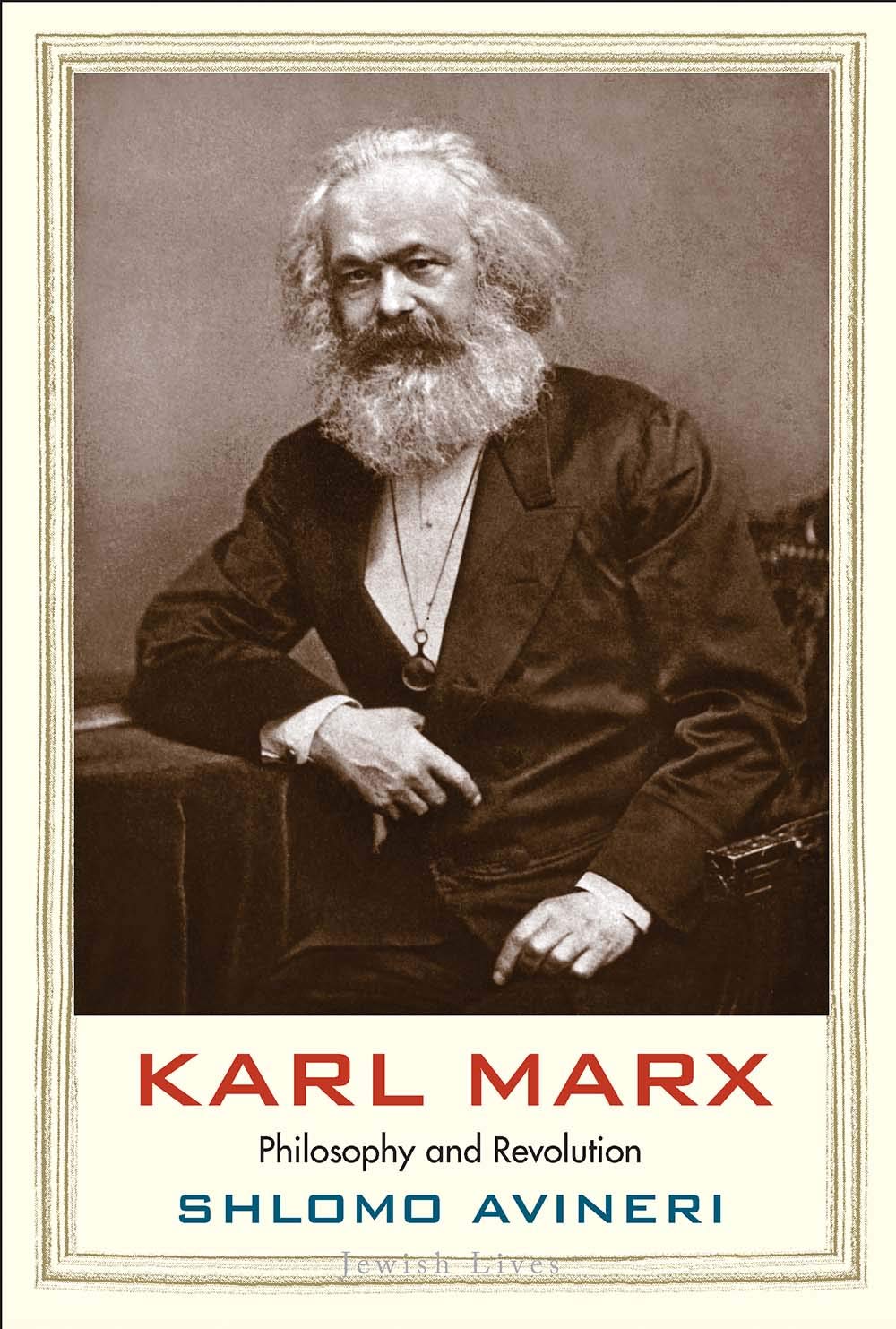
Karl Marx
Shlomo Avineri
Yale University Press, 2019, 240 pages
A world expert on Marx, Shlomo Avineri brings over sixty years of study and teaching to this monograph. True to the brief of Yale University’s Jewish Lives series, Avineri highlights the Jewish aspects of Marx, which the thinker himself barely acknowledged. Fairly early in his career, Marx ostensibly addressed the nature and political status of the Jews, but Avineri claims his subject used the term Jew only to elude the German censor when criticizing the “parasitism” of the bourgeoisie. Certainly, Marx nowhere identified outright with the Jewish people.
In the book’s final chapter, however, Avineri quotes an obscure article in which Marx – then the London correspondent for a New York newspaper – explains the political background to the Crimean War, including the power struggles within the Church of the Holy Sepulchre. In this context, he poignantly describes Jerusalem’s Jewish majority and its miserable conditions. Avineri may well be accused of clutching at straws to locate a Jewish consciousness in Marx. Nevertheless, a similar sympathy characterizes Marx’s much-maligned dismissal of religion as the opium of the people. Avineri points out that a sentence earlier, Marx calls religion “the sigh of the oppressed creature, the heart of a heartless world”:
Empathy, not scorn, for the suffering religious human being is what comes through very clearly here: religion is […] a protest against this suffering. (p. 39)
The author contends that Marx couldn’t have grown up with no Jewish identity, as it so severely affected his family. Emancipated by Napoleon’s conquest of Alsace-Lorraine, Marx’s father seized the opportunity to work as an attorney, only to be barred from the profession after his hometown once again became German territory. Conversion to Christianity was the only way to secure a livelihood, but Henry Marx continued living near his extended family. He even provided legal representation for his community, his brother being the cantor. Yet Karl seems to have had an uneasy relationship with his father, finding a mentor in the Prussian civil servant who later became his father-in-law.
The only ethnicity to which Marx ever professed – and jokingly at that – lay in referring to himself as “the Moor,” a nickname based on his swarthy complexion.
Avineri’s Marx is nuanced as much by his biography as by his writings. Analyst and critic of capitalism, he nonetheless struggled to provide his family with bourgeois security and comforts. While refraining from attributing The Communist Manifesto to Engels rather than Marx, the author emphasizes that it was published just weeks before France’s 1848 revolution but – for all its proletarian rhetoric – didn’t see the cataclysm coming. Marx subsequently spent years analyzing the circumstances and failure of the rebellion he missed.
Avneri clearly likes Marx – his foibles as well as his profundity. The biographer cuts through his subject’s lengthy, complex, and sometimes even contradictory prose, distilling its underlying theory of man’s alienation from the work of his hands by the commercialization of labor in far simpler terms than the writer himself. At the same time, Avineri readily absolves Marx of guilt for the sins his Manifesto was used to justify – in Bolshevik Russia and Mao’s China, to name only the most egregious examples. The redeemer of the proletariat, as Avineri reminds us, was first and foremost a product of the ivory tower, rubbing shoulders with intellectual exiles and politicians but not with the working man. Perhaps the most telling fact with which this scholar of Marxism leaves us is the number who attended Marx’s funeral and actually heard the eulogy that Engels later published all over the world: a mere eleven.
Not yet a Segula subscriber?
Access our full archive online, have print issues delivered to your door, and moreFeel free to share