
The date palm has long been one of the Holy Land’s agricultural and economic mainstays – and an emblem of its rise and fall
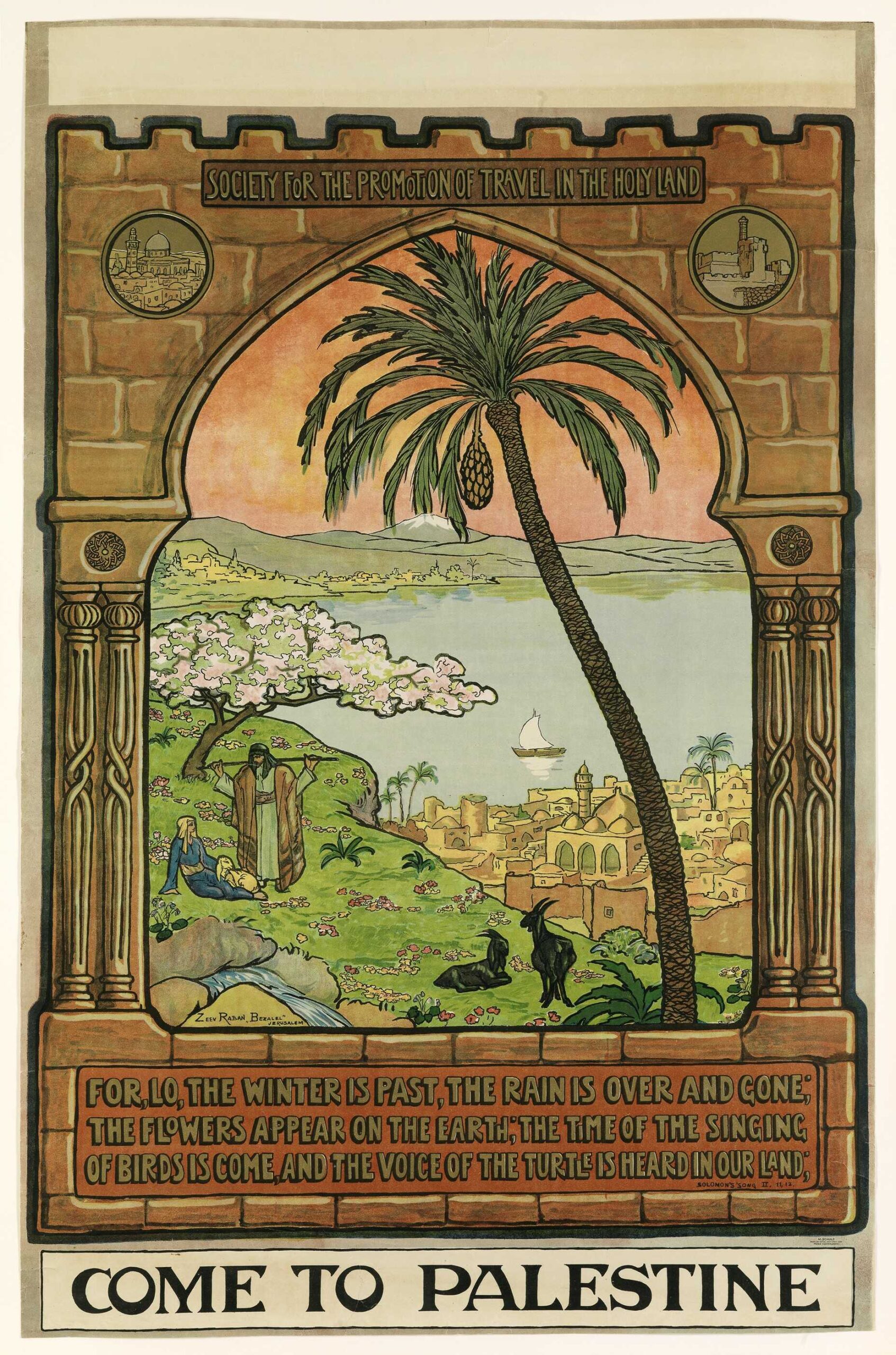
Come to Palestine
Lithograph
63 X 99 cm
British Mandate Palestine, 1929
Israel Museum, Jerusalem
Ze’ev Raban
1890–1970

Betzalel School
An eclectic style developed in Jerusalem’s Betzalel School of Arts and Crafts in the early 20th century and combining Art Nouveau, symbolism, and Orientalism
Celebrated Jewish author and historian Sir Simon Schama described his memories of planting trees as a youngster in Israel’s Jewish National Fund forests:
The trees were our proxy immigrants, the forests our implantation. And while we assumed that a pinewood was more beautiful than a hill denuded by grazing flocks of goats and sheep, we were never exactly sure what all the trees were for.
What we did know was that a rooted forest was the opposite landscape to a place of drifting sand, of exposed rock and red dirt blown by the winds. The diaspora was sand. So what should Israel be, if not a forest, fixed and tall? (Simon Schama, Landscape and Memory [Knopf Doubleday Publishing, 1995], pp. 5–6)
In antiquity, the date palm was one of the land of Israel’s most vital staples. The sages, who used every part of this generous tree, claimed: “This date palm has no refuse” (Bereishit Rabba 41:1). One of the land’s seven blessed species, it produces the sweet syrup the Bible calls “honey” (Deuteronomy 8:8), and the central, tight-leafed spine from which all its branches sprout is one of the four species waved on Sukkot. As if all that weren’t enough, its expansive leaves add instant beauty and romance to any landscape.
Emblem of Judea
It’s thus no surprise that the palm tree came to represent Judea in ancient art. Assyrian reliefs from the palaces of Nineveh, showing the capture of Lachish in 701 BCE, depict the captives from Judah filing past a row of palms en route to exile. Palm trees decorate mosaic floors and are carved into the capitals of columns in early synagogues. And on the famous sixth-century Madaba Map, a church mosaic discovered in Jordan, palms mark the location of Jericho, city of dates.
Date palms adorn the coins of the Great Revolt of 70 ce as well as those of the Bar Kokhba rebellion sixty years later – and the Romans also used them to symbolize the end of those insurrections. After the fall of Judea, coins featured a woman weeping beneath a palm tree as a Roman legionary towers over her. The inscription? “Judea Capta.”
More than any other tree, the palm has become the emblem of the modern return to Zion. While the olive tree never disappeared from the local landscape and always played a key agricultural role, the number of palm trees dwindled. When Zionist immigrants began arriving in relatively significant numbers before World War I, they were surprised to discover almost no palms in Ottoman Palestine. The visionary who reinstated them was Ben Zion Israeli of the Kinneret commune. In 1933, he started smuggling date saplings out of Iraq. These imports revived date horticulture, particularly in the Jordan Valley. Today, dates are among Israel’s most profitable and prominent agricultural exports.

Climbing the Palm
The flora and fauna of the land of Israel became the backbone of the Betzalel School’s ornamentation, which combined contemporary European art with a realistic yet classical touch. One of Betzalel’s most famous artists and first faculty members was Ze’ev Raban.
Raban’s work incorporated Jewish iconography from his collection of both European and Oriental Judaica, culled from a wide range of periods. Christian as well as pagan images also figure in his symbolist art.
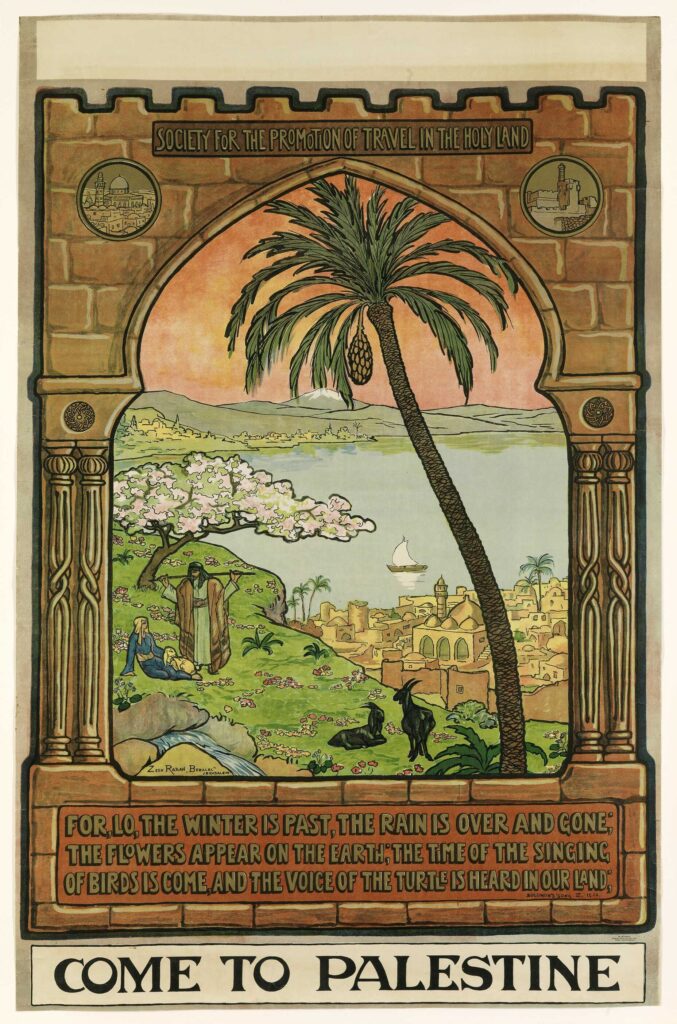
Pictured here is a publicity lithograph printed in 1929. Commissioned by the British government’s Holy Land Tourism Company, the poster appealed to both Diaspora communities and Christian pilgrims. A stone structure frames an Islamic-arched window shaped like a horseshoe, overlooking an idyllic view of the Sea of Galilee. The Golan Heights rise in the background, peaking in the snow-capped summit of Mount Hermon.
The style is both Orientalist and Romantic. Tiberias, one of Judaism’s four holy cities, occupies the foreground at right, romanticized as a tranquil Middle Eastern village. At left, a pastoral scene straight out of the Song of Songs: a shepherd and shepherdess in biblical attire rest among green pastures in the shade of a flowering almond tree. Black goats contrast with a small, white lamb nestling in the shepherdess’ lap. Lest the allusion be missed, a passage from the scriptural love song (Song of Songs 2:11–12) runs along the stone windowsill, waxing poetic about the coming of spring.
Dominating the entire landscape, however, is the spreading, fruit-laden palm tree, thrusting up to the full height of the arched window. More date palms, icon of the land of Israel, are scattered among the houses in Tiberias and along the shores of the Sea of Galilee.
Raban’s poster is boldly optimistic. “Come to Palestine,” it announces, though the country was then suffering from extreme unrest, culminating in the Arab riots in which hundreds were killed that August. In both theme and style, the artist bridges the gap between ancient Israel and the present, creating a sense of continuity. Without depicting a single Zionist colony, the work manages to convey confidence in the Jewish people’s future in the land. The date palm’s outstretched leaves were a well-known victory emblem; the heavy fruit hanging from its canopy was a promise. Past, present, and future – represented by the roots, trunk, and fruits of the palm – fan out in its richly symbolic foliage.
Plucked from Its Place
Born in 1974, artist Tal Shochat specializes in stylized photography, particularly fruit trees. The photograph shown here depicts a well-developed palm tree laden with fruit. Shochat placed opaque black cloth behind the tree for dramatic effect and bathed her subject head-on in artificial light, completely divorcing it from its natural context. As if plucked from its source of life, the tree stands in splendid isolation. It isn’t growing on the banks of the Sea of Galilee (like Raban’s tree) or anywhere else for that matter, not even in a grove of palm trees. Floating in space, beyond time and place, it doesn’t even cast a shadow.
Shochat’s palm, like many of her other trees, has been defamiliarized. It’s as if it has cast off the burden of national or religious context or multilayered symbolism. The photo opens a window onto a world stripped of identity and belonging, in which the image strains to shed its contextual trappings and just be a tree – not a Zionist tree or a biblical one; not a tree from a poem or even planted by a lake.
Raban’s tree represents a nation’s longing to return to the stage of history, to its roots, even as it renews itself and moves forward. As Schama wrote, “The trees were our proxy immigrants, the forests our implantation.” Jewish art in the pre-state land of Israel emphasized national and historical themes even as it borrowed from modernist artistic trends. By mid-century, the New Horizons (Ofakim Hadashim) movement had swung toward universalism and abstraction. Then social criticism and political protest began coloring Israeli art.
Shochat’s date palm has moved away from all these trends. Her photograph is starkly realistic; it’s just the tree, period. The subject seems to want nothing more – if that’s even possible?
Feel free to share