“Bevingrad” was the highest-security British prison in the Middle East, but that didn’t stop Jewish paramilitaries from lying through their teeth and crawling through its sewers in a daring escape

Where To?

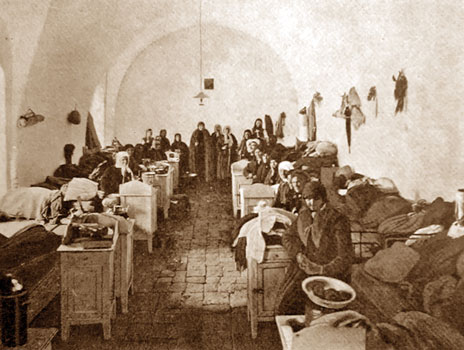
The average tourist would definitely wrinkle his nose in disgust and pity at the row of old women beaming from the photo of the Russian Compound’s pilgrim hostel in turn-of-the-century Jerusalem. The subjects are seated on iron bedsteads on a flagged floor in a muddle of nondescript bureaus and rags. What stranger can appreciate a pilgrim’s joy at journey’s end, the expense and uncertainty all behind him, and only the calm and quiet of the Church of the Holy Sepulchre ahead? Who cared about the standard of accommodation when it came gratis in the Russian Compound, with a premium breakfast and the dust of saints thrown in?
The free ride came to a tragic end as revolutionary skies darkened over Russia during World War I. Fate permanently disconnected the czar and his family from the hardships of this world, Russia became the Soviet Union, and state-sponsored pilgrimages to the Holy Land were discontinued. The sixty-acre Russian Compound – hostels, church, and all – stood empty, and the country’s new British rulers were delighted to repurpose it. The women’s hostel became a prison, where Jewish underground fighters soon rubbed shoulders with murderers, thieves, and sundry petty criminals. The men’s hostel housed a police station and lock-up, and the rooms reserved for visiting clergy were turned into a courtroom. The aristocrats’ section became the Agriculture Ministry, the small infirmary remained a hospital, and the entire complex was pressed into service as the seat of the Mandate government.
After the Jewish resistance movement bombed the King David Hotel in the summer of 1946, barbed wire went up around the Russian Compound, and the British declared it a closed security zone. The Jews mockingly called it “Bevingrad,” after Ernest Bevin, the British colonial minister whose discriminatory policies were downright anti-Semitic.
The fact that the compound was the most heavily guarded place in the country didn’t stop the underground fighters of the Irgun and Stern Gang from plotting their escape. At the beginning of 1948, Israel’s War of Independence was already well under way, and these inmates couldn’t stand wasting all their time and energy in jail. Their breakout involved two stages: smuggling themselves out of prison, then out of Bevingrad. Each mission was considered impossible – but so was the creation of a Jewish state amid a sea of hostile Arabs…
Pipe Dreams
Deep inside the prison, locked away in cell 23, the militia men formulated a plan. The cell was large, crowded with fifteen bunk beds. There was no point in examining the thick walls and heavy steel bars for possible weaknesses, so the convicts started work right away on the floor. It was Joseph Ehrlich’s idea; aside from his involvement in the Stern Gang, he happened to be a public works inspector for the Mandate government. He found a city plan that showed a sewage line passing right outside cell 23; the prisoners could dig a tunnel to the manhole that accessed it. From there they’d be halfway to freedom, leaving only the problem of escaping tightly patrolled Bevingrad.
As the best minds in the resistance struggled to find a way out of the Alcatraz of the Middle East, the rest put their backs into taking up the flooring under the bed farthest from the cell door. This bed belonged to Moshe Svorai, one of the Stern Gang commanders who’d devised the plan. He also needed the least sleep of any of them, which was lucky, as the excavation obviously took place mostly at night.
The floor was very thick, and its flagstones enormous and extremely heavy. Ehrlich managed to smuggle in implements, cement, and flashlights, but how to dispose of the earth and stones being dug up right under the British guards’ noses? In an urgent meeting with the prison director, the residents of cell 23 complained bitterly that the high stone threshold at its entrance precluded their sweeping out the water used to scrub the floor. They asked permission to dig a small drainage channel just by the door. Delighted by his prisoners’ concern with hygiene, the director agreed, even supplying them with tools and a wheelbarrow. For every “legally excavated” barrow of dirt, the diggers dumped two more from the escape tunnel.
As they dug, Irgun members on the outside came up with a way out of Bevingrad. Instead of trying to scale the fence or crawl under the barbed wire, the escapees would walk, bold as brass, through the main gate. First they’d clog the prison sewer system, prompting the British to bring in a public works team to fix it. Ehrlich and his Jewish crew would crowd around the crucial manhole just outside the jail, climb in one by one, and emerge stinking with sewage. Who’d get close enough to realize that more workers were coming out than had gone in? Hopefully, the whole group would walk straight past the guards, who’d prefer to get them out of smelling distance as fast as possible without checking too many identity papers.
This crazy plan would work only if two items were smuggled in: a camera – to take photos for fake certificates – and overalls for the “maintenance men.” Then they’d have to walk through the most heavily guarded gate in the country without batting an eyelash.
Not yet a Segula subscriber?
Access our full archive online, have print issues delivered to your door, and moreFeel free to share