Though the 1936 Berlin Olympics are perhaps best remembered for black runner Jesse Owens’ stunning victories, Jewish athletes’ achievements proved equally embarrassing for Hitler

In 1931, Germany was selected to host the 1936 Summer Olympics in Berlin, with the winter games to be played in the Bavarian market town of Garmisch-Partenkirchen. The sharp contrast between Hitler’s fascist regime and the Olympic values of universal fairness and equality added tension to every event. In fact, the National Socialist Party (a.k.a. the Nazi Party) originally opposed holding the games in Germany, but once in power, the Nazis realized the tremendous propaganda opportunity. The Olympics would sweep all political criticism of the regime aside, putting a new and improved Germany on international display. The nation’s athletic prowess would prove the superiority of the Aryan race, and mass spectacles – for which the party was famous – would showcase German power and efficiency.
In some countries, there were calls to boycott the games, but to no avail, as Hitler’s murderous intentions were still veiled, and fascism already held sway in such modern European countries as Italy, Yugoslavia, Poland, Romania, and Lithuania. Americans also worried that any fuss they made would exacerbate international criticism of their own segregation of blacks. Furthermore, German fascism seemed to counterbalance the more dangerous spread of Russian communism. Above all, many claimed that sports should be above politics. So felt Baron Pierre de Coubertin, founder of the modern Olympics. The show had to go on.
As the only serious public debate on the issue was in the U.S., the president of the American Olympic Committee, Avery Brundage, was invited to see for himself how Germany supported amateur sports. On his return, a committee vote won by a slim margin determined that the U.S. athletes were in.
Even Jews outside Germany couldn’t agree about the Berlin Olympics. The Jewish head of the Mandate Palestine Olympic Committee, British officer and Zionist leader Frederick Hermann Kisch, feared a boycott’s unfortunate repercussions for German Jews. So he told his German counterparts that his athletes simply didn’t meet Olympic standards – the same excuse the Germans would use to keep Jews off their team.
Maccabi World Union, a major international Jewish sports organization, was more forthright, demanding that Jewish sportsmen refuse to compete in a country that discriminated against Jews. French fencer Albert Wolff and Austrian swimmers Judith Deutsch, Ruth Langer, and Lucy Goldner all dutifully boycotted. Others, attaching little or no importance to their Jewish origins, saw no reason to stay away; in fact, some competed precisely to protest discrimination.
Too Good to Refuse
Throughout the Olympics, Germany downplayed its racism. Signs limiting entry to Aryans were removed from public spaces, anti-Semitic editorials were banished from front pages, and no anti-Jewish laws were passed. Yet Jewish participation in the German team remained a key test of Germany’s commitment to the Olympic ideal of equality. In 1935, the Nuremberg Laws had barred Jews from national sports clubs. After Brundage’s visit, however, the Nazis were forced to make an exception for the Olympic team. Thus, twenty-one Jewish athletes were invited to Germany’s Olympic training camp – but nearly all were deemed subpar.
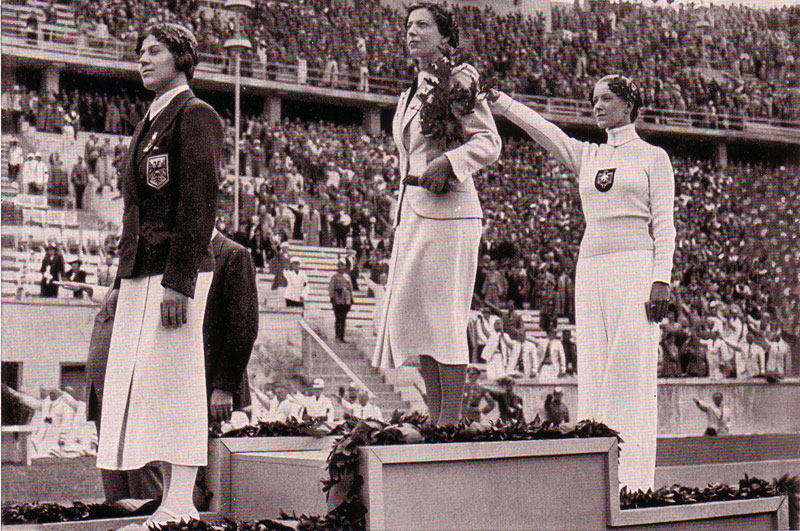
Three Jewish players were too good to disqualify: ice hockey star Rudi Ball; Helene Mayer, a fencer who’d brought home a gold medal from the Amsterdam Olympics in 1928; and Gretel Bergmann, a high jumper who’d won the British championships in 1934.

Mayer had been kicked off her team in 1933 because her father was Jewish. She then emigrated to the U.S., but the Americans pressured the German Olympic Committee to take her back. Bergmann had moved to Britain after she too was dumped by her team, but she was persuaded to return home for the games, so Germany could show off its tolerance. She won the pre-Olympic heats, even setting a new world record. Two weeks before the games, however, she was cut from the team, her achievement deleted from the record books. A German feature film, Berlin 36, was made of her story in 2009.
In the end, fourteen Jews won sixteen Olympic medals – nine gold, five silver, and two bronze – while Hitler fumed.
Not yet a Segula subscriber?
Access our full archive online, have print issues delivered to your door, and moreFeel free to share