Jules Védrines was the first to fly to the Holy Land, though he skipped Jerusalem. But what made the famous pilot miss his designated landing at Mikveh Israel?

Where To?
Mikveh Israel
The temporary landing strip by the cypress grove

Perhaps no technology has developed as quickly and dramatically as aviation. When the Wright brothers, Orville and Wilbur, first took off in 1903 from North Carolina in their small plane, the entire contraption was basically one long double wing with a gas engine attached. It flew only a few seconds but sustained considerable damage. News of the pair’s achievement traveled much farther. Just five years later, Wilbur Wright’s initial European flights were greeted by cheering crowds in France, and a year after that Frenchman Louis Blériot became the first pilot to cross the English Channel (surprising a good few birds along the way).
French Romance
The French fell in love with the new invention, and by 1909 they’d founded their own National Air League and launched the first international competitive aeronautical display, with pilots bravely performing aerial acrobatics while throngs oohed and aahed. By 1911, France boasted 353 licensed pilots, and less than two years later that number had risen to almost a thousand – more than all other countries combined. A Frenchman with both feet on the ground might well have felt intimidated by his many contemporaries staring him down from above.
In 1913, to mark ten years since the Wright brothers’ maiden flight, league president René Quinton offered half a million francs to the first daring aviator to fly from Paris to China. Yet such a distance proved impossible, even with stops. So Quinton changed the destination to Cairo, necessitating a mere 5,400-kilometer jaunt via three continents – Europe, Asia, and Africa.
Contestants had to be licensed pilots with their own “flying machines” and gas money. The French government even partly covered other expenses. French representatives in stopover countries were asked to fete the pilots with lavish receptions and, where possible, arrange appropriate landing strips.
Six months of dry runs narrowed the competition to five proud pilots, divided among three planes: two two-seaters and one solo. Takeoff was set for October 1913, ensuring they’d all be airborne on December 17, the 10th anniversary of that famous first flight. Landings were planned in Prague, Istanbul, Konya (Turkey), Beirut, Jaffa, Jerusalem, and Port Said.
Well-wishers watched excitedly as the three aircraft took off and headed for Prague, where an extravagant reception awaited them. Curious crowds flocked to see the winged wonders, and the pilots were overwhelmed by fainting female fans. Forgetting the race, contestants added stops wherever they were promised a sufficiently tempting welcome.
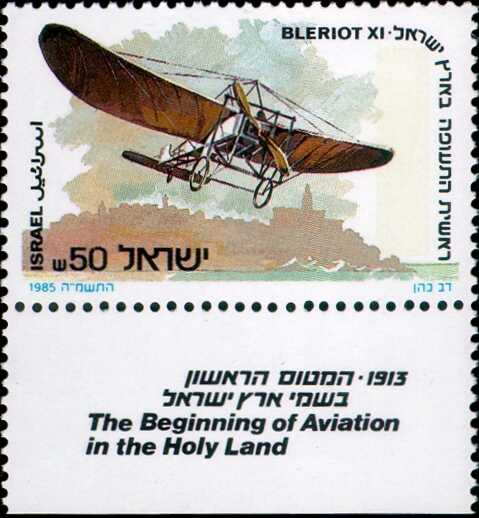
Védrines’ plane against the Jaffa skyline, part of a stamp series commemorating early aviation in Israel. Designed by Dov Cohen, 1985 | Israel Philatelic Federation

Jules Védrines landing his Morane-Borel monoplane in a race from Paris to Madrid, 1911 | Photo: Morris News Agency; courtesy of the French National Library
Bad Boy in the Sky
Pilot Jules Védrines was known as “the flying bully,” having grown up on the mean streets of Paris. His record-breaking speed of a hundred miles an hour, achieved in 1912, had already earned him mass adoration. Aeronautical stunts were also his specialty, including grazing Notre Dame Cathedral with the tail of his aircraft and tossing out violets while flying over a Catholic procession.
With no intention of sharing the glory, Védrines set out alone on the long flight from Paris in his Blériot monoplane. Reaching Istanbul on December 5, he was treated to a Turkish banquet, a tour of the city, and a VIP reception. A few days later, Védrines was off to Beirut, then Jaffa.
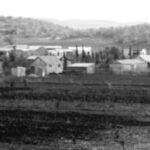
A landing strip had been prepared for him outside the latter city, beside a cypress grove in fields belonging to the Mikveh Israel agricultural school. A large bonfire would indicate where to touch down.
Mikveh Israel wasn’t chosen by accident. The institution was completely French, funded and run by Baron Edmond de Rothschild, and its staff was determined to participate in this French national event. French flags lined the runway, and the school orchestra tuned up its trumpets to play the Marseillaise in honor of the first aircraft landing in the Holy Land.
As there was no knowing when the plane would actually show up, tension mounted with every passing day. Eventually a telegram sent by Védrines from Beirut reached the Jaffa post office, advising of his arrival on Saturday, December 27, at 10:30 am. Regardless of the Sabbath, the public planned to take all manner of transport just to see the iron bird fly. All shops in Jaffa were closed for the occasion, and the train company beefed up service to Mikveh Israel, from which stagecoaches ferried passengers to the airfield.
The events of that dramatic morning were chronicled by the Hebrew press. Moriah, a newspaper serving the religious community, criticized the Jews who’d desecrated the Sabbath to be there:
To our regret, many Hebrews were among those who took the train. (“The Parisian Plane in Jaffa,” Moriah, 2 Tevet 5674/December 31, 1913, p. 2)
The paper also noted the impressive attendance by numerous Jaffa educational institutions, such as the Hebrew Gymnasium, the teachers’ seminary, and the Muslim school.
The Hebrew periodicals naturally found the holy tongue ill-equipped to describe modern flight. Thankfully, in 1907 Itamar Ben Avi (son of the father of modern Hebrew, Eliezer Ben Yehuda) had at least coined the terms aviron (aircraft) – from the word avir (air) – and me’offef (pilot, or literally flyer).
Armed with this vocabulary, local papers were able to report the following:
By Friday afternoon, special posters announced the imminent arrival of the French plane […], and starting that morning Jaffa residents were flocking to the Mikveh Israel grounds […]. In addition, many came on foot or by horse and cart, and the field at Mikveh was filled with thousands who’d gathered to see the plane. Until noon, the entire crowd waited with rapt anticipation […]. Eventually the pilot came in his aircraft, but he landed on the seashore instead of at the designated spot. (“The French Pilot in Jaffa,” Ha-herut, 1 Tevet 5674/December 30, 1913, p. 2)

Rough Landing
Why didn’t Jules Védrines land in Mikveh Israel? While searching for the promised bonfire, Védrines was confused by other blazes, lit either for burning refuse or for picnicking purposes. None seemed a clear landing signal, so after rounding what he assumed was Jaffa, he gave up and settled for the beach.
Local police, who hadn’t managed to be off duty to watch the proceedings at Mikveh Israel, hastened to ascertain that he’d survived – and to protect his aircraft from attack:
When the first plane landed in Jaffa, it had to be guarded by a police squad to stop Muslim extremists from damaging what they regarded as the devil’s handiwork. (“Letters from Abroad,” Ha-tzefira, 17 Tevet 5764/January 15, 1914, p. 2)
Meanwhile, those assembled at Mikveh Israel were crushed. How could the pilot have stood them up? That Saturday night, the French consul did his utmost to raise their spirits with a reception celebrating Védrines’ safe arrival at Jaffa’s Park Hotel (see “Tale of a Trail,” Segula 70). But folks wanted the aerial pirouettes they’d been dreaming of.
So the next morning, the travel-weary pilot dutifully took off once again, performing some impressive somersaults before landing – this time as scheduled – at Mikveh Israel, accompanied by the full complement of crowds, flags, the Marseillaise, and fainting maidens.
French and Turkish notables who’d already enjoyed the aeronaut’s company over the weekend also attended the soirée held there afterward. The pasha of Jaffa, his officials, and the French consul all thanked the famous flyer for the glory he’d brought to both the motherland and the Holy Land. The guest of honor smiled until his jaw ached, then announced the next day that he wouldn’t be flying to Jerusalem but would proceed straight to Cairo.
Védrines reached the final destination first and won the prize money. Having skipped the holy city, however, he missed out on being the first Christian pilgrim to arrive there by air. That accolade went to his competitors, pilot Mark Bornier and engineer Joseph Bernie.
By the By
-
Jules Védrines’ victory in the 1913 flying competition landed him an important assignment in the French army during World War I. He clocked over a thousand hours, flying mostly secret missions.
-
In 1919, Védrines broke another record by landing an aircraft on the thirty-meter-long rooftop of Paris’ most famous luxury department store, Galeries Lafayette. His reward amounted to thousands of francs, but sadly he didn’t live to enjoy them. Three months later, en route to Rome, the thirty-eight-year-old daredevil and his engineer were killed when engine failure resulted in a crash landing. His wife and children erected a monument on the store balcony, which commemorates his illustrious career to this day.
Feel free to share