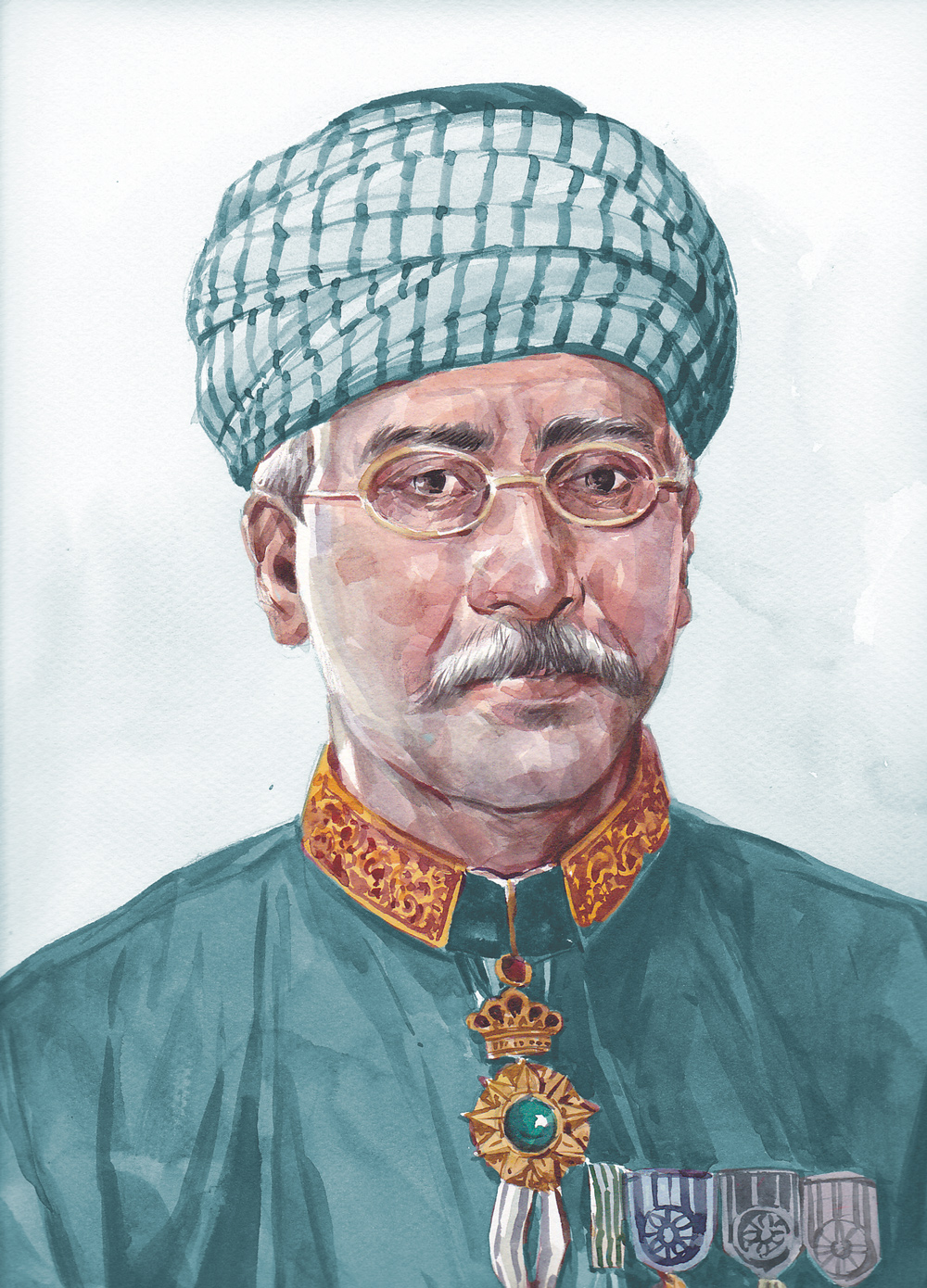
Banished from Egypt time and again for promoting nationalism and exposing government corruption, James Sanua harnessed humor and drama to continue jabbing at the regime from afar. Soon his satirical journal’s popularity outstripped even that of the theater he’d founded in Cairo

Egyptian history has certainly had its glory, but it seems almost ironic that Egyptians should term the period from the late 18th century until World War I “The Great 19th Century.” Yet although this was exactly when Europe’s colonial ambitions began to solidify in Egypt, it was also a time of intensive national development, from which the modern Egyptian state emerged. These years ushered in a new era for Egypt’s Jewish community as well, granting it an unprecedented sense of security culminating in full-scale integration into a newly secular Egyptian society.
The centralized government introduced by Ottoman governor Muhammad Ali Pasha in the1820s brought a measure of law and order to Egypt and its Jews. Carefully consolidating his power after Napoleon’s brief conquest and withdrawal from Egypt, Muhammad Ali disposed of all opposition and installed himself as khedive, or semi-independent ruler, in 1805. He embarked, with moderate success, on a nationalization program intended to fund the modernization of Egyptian society. The first communal board of Jewish representatives was founded in Alexandria in 1840 (the year of the blood libel known as the Damascus Affair), and by 1861 Egypt had an estimated twenty thousand Jews.
Instability followed Muhammad Pasha’s death, but in 1863 his grandson, Ismail Pasha, succeeded him. Modernization speeded up under Ismail, who ruled until 1879. The Suez Canal was dedicated in 1869 to international acclaim, putting Egypt squarely on the map. With its gates now wide open to western investment, Egypt encouraged education and professional training among its citizens. Jews began playing a significant part in public life as well as in the economy; European arrivals also added to the community.
Then Ismail resigned under the weight of Egypt’s national debt and amid pressure from European creditors. Rioting broke out, developing into the ’Urabi Revolt (led by officer Ahmed ’Urabi) and the dawn of Egyptian nationalism.
The revolt was crushed by the British conquest of Egypt in 1882, but nationalist fervor continued seething below the surface. At the beginning of the 20th century, Egypt was ostensibly independent but remained a British protectorate until 1922. Relatively few Jews played a role in Egypt’s political and national awakening, and the most outstanding was without a doubt Yaqub James Sanua.

Egypt’s first reformer. Muhammad Ali Pasha, oil on canvas by Auguste Couder, 1841

Ismail Pasha opened Egypt up to western influences, but instead of being grateful, the European powers forced him to abdicate | Library of Congress collection
Biting Satire
Yaqub son of Raphael Sanua was born in Cairo in 1839. French educational influence later resulted in his acquiring the name James, and it’s as James Sanu that he’s famous in Egypt. His mother too was Egyptian-born, but his father immigrated from Italy. Rafael Sanua was a trusted adviser to Prince Ahmed Pasha Yaken, another powerfully placed grandson of Muhammad Ali Pasha. Impressed with the boy’s intelligence and abilities, knowledge of languages, and familiarity with Jewish Scripture, the Quran, and Arabic poetry, Prince Ahmed paid for his education in Livorno, Italy.
Arriving in 1852 in Livorno, Yaqub studied art history, music, drawing, and languages, and staying in Italy for four years. He soon became enamored of the theater. The young man was also influenced by the rise of Italian nationalism during this period and witnessed the swift modernization of European cities.
Shortly after Yaqub’s return to Egypt, both his father and his patron Prince Yaken died, forcing him to forge his own path. At first he turned his proficiency in Arabic, Hebrew, Italian, French, English, German, Spanish, Greek, and Russian to his advantage, working as a teacher. But he never abandoned his love for the theater.
In 1869, Cairo’s French Comedy Theater opened in the Al-Azwaheya Gardens, followed by the Egyptian opera house. Both were built by Ismail Pasha to host the foreign troupes he invited to entertain his guests at the dedication of the Suez Canal.
Since none of these groups performed in Arabic, James Sanua resolved to launch his own theater company, believing that Egypt deserved its own culture, just as it was entitled to determine its own fate. Sanua began appearing with his players in a large coffeehouse by the opera house.
Only four months later, James was invited to perform at Ismail Pasha’s palace. Sanua staged three plays there, all in Arabic: Modern Girl, Two Wives for One Man, and Egypt’s Coquette. All three comedies included a moral and, between the lines, social criticism. Ismail Pasha was delighted, declaring to all his senior aides and ministers that Sanua had founded Egypt’s national theater company. The governor promptly dubbed the playwright “Egypt’s Molière.” The comparison was apt. Not only was Molière (1622–1673) patronized by Louis XIV of France, with his actors known as “the King’s Company,” but his plays combined wit, biting satire, and social commentary.
Sanua saw himself first and foremost as an Egyptian; his Jewishness was secondary. As Egypt’s intellectuals began envisioning national independence, he shared their dreams. His theater was part of the nationalist struggle. He wrote his plays in colloquial Egyptian Arabic, incorporated Egyptian music, and drew on his intimate knowledge of Egyptian mores and culture. Plays of and for the people – that’s what gave Sanua’s productions their authenticity and mass appeal. Nevertheless, his work was both Oriental and Occidental, blending European culture with Egyptian earthiness.

Not yet a Segula subscriber?
Access our full archive online, have print issues delivered to your door, and moreFeel free to share