
Spanning numerous countries and generations, the remarkable odyssey of Arye Steinberger’s sukka art mirrors that of the Jewish people. Both have survived against all odds

Walking into the first exhibit hall of the Museum of Jewish Heritage – A Living Memorial to the Holocaust (at the southern tip of Manhattan Island, just across from the ferry to the Statue of Liberty and Ellis Island), one can’t help but be struck by the largest piece of Judaica on display: a series of sukka hangings created by Arye Steinberger in Budapest and smuggled across the Austrian border by his granddaughter Piroska Lindenblatt in the confusion of Hungary’s October Revolution. Like the museum as a whole, these decorations reflect not just the culture and way of life preserved by Jewish immigrants in their hearts and minds, but the articles they brought with them, sometimes at great personal risk.

Jack of All Trades
Arye Steinberger was born in the village of Olaszliszka, Hungary, in 1859. A blood libel and a protracted trial of Jews in nearby Tiszaeszlár in 1882 resulted in recurring pogroms in the area, driving Steinberger and his family first to the town of Halas (now Kiskunhalas) – where his children were born – and then to Budapest in 1906.
Wherever his Jewish education came from – the village or the town – it was extensive. He was a shohet well-versed in Jewish law; a teacher steeped in Bible stories and rabbinic legends; and a cantor deeply committed to prayer and never speaking in shul. But Arye was also a talented artist and scribe. His self-taught calligraphy was flawless, and his piety renowned. His love of letters was rooted in Jewish mysticism; he was well-acquainted with the Zohar, including the section dealing with palmistry.
Somewhat incongruously, Steinberger was active in the trade union movement as well. It was actually fairly common for observant Jews to champion workers’ rights in the early 20th century. With fair and prompt pay, a day off, and safe working conditions all mandated by biblical statutes, Jews almost instinctively spearheaded these demands.
Tall, strong, and fearless as his namesake, the lion, Arye once singlehandedly defended his family from attack on the way home from synagogue, sweeping the assailant off his feet.

Steinberger had two daughters, Regina and Gisella, and a son, Salomon. The boy received a traditional Jewish education and attended high school in Budapest, then studied for nine years in Pressburg’s talmudic academy. But when Regina wanted to enroll at the local gymnasium, the synagogue committee informed her father that as an employee of the Orthodox Jewish community, he couldn’t send his daughters to high school. So Arye opted for homeschooling, but he devoted much thought to the girls’ future. Seeing Gisella’s short lifeline in her palm, Steinberger became even more pious, hoping to save her. When she died young, just as he’d foreseen, he renounced Kabbala. A kabbalistic amulet he’d written on parchment is still treasured by his great-grandson, Jehuda.
Salomon (a.k.a. Shalabacsi, or Uncle Shala) followed in his father’s footsteps, becoming senior cantor at the Friedberger Anlage synagogue in Frankfurt am Main. (He left Germany for England with his family in 1939.) Widowed early, Arye moved in with Regina and her husband.
The Lion’s Legacy
At sixty-five, Steinberger retired from the slaughterhouse and dedicated himself to the scribal arts, penning ketubbot and gittin (marriage and divorce documents) as well as tefillin and mezuzot. For the family he produced an illuminated Haggada and a scroll of Esther. And to provide for his three granddaughters’ dowries, he wrote three Torah scrolls. One remains in the family, used for bar mitzvas. But his pièce de résistance, years in the making, adorned the Steinbergers’ wooden sukka.
Combining calligraphy and folk art, these four canvas sheets contain every prayer recited within the sukka. The blessing upon entering the structure, grace after meals, the kabbalistic meditation and blessing before shaking the four species, passages from Hallel (the psalms sung on festivals) – all are boldly inscribed within decorative borders.
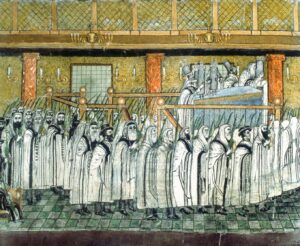
Beneath and interspersing these texts are illustrations depicting the life and dreams of Arye Steinberger. Some scenes are from Budapest, others from his native countryside. One panel recreates the elegant gold railings and gates of the Dohány Street synagogue, the first in Pest, built by the Neolog (Reform) community and topped with a Hungarian flag. Dark green cypresses all but wave in a breeze, and palm trees – out of place and drawn from pictures – symbolize the distant land of Israel. Biblical tableaux feature the seven mystical guests welcomed into the sukka each night of the festival: Abraham, Isaac, Jacob, Joseph, Moses, Aaron, and David.
Among the lush, green, meadows, wooded hills and valleys, bridges, and old, walled towns of Hungary, Steinberger placed his friends and family. At first their faces are blurred, in keeping with the biblical ban on human images; as time passed, however, and it became more important to Steinberger to people the sukka with his nearest and dearest, he consulted his fellow scholars and the rabbis of Budapest, and details were added.
In one pastoral moment, he captured granddaughter Piroska almost knee-deep in grass, holding her firstborn, Jehuda. Arye too “appears” on every panel, represented by a lion. Four generations – the kind of continuity that already then, after the upheaval of the First World War and the Russian Revolution, was no longer taken for granted. Of course, no one knew the worst was yet to come.
Steinberger painstakingly mixed colors and inks, using pine sap to fortify them against the seasonal rains to which the sukka stands exposed. In fact, European sukkot were commonly built with wooden roofs that could be raised and lowered to accommodate the weather. These booths too appear on the panels – some open-roofed, others closed. So do Arye’s favorite times of year: the Tashlikh ceremony, in which the Jews of Budapest symbolically cast their sins into the depths of the Danube; the Seder; and Simhat Torah, with Torah scrolls joyously carried out into the street.
Every year, Arye’s masterpiece lined the walls of the family sukka on Regina’s balcony, making it a focal point of Budapest’s shrinking Orthodox community and attracting long lines of eager visitors that snaked out of the apartment and downstairs to the street.
Arye died in 1942, blissfully oblivious to the approach of war. He blessed his daughter and granddaughters and their children on his deathbed, his memory etched indelibly on young and old alike. A year and a half later, the Nazis invaded Hungary.
Not yet a Segula subscriber?
Access our full archive online, have print issues delivered to your door, and moreFeel free to share