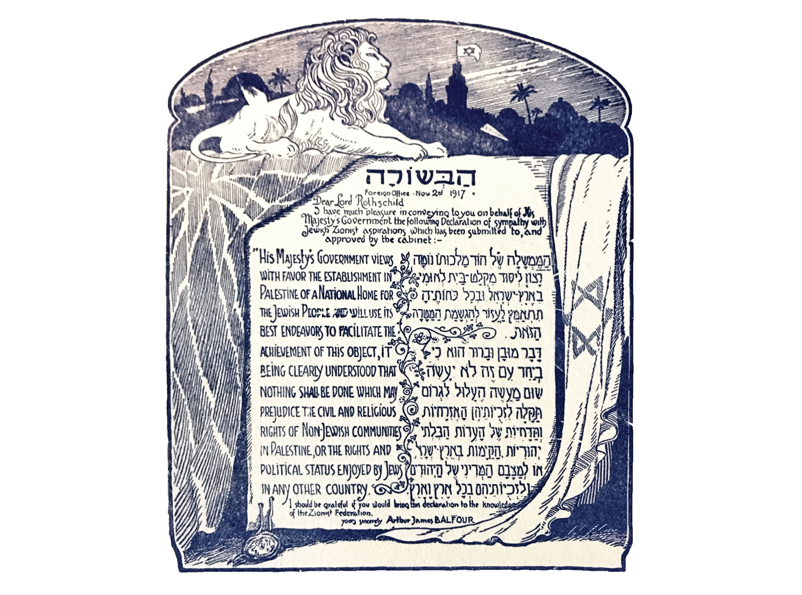
While the Balfour Declaration is famous as the first major step toward creating a modern Jewish homeland in the land of Israel, the groundwork was laid centuries earlier, gaining momentum with the approach of World War I

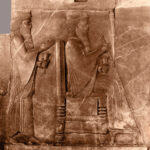
Almost two and a half millennia separate the two famous declarations that restored the exiled Jewish people to its homeland of Zion – the Cyrus Declaration of 538 BCE and the Balfour Declaration of November 1917 (17 Marheshvan 5678), exactly a century ago. Both documents reflected shrewd political considerations and genuine sympathy for the idea of a return to Zion.
Cyrus was apparently attempting to cast himself as benevolent ruler, extending his magnanimity to the nations he’d conquered in order to stabilize his southern border with the Egyptian empire. Persian polytheism tolerated other religions, including Judaism, and therefore respected the Jews’ wish to reclaim their homeland and rebuild the Temple. (Theirs was not the only such temple reconstruction permit granted by Cyrus.)
So far, this is all familiar territory. Between the two declarations, however, and particularly around the time the Zionist movement was established, several lesser-known pro-Zionist statements – or at least pro-Jewish ones – were issued by various sovereign states. Some of these writs served as a fig leaf – or even a precedent – for the Balfour Declaration, and they certainly boosted the solitary diplomatic efforts of a daring young journalist named Theodor Herzl.

Tax Haven
The earliest and best-known document of this kind was a firman, or charter, presented by Suleiman the Magnificent to Donna Gracia Mendes Nasi – then probably one of the world’s richest individuals and certainly its most famous Jewess – and her nephew and son-in-law, Don Joseph Nasi, in 1561.
When Donna Gracia’s firman was issued, European Jewry was suffering severe Christian persecution following the Spanish expulsion and the forced conversion of Portugal’s Jews. (She herself had escaped Portugal, first to Italy, then settling in Ottoman Constantinople in 1553.) The Spanish refugees found little and often only temporary shelter elsewhere in Europe. Most telling was the fate of conversos in the port city of Ancona, in central Italy. Invited there by Pope Paul III in the 1540s, with due assurances of safety, the Jews found themselves trapped after the ascent of Paul IV to the papacy in 1555. Violating all previous agreements, he imprisoned twenty-four conversos who’d reverted to Judaism, then burned them at the stake. One was a senior employee of Donna Gracia’s, but all her efforts to save them – including a devastating but short-lived boycott of Ancona by Jewish shippers – failed. As a result, she was determined to find a solution for her persecuted brethren.
First Donna Gracia sought to acquire part of the archipelago making up the Venetian Republic, hoping Jews could settle there freely and openly practice their religion. But once Venice’s economy improved, its doges were less inclined to grant concessions that troubled their Catholic consciences. In addition, Holy Roman Emperor Charles V, then also ruler of Spain and the source of much anti-Semitic policy throughout the continent, vehemently opposed Gracia’s bid.
The Mendes family then explored the Ottoman Empire. Utilizing Joseph Nasi’s influence at the Sublime Port (as Suleiman’s court was known), Donna Gracia acquired a license to collect taxes in Tiberias and seven surrounding villages, perhaps aiming to create a refuge in the Holy Land for wandering conversos.
These economic and diplomatic initiatives drew harsh criticism from several statesmen. Boniface of Ragusa, the pope’s representative in the province, complained to the grand vizier, Rustam Pasha, while de Petremol, the French ambassador in Constantinople, bitterly reported to his monarch that Don Joseph had declared himself “king of the Jews” and was demanding payment of the immense debt owed him by the French crown. De Petremol referred to the “Jewish tricks” Don Joseph had employed to secure the charter from the sultan, typifying the derogatory language used by European Christians to describe Jews.
Donna Gracia’s interest in Tiberias could well have been economic as much as proto-Zionist. It could easily have ranked among her many philanthropic activities on behalf of Jewish refugees. Clearly, however, it was her initiative rather than her nephew’s. After her death, he lost interest in settling Jews within a semi-autonomous feudal system in the Galilee. Sultan Selim offered him a different feudal estate – an island near Greece – and even a title: duke of Naxos. Promises of large annual tributes pouring into the spendthrift sultan’s coffers almost won Don Joseph the throne of Cyprus as well.
Almost 350 years after Donna Gracia’s death, Herzl tried settling Jews once again in their ancient home. He turned to Sultan Abdul Hamid II, Ottoman emperor and ruler of the province of Syria Palaestina. The two met twice, in 1899 and 1901, and their correspondence in Turkish is documented in the Topkapi Palace archives in Istanbul.
Herzl asked that the sultan renew the firman Suleiman the Magnificent had granted Donna Gracia Nasi. Abdul Hamid acknowledged the document’s existence but felt no obligation to uphold his heretical predecessor’s decrees. Nonetheless, Donna Gracia’s firman was and remains part of the international legal foundation for Herzl’s diplomatic efforts on the Ottoman front.
Not yet a Segula subscriber?
Access our full archive online, have print issues delivered to your door, and moreFeel free to share