
Years before Herzl dreamed of a Zionist movement, and well before Tel Aviv was even a dream, B’nai B’rith’s Sha’ar Zion Lodge in Jaffa was hard at work bringing the American organization’s values of Jewish solidarity, progress, and culture to the port’s splintered Jewish community

In a mere five years, a revolution took place in Jaffa toward the end of the 19th century. The first wave of Jewish immigration was just getting underway, with many of these Jews joining the hodgepodge of the town’s Jewish community: mainly Sephardic families with a few Ashkenazim thrown in. The newcomers bolstered the proportion of eastern Europeans in the increasingly fractured, disorganized community until soon almost nothing could be agreed upon. One young man changed all that – Shimon Rokach, then only twenty-one, who’d arrived in Jaffa from Jerusalem in 1883. Surprisingly quickly, Rokach united the community, setting up infrastructure and organizations that radically improved both living conditions and Jewish life.
Shimon and his brother Elazar were the driving force behind Ezrat Yisrael, a Jewish aid society whose activities not only were instrumental in founding the Jewish neighborhood of Neve Tzedek, a hospital, and a library, but led to the creation, 131 years ago, of a B’nai B’rith branch in Jaffa. B’nai B’rith, whose first lodge in Ottoman Palestine had been established two years earlier in Jerusalem, became a powerful agent of progress in the city – and not only there.
Named Sha’ar Zion, Gate of Zion, since most Jews took their first steps in the Holy Land when they disembarked in Jaffa, the city’s lodge took over where Ezrat Yisrael left off, deepening and quickening the pace of change. Sha’ar Zion transformed the way Jaffa’s Jews perceived themselves and their goals, nurturing a public spirit of urban and national renewal a decade before Herzl’s political Zionism took root and the first Zionist Congress convened in Basel in 1897.
The chapter spearheaded the establishment of the first Hebrewspeaking kindergartens in Neve Tzedek and Jaffa, founded Hebrew schools and an employment agency for new immigrants in Jaffa, and was behind the first Jewish public library, still operating today as Tel Aviv’s municipal library, now known as Beit Ariela. It was also responsible for the Jewish cemetery later named after Joseph Trumpeldor and for Jaffa’s first Jewish hospital, also called Sha’ar Zion.
Historians of Jewish Jaffa tend to overlook the major contribution made by Sha’ar Zion and Shimon Rokach. But the latter’s quiet revolution was a vital factor in the creation of Ahuzat Bayit, the precursor of Tel Aviv, officially launched in April 1909 by a lottery of plots on the Jaffa shore. The neighborhood’s founding council included four Sha’ar Zion members – Meir Dizengoff, Yechezkel Danin, David Smilansky, and David Ismogic – solidifying its connection between Sha’ar Zion and Tel Aviv.
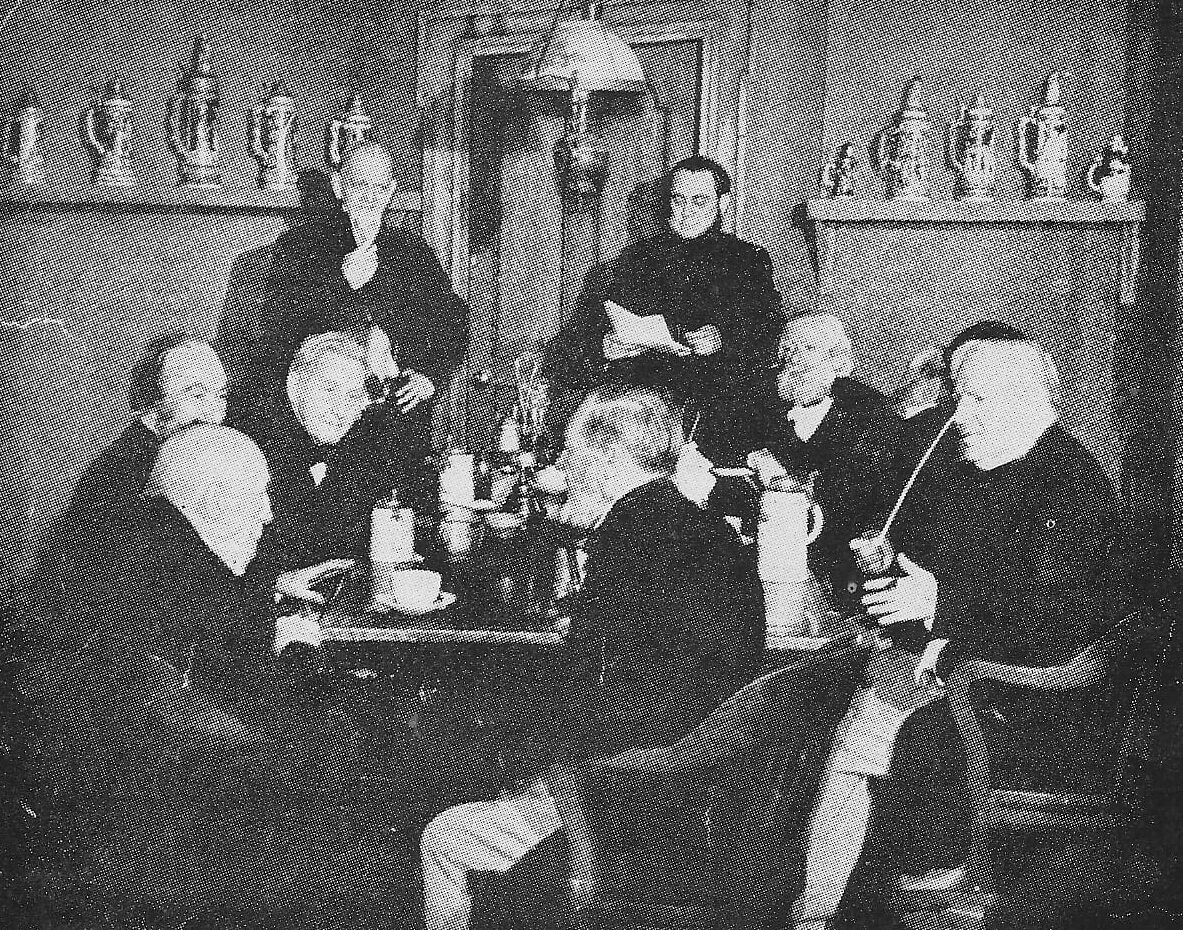
The founders of B’nai B’rith in New York, late 19th century
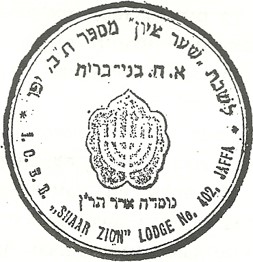
Seal of B’nai B’rith lodge 402, Sha’ar Zion
Jewish Masons
It all began across the sea, amid the West’s social and political awakening in the late 19th century. Alongside the surge of nationalist movements, of which Zionism was only one, society resolved to improve itself. Organizations such as the Rotary Club, the Lions’ Club, and even the Salvation Army sought to engage the increasingly comfortable middle class in activities benefitting those less fortunate. The most eminent and perhaps most ancient of these groups were the Freemasons (see “Finding Freemasons in Jerusalem,” Segula 2).
As in numerous other organizations, membership in the Freemasons was initially limited to Christian men. According to many scholars, this restriction prompted the founding of B’nai B’rith, the oldest international Jewish association still in existence. Some claim that only after the Freemasons rejected German Jewish engineer Henry Jones did he and eleven fellow Jews establish their own men’s philanthropic organization in New York. The new society aimed to help Jewish immigrants arriving penniless in the United States.
The order was founded on 19 Tishrei, 1843, and the name B’nai B’rith – sons of the covenant – expressed the solidarity the organization intended to encourage. Jewish immigrants already settled in the U.S. were to support their newly arrived brethren despite the yawning gaps in income and status dividing them and although most of the greenhorns were Ashkenazim whereas the veterans were primarily Sephardic.
By 1852, New York’s B’nai B’rith lodges had banded together as the Supreme Lodge, founding hospitals, old age homes, orphanages, libraries, and schools. B’nai B’rith chapters subsequently sprang up all over America and Europe, and in 1896 Jewish women gained their own lodge, Daughters of Judah.
From the end of the 19th century, Jewish settlement in the land of Israel became a major focus of B’nai B’rith’s philanthropy. In 1947, at the behest of B’nai B’rith president Frank Goldman, member Eddie Jacobson persuaded President Harry Truman to meet with a colleague of Jacobson’s – Chaim Weizmann. The encounter convinced Truman to prevent the exclusion of the Negev from the Jewish state under the United Nations’ Partition Plan.
Not yet a Segula subscriber?
Access our full archive online, have print issues delivered to your door, and moreFeel free to share