
A mariner, a knight, the governor of the Isle of Guernsey, and a nobleman with influence at the English and the Portuguese courts – Edward Brampton, the son of a Jewish blacksmith, defied the so-called strict hierarchy of late medieval society and earned status, prestige, and fortune

Englad’s Jews were expelled by Edward I in 1290, returning only in the days of Oliver Cromwell, in the mid-17th century. As in many other European countries, however, certain Jews escaped this fate. One such was Edward Brampton, a figure whose story defies imagination. Born to a Jewish father around 1440, Brampton was a rare example of social mobility in England and Portugal in the late Middle Ages.
This feat was possible only in a country in flux – as was England during the second half of the 15th century. The Hundred Years’ War had ended with England’s defeat by France in 1453. The resulting economic and social changes, combined with the weakness of Henry VI of Lancaster (who’d lost the war), led to a power struggle between his wife, Queen Margaret of Anjou and Richard Plantagenet, duke of York. This clash erupted in 1455 into an all-out, three-decade war – known as the War of the Roses – between the house of Lancaster (whose symbol was a white rose) and the house of York (represented by a red one).
After Henry suffered a decisive defeat at the Battle of Towton, the Yorkists replaced him with Edward IV, son of their leader, Richard of York. Henry regained the throne in 1470 for a short time, only to be ousted again when Edward returned from exile. Against this backdrop, Edward Brampton’s star began to rise.
Edward Who?
In the first half of the 20th century, scholars concluded that Portuguese mariner Duarte Brandão was actually English nobleman Sir Edward Brampton. Although many details of Brampton’s life remain debatable, it seems that Mariana, his mother, gave birth in Lisbon no later than 1440. The father was a Jewish blacksmith, and the child received a Jewish education. Brampton later claimed his father was Rui Barba, descendant of Portuguese nobles. This assertion besmirched both his mother’s reputation and his own legal standing (particularly from a Jewish point of view). Yet Brampton preferred to be considered the bastard son of a prominent Christian nobleman rather than the offspring of a Jewish blacksmith; clearly the former was a better starting point for ascending the social ladder.
Portuguese records show that Brampton left for the city of Bruges (now part of Belgium) in 1468. It has been suggested that he did so either to distance himself from his Jewish roots or to escape involvement in a murder case, although there is no evidence of the latter. From there he moved to England, where he seems to have been baptized, as he subsequently lived in London in a house for Jewish converts to Christianity (known as the Domus Conversorum). As living proof of Christianity’s supremacy, such proselytes were under royal protection, and Brampton’s sponsor (like that of all others in the House of Converts) was King Edward IV. Hence Brampton’s adoption of the name Edward, after his lord and patron. In fact, both men’s fortunes were inextricably intertwined.
Brampton resided at the Domus Conversorum on and off until 1472. He received a daily stipend of a penny and a half, amounting to two and a third pounds sterling a year – hardly a fortune but more than enough to survive.
As a retainer of the house of York, Brampton followed Edward IV into his brief exile in the Low Countries in 1470, apparently growing close to him. On Edward’s return, Brampton moved back to the Domus Conversorum, but as the recipient of honor and benefits bestowed by the king.
Brampton advanced rapidly. In June 1472 he received a naval commission, and later his first joint command of one of the king’s armies. The king rewarded his service with property in London and allowed Brampton to marry Isabella, the wealthy widow of Sir William Pecche.

Founded by Philip, duke of Burgundy, in 1430, the prestigious Order of the Knights of the Golden Fleece is intended to encourage noble deeds. Edward IV’s coat of arms as a member of the order reflected his close alliance with Burgundy. Insignia painted ca. 1480 and attributed to Pierre Coustain | Het Noordbrabants Museum, Den Bosch, Netherlands
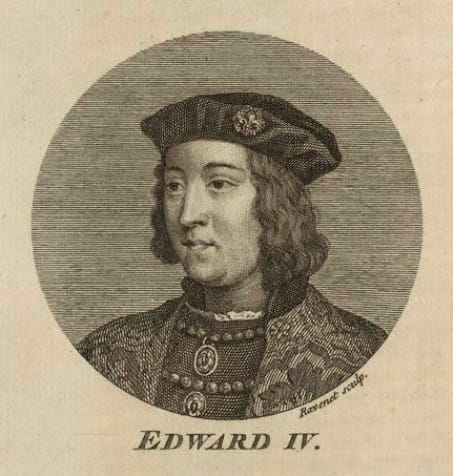
The patron who launched Brampton’s meteoric rise. King Edward IV, Simon François Ravenet, engraving, ca. 1760 | National Portrait Gallery, London
Not yet a Segula subscriber?
Access our full archive online, have print issues delivered to your door, and moreFeel free to share