

Musings on history, alternative history, and theology based on the surprising final scene of Tarantino’s film.

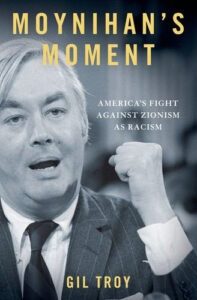
Moynihan’s Moment: America’s Fight against Zionism as Racism
Gil Troy
Oxford University Press,
2013, 358 pages
On November 10, 1975, the United Nations General Assembly, by a vote of 72 to 35 with 32 abstentions, resolved that Zionism is racism. After the vote the American ambassador to the UN, Prof. Daniel Patrick Moynihan, took the podium to state: “The United States rises to declare before the General Assembly of the United Nations and the world that it does not acknowledge, it will never abide by, it will never acquiesce in this infamous act.”
Moynihan knew that, though the resolution originated with the Arab states, it was a propaganda ploy cooked up in Moscow and advanced by an unholy alliance of communist and third world despots. Its purpose was intended to taint Israel – and by association any Western democracy that rose to its defense – with the stain of racism. Moscow’s was the logic of the wolf pack: let one vulnerable sheep out of the herd of decadent democracies be devoured, and the rest would run scared for good. “There will be more [such] campaigns,” Moynihan warned. “They will not abate . . . for it is sensed in the world that democracy is in trouble. There is blood in the water and the sharks grow frenzied.” But Moynihan didn’t scare. In the weeks before the vote and in his speech afterward, he denounced the resolution and asserted the moral superiority of free societies over repressive regimes of any kind.
Moynihan’s stand proved popular throughout the United States. The 1970s were a difficult decade for America. Race relations were at a nadir, a weak economy caused the collapse of the Bretton Woods system of fixed exchange rates that the United States had instituted after World War II, and the Watergate scandal forced President Richard Nixon from office. The Soviet Union was arming at an alarming rate, and in April 1975 South Vietnam fell to the communist north, ostensibly marking America’s global decline. Against this background, Moynihan’s spirited defense of democracy heartened many. A year later it propelled him to the Senate, where he served for twenty-four years.
Not everyone approved Moynihan’s stand, however. America’s radical left preferred the Soviet narrative that the United States was racist, aggressive, and exploitative. In addition, Secretary of State Henry Kissinger begrudged Moynihan’s popularity – both men were Harvard professors – though Moynihan’s prestige never equaled Kissinger’s. Moreover, Kissinger’s policy of détente assumed that the United States was indeed in decline relative to the USSR. An uncompromising affirmation of the moral distinction between freedom and despotism did not mesh with that policy. (It is not clear that Kissinger believed democracy conveyed any advantages, moral or other.) Kissinger characteristically supported Moynihan to his face while undermining him behind the scenes, forcing the ambassador to resign in January 1976.
Not yet a Segula subscriber?
Access our full archive online, have print issues delivered to your door, and moreFeel free to share