

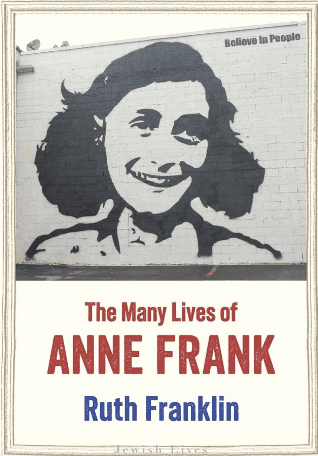
The Many Lives of Anne Frank
Ruth Franklin
Jewish Lives series, Yale University Press, 2025
424 pages
Is Anne Frank a symbol of Jewish oppression or a universal model of courage in the face of persecution? As very possibly the most widely read of all Holocaust literature, Anne Frank’s Diary of a Young Girl has inspired much scholarship and fiction. Many Lives endeavors to recount both Anne’s story (filling in the gaps – many of them intentional – in her own narrative) and that of the diary itself: its survival, publication, reception, and, above all, numerous spinoffs.
The introduction to Ruth Franklin’s cultural history – it’s no biography – calls Anne an icon. That description justifies the second, more difficult and disturbing section of the book, discussing those who’ve expanded global exposure to the diary, in myriad variations, and at what cost. That saga begins not with Anne’s father, Otto Frank, who edited and published the volumes left scattered on the floor of the Secret Annex in Amsterdam, but with his daughter herself.
Perhaps the biggest revelation – though it’s actually recorded in Anne’s entry for March 29, 1944 – is that hers is not a diary at all, but a memoir based on diary entries written over the previous two years. It was Anne’s response to Dutch education minister-in-exile Gerrit Bolkestein’s radio appeal for testimony to preserve his country’s experience under Nazi occupation. Thus, the first to rework the raw material of Anne Frank’s diary was its own author. This fact in itself is poignant proof of her skill as a writer; Franklin’s fine chapter comparing versions of the diary paints Anne as a consummate literary artist.
Anne came up with a bold solution. She rewrote the first months of her diary almost from scratch, using her first draft as a scaffold. […] Version B, which includes both more and less information about the crucial period between June 12 and July 5 [when the Frank family went into hiding], [is] delivered in a tightly written sequence of entries jam-packed with all the background information necessary for the reader to appreciate what a blow the move to the Annex will be. […] And she cleverly seeded her accounts of what appears to be a normal teenager’s life with hints about the mounting persecution of the Jews. (pp. 136–37)
Not yet a Segula subscriber?
Access our full archive online, have print issues delivered to your door, and moreFeel free to share