The memoir of an anonymous scholar features miracles, mishaps, and multiple wives as his thirst for Jewish learning drives him from home

Highly Respected Professor,
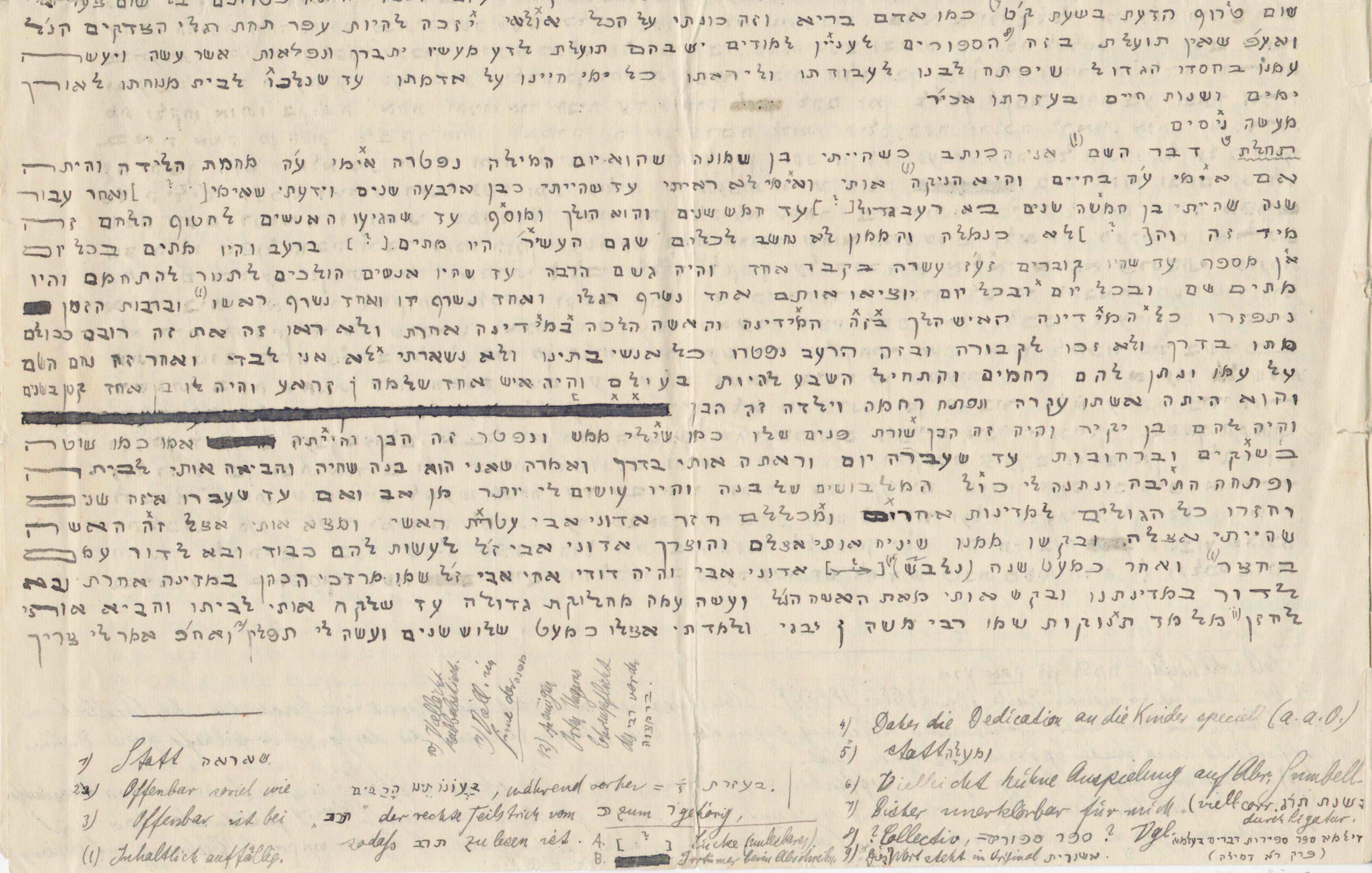
This copy, which I made in my student days from my grandfather’s notebook, was damaged by the passage of time, so I decided to redo it.
So wrote Benjamin Cohen in German to one of his teachers, apparently at a rabbinical seminary in Berlin, on December 2, 1914. Cohen then describes the original manuscript – his grandfather’s memoirs – and apologizes for its being cut short where the text becomes illegible.
The author’s name and precise origins are unknown, but he seems to have summarized his life story in the mid-19th century. His adventures appear here verbatim, without his grandson’s learned comments. Square brackets indicate omissions, additions, explanations, and corrections.
A Miracle
I wished, modest as I am, to recount a few of the miracles that the Holy One, Blessed Be He, performed for me from the day my eyes first opened and I recognized my Creator until this very day. Some occurred in my youth, and some after I matured, and they include several Jews who sanctified God’s name in public, and wondrous deeds not yet forgotten either in my day or latterly.
After describing the moral benefit readers will derive from his work, the grandfather begins with his childhood in Morocco. Working backward from the only date mentioned in the manuscript, we can surmise that he was born in the second decade of the 19th century:
The beginning of God’s word! When I, the author, was eight [days] old, on the day of my circumcision, my mother, may she rest in peace, died as a result of my birth. My mother’s mother was still alive, and she nursed me […].
Later, […] when I was five, a great famine came and lasted five years, steadily worsening until people were reduced to snatching bread from one another […]. Money was worth nothing, for even the rich were dying of hunger. Countless people perished every day, until they were burying ten in a single grave. It rained so much that people went to the oven to warm themselves and died there, and every day they’d be taken out, one with his leg burnt off, another his hand, yet another his head.
Over time, the entire city dispersed; a husband went to one place, his wife to another, and they didn’t see each other again. Most expired on the way and were never buried. In this famine, everyone in our family departed, and only I was left.
Afterward God took pity on His people […], and abundance began [returning to] the world.
A certain man, Shlomo ibn Kara, had but one young son. His wife had [long] been barren, but her womb was opened, and she bore him this child. He was very dear to them, and this son’s face was just like mine, and he died. His mother was like a madwoman, [running amok] in the streets and markets, until one day she saw me in the street and said I was her son, who never died.
She brought me home, opened a chest, and gave me all her son’s clothing. [She and her husband] did more for me than any father or mother, until a few years passed, and all the exiles came back from other lands, including my lord and father, the crown of my head. He found me at this woman’s, who had taken me in, and [the couple] asked him to leave me there. To honor them, my father, may he rest in peace, came to live with them in the same courtyard.
My father died almost a year later, while my uncle, my father’s brother, whose name was Mordekhai Hakohen, was in another city. My uncle came to live in our town and asked the woman to give me up. He argued fiercely with her until eventually he took me home.
He brought me to a children’s tutor, named Moshe ibn Ivgi, and I studied with him for almost three years. He made me tefillin, then told me: “You must go learn a trade.” He brought me to be apprenticed to one of the leatherworkers.
Torah Study or Trade?
Though this uncle thought the boy should learn to be an artisan, he wished only to study Torah.
Every day he brought me [there], and by evening he’d always find me in the study hall. He’d beat me and tell me I was an orphan and had to learn to support myself. After he defeated me, I went and did as he wished, and in a short time I’d learned the trade. But every day my heart struck [at me] to study Torah.
I stuck with the trade for roughly four years, made a little money, and moved out of my uncle’s; for my soul desired Torah, and I wanted to return to my studies, and he, may he rest in peace, didn’t want me to.
The young orphan describes his pining for Torah as the exile of the Shekhina, the loss of God’s presence.
I’d work at night with the Tikkun [a kabbalistic text] recited at midnight in my hand, crying and weeping and yearning to return to my studies. But I couldn’t, since I was unable to support myself. One night, I fell asleep weeping, and an old man […] appeared to me, saying: “Why are you sad? Tomorrow, go study with a certain sage” – his name was Rabbi Azaria, and he taught Talmud – “and you’ll know no sorrow.” Next day I did as he said and went to the scholar, who received me kindly, and I studied with him for almost three years, until I could understand the Talmud on my own. Every week I paid him from the money I earned from my trade.
When my uncle, who had a young daughter, saw that my learning was successful, he asked me: “Do you want to marry my daughter? I’ll provide for all your needs.” […] I said, “This is surely God’s doing!” So I entered into an engagement with her for almost two years, while her father prepared all she needed for her dowry and even made me gifts [for the bride] at his own cost and prepared the [wedding] food, all as is generally expected.
Not yet a Segula subscriber?
Access our full archive online, have print issues delivered to your door, and moreFeel free to share