

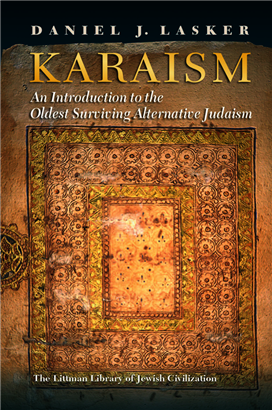
Karaism: An Introduction to the Oldest Surviving Alternative Judaism
Daniel J. Lasker
Littman Library of Jewish Civilization, 2022
253 pages
A useful and informative handbook on a little-known but intriguing strain of Judaism, Karaism is clearly written and structured, with each chapter built like a lecture, complete with recommended reading. Emeritus professor Daniel J. Lasker briefly surveys Karaite origins, literature, and history. The chapter on the Karaites’ mysterious provenance leaves the reader little the wiser, but that reflects the sorry state of Karaite studies rather than any lack of scholarship on the author’s part. Regarding said origins, Lasker shares several theories, none conclusive. The earliest, connecting the Karaites to Jewish sects such as the authors of the Dead Sea Scrolls or the Sadducees of the Hasmonean era, are based more on no evidence to the contrary than on actual archaeology. A further, more subtle attempt to portray rabbinic Judaism as just one of many early, competing Jewish sects is the use of the terms Karaite and Rabbinate throughout the book, implying that two equal versions of Judaism are under comparison rather than a mainstream orthodoxy and an alternative practiced by few.
Each chapter begins by quoting a primary Karaite source, often providing insights into relations between Karaites and their Rabbanite “brothers.” The recurrent use of this term by Karaite authors when referring to their Jewish neighbors is telling, particularly in view of Karaism’s later history. Lasker maintains that the two communities diverged with the reign of Austrian empress Maria Theresa and the division of Poland and Lithuania. Increasing persecution of Jews led Karaites to distinguish themselves, taking advantage of Christian Hebraists’ tendency to identify rabbinic Jews with Catholics and Karaites with Protestants, due to the latter two’s devotion to the biblical text. (Exacerbating this trend were leading Karaites such as the legendary Abraham Firkovich, an avid collector of ancient documents who wasn’t above forging tombstone inscriptions to suit his purposes.) By distancing themselves from Jewry, Karaites avoided not only the drafts and professional limitations imposed on Russia’s Jews, but also the worst of Hitler’s annihilation efforts.
In Egypt, where no such incentives existed, Jews and Karaites traditionally lived side by side (often intermarrying), and both communities’ cast off documents were stored in the Cairo Geniza. According to Lasker, Egypt was one of five Karaite centers and eras, beginning with the land of Israel, site of a golden age of Karaite exegesis and scholarship; then Byzantium; the Iberian Peninsula, where there were extensive mutual influences between Jews and Karaites under Islam; and finally Crimea.
The differences between Judaism and Karaism are broadly outlined; some of the more fascinating involve the laws of ritual purity, which for Karaites means bathing in running water as opposed to the mikvaot used by rabbinic Jews. Consumption of meat and milk mixtures are only forbidden if both come from the same animal; beef cooked in goat’s milk is thus permissible.
The author also demonstrates that, contrary to popular belief, Karaites don’t adhere only to the literal meaning of the Bible, rejecting the Oral Law. They have their own exegetical tradition, based on the logic of their sages rather than on Talmudic principles. Yet these readings are subject to change. Thus, in the 15th century, a reinterpretation of the biblical ban on lighting fires on the Sabbath made the darkness of the holy day a thing of the past.
Later chapters consider how secession from Judaism has impacted the Karaites now living in Israel, where their official exclusion from the definition of who is a Jew has become a disadvantage, particularly in terms of obtaining state funding. Their future in a largely secular society is also uncertain.
Despite Karaism’s extensive index, glossary, and biographies of Karaite scholars and leaders, footnotes would have been helpful, even in a book clearly written for a popular audience. For example, a note could have pinpointed where in the Kuzari Rabbi Judah Halevi attributes the first schism between rabbinic and Karaite Jews to a Second Temple leadership dispute. In addition, later chapters’ tendency to expand on basic information provided earlier results in a certain degree of repetition, although considering how little most readers know about Karaites, maybe that’s just as well.
Not yet a Segula subscriber?
Access our full archive online, have print issues delivered to your door, and moreFeel free to share