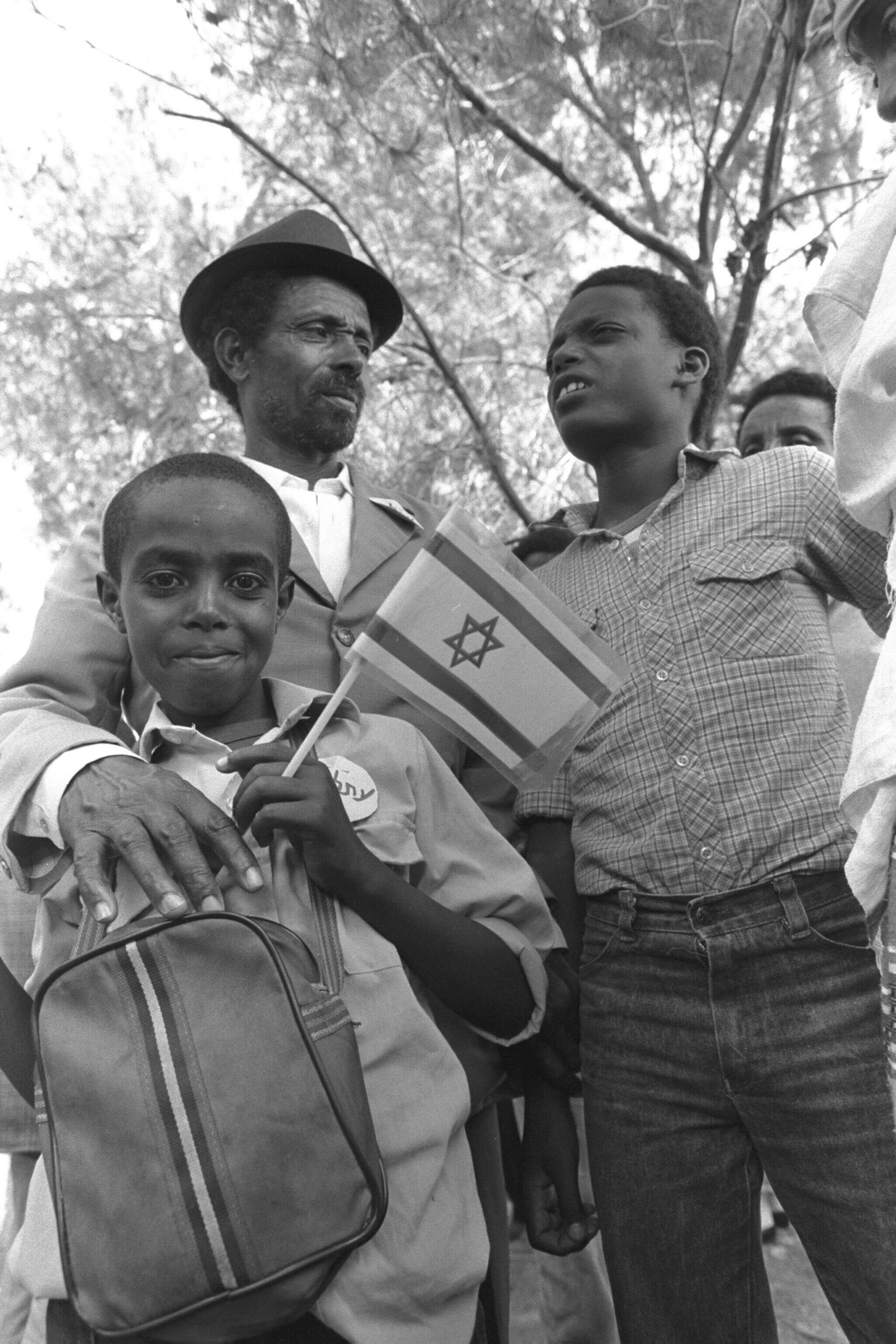
How does Ethiopian Jewry’s observance of Pesach differ from that of most Jews, and why? Are these differences a function of this community’s historic isolation or a matter of principle? And what can they teach us about the nature of Jewish tradition?

Ethiopian Jews – known to themselves as the Bete Israel (often spelled Beta Israel), meaning House of Israel – no longer sacrifice a Paschal lamb as they did in their native villages. Only Kiryat Gat’s Ethiopian community continues the rite, meticulously performed by a kahin (Kohen, or priest) and several kesim (religious leaders) despite the Israeli chief rabbinate’s ban on sacrifices. Yet no Bete Israel eat injera bread – a staple made of ground teff seeds – on Pesach, even though this grain isn’t one of the five forbidden as hametz.
Ethiopian Judaism’s arrival in Israel is a fascinating example of an ancient tradition confronting its modern counterpart. A community whose observances derive directly from the text of the Torah has come face to face with a far larger majority whose Judaism is based on rabbinic literature.
Rarely does a long-lost community return to its nation after millennia in exile. The Bete Israel are one of the oldest surviving Jewish populations. Their unique customs, traditions, and myths have been transmitted orally despite thousands of years of persecution. Their Jewish law likewise passed from father to son, from one kahin to another, and from place to place. The Bete Israel differ from every other Jewish community – except perhaps the Karaites and Samaritans – in that their religious observances reflect the simple meaning of the biblical text plus a set of internally developed oral traditions, both untouched by the rabbinic decrees that shaped Jewish practices after the destruction of the Second Temple.
Scattered among villages in northwest Ethiopia’s isolated Semien Mountains, to which they were exiled in the third century, the Bete Israel remained separate from mainstream Judaism. When they finally began leaving that area – especially in their great exodus, trudging through Sudanese deserts to reach Israel in the 1980s – things changed. Ever since the arrival of most of the Bete Israel in the Jewish state, they’ve been poised between their ancient traditions and rabbinic Judaism.
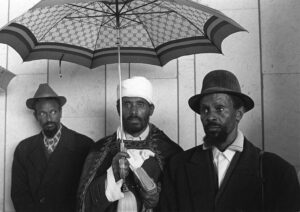
Traditions Meet
It’s unclear whether Jews arrived in Ethiopia in the days of King Solomon and the Queen of Sheba, as the Bete Israel’s own narrative supposes, or when the ten tribes of Israel were exiled by the Assyrians, as hinted in the Talmud – or under other circumstances altogether. Ethiopian Jewry certainly predates the destruction of the First Temple in 586 bce and the subsequent exile of the kingdom of Judah.
Regardless, the Bete Israel were isolated from Jewish law as it developed elsewhere in the world, and not only – as researchers Rabbi Yoel Ben-Nun and Nir Sagih suggest – because of their geographic distance from other Jews. In my opinion, the divisions separating Ethiopian Jewish tradition from the mainstream stem from a fundamental disagreement about how to interpret the Bible. Not only did the rabbinic revolution after the fall of the Second Temple (see Yair Furstenberg, “From Temple to Talmud,” Segula 69) fail to reach Ethiopia, but when the rabbis finally made contact with Ethiopian Jews in the 19th century, the Bete Israel leadership felt no need to adapt.
While rabbinic Judaism coalesced around the Mishna, Talmud, and later halakhic literature, Ethiopian Jewry’s faith and practices grew out of an oral tradition (alongside liturgical and narrative texts). This parallel version of Judaism shaped the Bete Israel’s religious identity and way of life, keeping them distinct from Christians and creating close-knit subcommunities connected by pilgrimage. After three thousand years apart, these two traditions now confront one another in Israel. This phenomenon is not only a social and demographic by-product of migration, in which rival groups compete for resources and recognition. It’s a meeting of two different strains of the Jewish melody, two different approaches to the Torah, Jewish law, and religious existence.
The rabbinic heritage includes a profound awareness of the non-literal nature of Talmudic exegesis. This creative latitude transformed biblical Judaism, empowering elite Torah scholars to continue reinterpreting the Oral Law. The Bete Israel, on the other hand, remain firmly rooted in the Bible, with no recourse to such radical readings. The resultant gap between these two forms of Judaism is thus not a question of levels of religious commitment or observance. It’s not even a matter of the integrity of Jewish law. It’s the gap between two divergent models of loyalty to tradition.
The differences between Passover observances and customs in rabbinic as opposed to Ethiopian Judaism invite discussion. Deeper understanding and internalization of these variants can facilitate mutual understanding, based on the recognition that each tradition provides a coherent and complete rendition of Jewish life. There are no shortcuts on this path, but it’s a journey well worth taking.
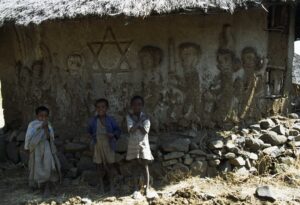
Pasika in Lissan
The Hebrew month of Nisan, when the Israelites miraculously left Egypt, was called Lissan in Ethiopia. From the very beginning of the month, the entire Bete Israel community excitedly prepared for Pesach – or as they call it, Pasika:
Immediately after Rosh Hodesh, the women began preparing new vessels for Passover. […] They began the process of cleaning and removing all hametz (leavened food) in the courtyard, and continued into the house. […] Three days before offering the sacrifice, the house was clean of all hametz. New clay vessels had been brought to replace the old, broken ones, and any food that had come into contact with water [and was therefore liable to ferment] was removed from the home. Three days before Passover, they ate only roasted chickpeas, “so as to begin Passover with no hametz in our intestines” (Kes Barhan Yeheis). (Sharon Shalom, From Sinai to Ethiopia: The Halachic and Conceptual World of Ethiopian Jewry [Gefen Publishing, 2016], pp. 145–6)
Aside from this novel three-day pre-Passover cleanse, the Bete Israel uniquely celebrated the fourteenth of Nisan. Their ritual closely adhered to the Temple service on that date, as described in the Mishna – of which, of course, they had no knowledge.
The kesim (or kahinim) fasted along with the shmaglotz (elders) and others. At sunset, the whole community donned its holiday best and gathered outside the synagogue, having undergone ritual purification in the nearest river. A kahin slaughtered a goat or sheep designated as the Paschal sacrifice on the tenth of the month. He placed its flesh on an altar erected in the courtyard for that purpose. As the animal roasted, the kahinim recited prayers and sang; all present felt uplifted. Finally each family received a portion of meat and some kita (soft Ethiopian matza). They ate in sacred silence, the shmaglotz with sticks in hand, loins girded, and a bundle on their backs as if ready for a journey – just as prescribed in Exodus 12:11.
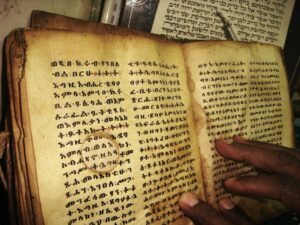
After more prayers by the kahinim, one of them read a passage from the Orit (the Ethiopian Torah) describing how the Hebrews left Egypt. This text was read in Ge’ez, the sacred language of both Jews and Christians in Ethiopia, which only the priests and the learned understood. A kes translated into Amharic or Tigrinaya, and everyone listened raptly. The remains of the offering were then collected and burned. Some participants went home at this stage; others remained in the synagogue all night as kahinim recounted the Exodus.
There was, of course, no haggada, and no child asked the Four Questions. Not a single cup of wine was drunk either, because anything fermented was forbidden on Pesach.

Exodus Consciousness
Attorney Zeev Kaso, head of the Ethiopian students’ advancement and integration program at Ono Academic College, recalled an incident that occurred in the 1980s in Jerusalem’s Machon Meir yeshiva. While discussing the laws governing kosher meat, he and his fellow students read in the Code of Jewish Law (Shulkhan Arukh, Yoreh De’a 76:16) that raw meat may be eaten once all blood has been removed by means of salting and washing.
The kesim present were shocked. As far as they were concerned, consumption of uncooked meat was forbidden outright by the Bible. Pointing to Exodus 12:9, “You shall not partake of it raw” (referring to the Paschal lamb), they said that in Ethiopian Jewish tradition, these words constituted a comprehensive ban on raw flesh.
Thus, the Bete Israel cultivated an “Exodus consciousness” not just on Pesach but year-round, rooted in everyday ritual.
The Mishna contrasts the Passover celebrated by the Israelites of the Exodus with the one observed by subsequent generations:
What is the difference between the Passover-offering of Egypt and the Passover-offering of [subsequent] generations? The Passover-offering in Egypt was taken on the tenth [of Nisan], [its blood] required sprinkling with a bunch of hyssop on the lintel and on the two door-posts, and it was eaten in haste on one night; whereas the Passover-offering [i.e., the related ban on leaven] of [subsequent] generations is kept the whole seven [days]. (Pesahim 9:5, Soncino Talmud translation)
Among the Jews in Ethiopia, however, there was no such distinction. They observed Pesach exactly as the Hebrews in Egypt had been commanded in the Torah:
Select or acquire a lamb for yourselves, for your families, and slaughter the Passover sacrifice. Take a bunch of hyssop, dip it in the blood in the bowl, and place some of the blood […] on the lintel and both sides of the doorframe. None of you shall leave by the door of your house until morning. […] Keep this as a law for you and your children forever. (Exodus 12:21–22, 24)
The Bete Israel assumed they had to offer the Paschal sacrifice with or without the Temple and whether inside or outside the land of Israel. “Keep this as a law […] forever” meant exactly that – to observe Pesach just as it was kept in Egypt, in all subsequent generations. Every year, according to this reading, they were equally obligated to swab blood on their doorposts and consume the Paschal lamb. And that’s what they did:
At the beginning of the month, they chose a goat or a sheep, so as to bring it on the tenth of the month to the synagogue courtyard where it was tied up until the fourteenth day of Nissan, when they sacrificed it. (Shalom, From Sinai to Ethiopia, p. 145)
Once the lamb was slaughtered, they took at least three sprigs of hyssop, dipped them in the sacrificial blood, and smeared them over the synagogue lintels. Blood was then sprinkled at the entrance to each home as well.
Interestingly, mainstream Jewish law itself considers the possibility of a Paschal sacrifice even without the Temple:
Halakhically, in principle, the Passover sacrifice should be offered [even] in our own times, when there is no Temple, and rabbis have ruled that it should be renewed. The question was raised most extensively by Rabbi Zvi Hirsch Kalischer, whose suggestion provoked lively rabbinic discussion in the late 19th century – a debate that continues today.
With regard to whether sacrifices may be offered outside Jerusalem, the halakhic opinion that the ban on sacrificing in [other sacred] places doesn’t apply when there’s no Temple is sufficient basis [to allow such a procedure]. (Yehuda Brandes, “The Challenge of the Bete Israel,” in Sharon Shalom, From Sinai to Ethiopia [Gefen Publishing, 2012], p. 333 [Hebrew])
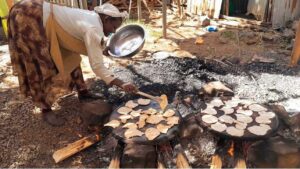
Same-Day Stringency
Unlike other Jewish communities, the Bete Israel define hametz as any food that’s no longer fresh and has lost some of its flavor. On Pesach, therefore, everything must be consumed on the day it was prepared – milk on the day it was extracted from the cow or goat, and meat on the day the animal was slaughtered. Accordingly, all processed foods – such as yogurt and cheese, alcohol, and vinegar – are forbidden.
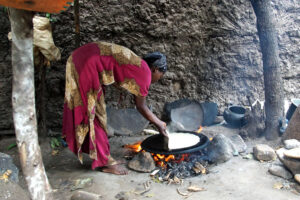
Another stringency concerns teff, a highly nutritious, gluten-free grain cultivated widely in Ethiopia and a staple of its diet. Teff flour is used to make flatbread (injera) and other baked items. Rabbis and scholars such as Profs. Zohar Amar, Yehuda Felix, and Mordekhai Kislev have all concluded that teff isn’t botanically equivalent to any of the five grains listed in the Talmud as capable of becoming hametz. Yet the Bete Israel won’t eat injera on Pesach – because of the time involved in making it. This community makes matza from any flour, including teff and corn – as long as it’s made quickly, just as the Israelites “were driven out of Egypt and couldn’t tarry” (Exodus 12:59).
Yet another stricture: Ethiopian Jews traditionally wait until the morning after Pesach – rather than the night after – to eat hametz.
Teff Test
Are teff seeds botanically closer to the five grains that can become hametz or to legumes, and how does that affect their Pesach status? A home experiment
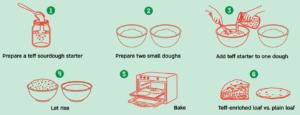
The Torah states repeatedly that se’or, a leavening agent, is prohibited on Pesach. Does teff have similar properties, implying that it too should be forbidden? To find out, I conducted an experiment.
First I prepared a teff sourdough starter, using just flour and water. A few days later, I prepared two small doughs made with wheat flour. I added a bit of teff starter to one of them, then baked both.
The teff-enriched dough rose more than its counterpart, and the resulting bread was likewise airier, suggesting that teff is botanically similar to the five types of grain banned by the rabbis on Pesach.
Rabbi Shabtai Rappaport, emeritus head of Bar-Ilan University’s Advanced Torah Institute, dismissed this experiment, since many starters aren’t considered hametz. Instead, he proposed an alternative test: Bake a teff pita on a saj (a convex pan placed over a heat source). If the pita stays fresh long afterward – like grain-based flatbreads – teff is closer to other grains than to legumes.
(This principle, Rabbi Rappaport claims, clarifies a verse describing how the Israelites left Egypt:
They baked the dough they had brought out of Egypt into matza cakes, since they were driven out of Egypt and could not tarry and had not prepared provisions for themselves. [Exodus 12:39]
According to Rabbi Rappaport, “provisions” means bread suitable for a journey, i.e., keeping well over time, as opposed to the [soft] matza mentioned earlier in this passage, which is highly perishable.)
I put teff to the rabbi’s test, and the resulting pita was in fact still good twenty-four hours after baking.
Rabbi Reuven Tal-Iasso, who has studied the Bete Israel traditions, adds that injera too is perfectly edible even four days later. Nevertheless, he insists that Ethiopian Jewish practices are based on custom, not scientific experimentation. Likewise, Ashkenazim avoid legumes (kitniyot) on Pesach because of custom, not science.
In any case, my original experiment would seem to confirm the Bete Israel’s Pesach ban on injera and any other form of leavened teff.
Standing before God
After arriving in Israel, Ethiopian Jews stopped offering the Paschal sacrifice on the evening of 14 Nisan. Nevertheless, they cling to their traditional, extremely broad definition of hametz. What other traditions will this biblically oriented community preserve, and which will they abandon? What happens when two traditions, both claiming the same source, must coexist? Prof. Avi Sagi emphasizes the conceptual difficulty posed by such an encounter:
Anyone living within a traditional framework doesn’t question it; it’s not up for discussion […]. A traditional lifestyle is all-encompassing, affecting every aspect of life. Life has no meaning outside the context of the tradition. […] That is, tradition is a priori; it’s foundational to the traditional society’s full complement of meanings, insights, and practices. Tradition provides the lens through which the world is viewed. (Avi Sagi, A Challenge: Returning to Tradition [Shalom Hartman Institute, 2003], p. 16 [Hebrew])
Every religious tradition is an attempt to stand in relationship with God. However, such traditions should create unity rather than uniformity, recognizing other legitimate forms of worship and thereby fostering mutual respect, tolerance, and receptivity to different viewpoints without sacrificing one’s own religious obligation. The Bete Israel and their biblical heritage challenge us to look at reality from someone else’s perspective rather than making one tradition the standard against which others are judged. Instead of analyzing one tradition according to another’s alien criteria, each should view the alternative as a dialect of the same language.
The sages demanded that we use our “Pesach of subsequent generations” to relive the Exodus:
In every generation, one is obliged to view himself as if he too went out of Egypt. (Mishna Pesahim 10:5)
This obligation demands not only imagination, but existential identification. For many Ethiopian Jews, it’s not a matter of seeing ourselves “as if” we came out, but a living, breathing memory. We indeed left “Egypt”: We left our villages in haste, crossed the Sudanese desert, lost loved ones and friends, and were blessed to reach Jerusalem. There, after thousands of years apart, a single prayer is on our lips. May we continue to behold the ingathering of the exiles, the miracle of the State of Israel, and a positive meeting of different Jewish traditions.
Glossary of Ethiopian Jewish Terms
Ge’ez – ancient, sacred Semitic language used in Ethiopia by both Jews and Christians
injera – traditional Ethiopian flatbread, considered by the Bete Israel to be hametz on Pesach
kes or kahin – priest (though not a descendant of Aaron); spiritual leader
khurban – sacrifice
kita (Amharic) or kitcha (Tigrinaya) – soft matza made from any kind of flour (especially corn); similar to Iraqi pita
Lissan – Nisan
masgid – synagogue, from the Hebrew root s-g-d (worship)
Orit – Torah (from the Aramaic Oraita); the Septuagint version of the Pentateuch, Joshua, Judges, and Ruth, written in Ge’ez
Pasika – Pesach
shmaglotz – elders, who resolve marital, family, and property disputes
yetzulot bayit – prayer house
Feel free to share