
The hero of Roman Polanski’s new film isn’t Dreyfus, or even Zola, but the French officer whose pursuit of justice led to the Jew’s release

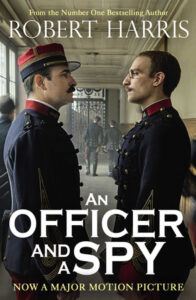
An Officer and a Spy
Roman Polanski
132 minutes
French with English subtitles
Based on the beautifully crafted novel by Robert Harris, published in 2014, An Officer and a Spy is polished, understated, and incredibly detailed. Unfortunately, with cinemas worldwide shut down by Corona, you’ll have to wait to see it. Meanwhile, you could do a lot worse than console yourself with the book.
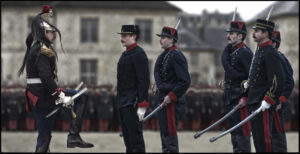
Roman Polanski treats us to an unmatchable historic recreation of the carefully staged drama that launched the Dreyfus Affair as far as the French public was concerned: the full-dress parade at which Capt. Alfred Dreyfus was stripped of his rank and his sword snapped in two in 1894. Every ribbon on the uniforms, the soldiers’ marching in step, the mounted guard, and the maneuvers around Paris’ École Militaire has clearly been meticulously researched. The same goes for the crowds gathered to watch this humiliating spectacle and the officer reporting to his superiors on how it was received – Georges Picquart, the film’s hero.
No Jew-Lover
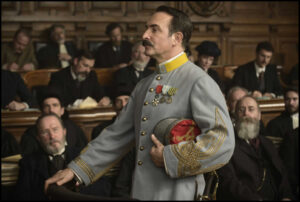
Arguably, neither the officer nor the spy of the title is in fact Dreyfus, falsely accused of betraying the French army to the Germans and sentenced behind closed doors to lifelong, solitary exile on Devil’s Island. The spy is presumably Ferdinand Walsin Esterhazy, the aristocratic drunkard who sold information to subsidize his lavish lifestyle and for whom the French military was willing to sacrifice Dreyfus rather than admit its mistake. The officer is Picquart, who attended the Jew’s original hearing and – as chief of army intelligence – read the letters he sent and received from his wife and children as he languished in prison.
Dreyfus himself is a minor character, portrayed with admirable woodenness by Louis Garrel as a stark contrast to the likeable, lively Picquart. The scenes of Picquart’s social life among Paris’ professional, upper-middle-class intellectuals could be modeled on Impressionist paintings of the period: Well-dressed young women picnick with their beaus in public gardens, attend parades and concerts, and flirt with dashing, single officers.
Picquart is conducting an illicit affair with the wife of a colleague from the War Ministry, and one of the book’s strengths (glossed over in the screen adaptation) is the grudging admiration he develops for Dreyfus on reading said correspondence, with its protestations of innocence and suffering. (Ironically, the only one to read most of these intimate missives is the military censor – Picquart.) It’s this growing respect for Dreyfus as a husband and father, in contradistinction to his own uncommitted bachelorhood, that first makes the intelligence officer suspect the case against the unfortunate captain.
The main action revolves around Picquart’s investigation into the authenticity of a letter recovered from the German Embassy and attributed to Dreyfus. The film emphasizes that the bureau chief is himself not unprejudiced against Jews and has no interest in Dreyfus personally. Picquart’s struggle is for truth, justice, and the integrity of France itself.
Not yet a Segula subscriber?
Access our full archive online, have print issues delivered to your door, and moreFeel free to share