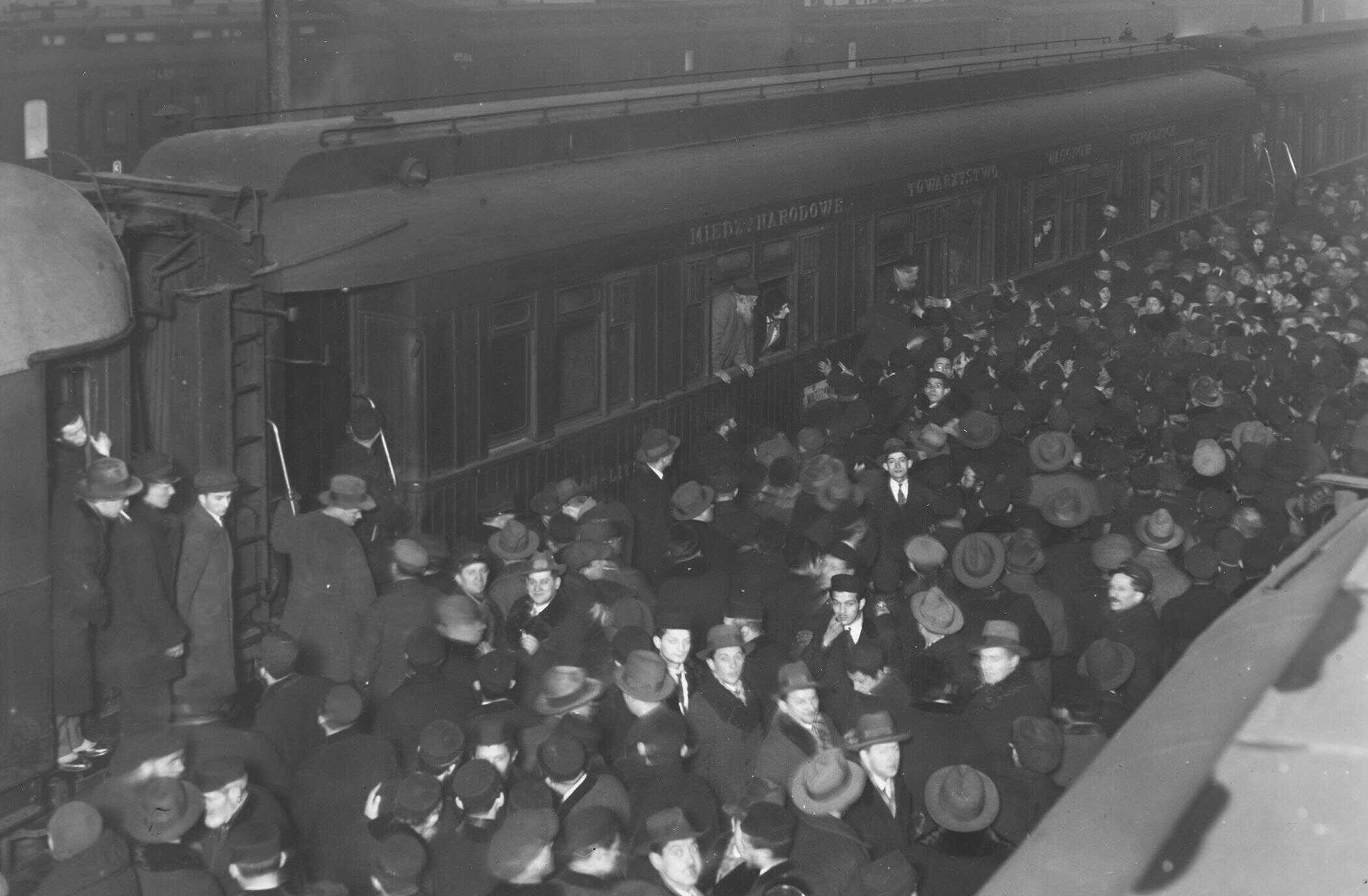
Change followed swiftly in the wake of the railway, making the steam engine’s power and speed synonymous with modernity. Yet the ostensibly conservative Hasidic movement eagerly embraced the noisy, crowded carriages of train travel. New ways of traversing the traditional track

“Two Jews are on a train…” An entire section of Alter Druyanow’s classic, threevolume Book of Jokes and Wit (Shoshani Press, 1935 [Hebrew]) is devoted to jokes beginning with these words. The impact of the train on Jews in general – and Hasidim in particular – was profound and multifaceted, encompassing much more than just humor. Railways were the source of as much innovation and disruption in 19th-century eastern Europe as they proved to be everywhere else. Only some of these changes were technological; the ease of rail transport and travel affected people religiously, spiritually, and even morally. Hasidim, it turned out, were no exception.
Man vs. God
Wolfgang Schivelbusch, author of a fascinating series of books and articles on the cultural upheaval set in motion by the railroad, describes how this mode of transportation literally redrew international maps. Big cities lacking railway stations were swiftly upstaged by new towns built along the tracks.
Trains were most people’s first and most dramatic encounter with steam technology, transforming their notions of time and space. The rapidity of train travel altered the very pace of time, while railway timetables subtly reduced individuals’ autonomy, and the random possibility of mechanical failure and railroad accidents redefined perceptions of danger.
Schivelbusch sees acceleration as the very essence of modernity. Every technological development shrinks the interval between cause and effect, and the train was the first and most obvious manifestation of that phenomenon in transportation.
Harvard comparative literature professor Jeffrey Schnapp likens speed to an addictive drug, conferring an exhilarating sense of liberty and privilege – the freedom to pursue, access, acquire, and achieve. In 19thcentury art, the train symbolized progress. Riding the rails was so intoxicating that some compared the experience to induction into a new religion – that of modern science. The old world and its traditions were swept away by the ever-increasing pace of train travel.
Futurism was an extreme expression of such convictions, calling on humanity at the turn of the 20th century to worship at the altar of technology. The movement’s founder, Italian poet and thinker Filippo Tommaso Marinetti, wrote:
We say that the world’s magnificence has been enriched by a new beauty: the beauty of speed. (“Futurist Manifesto,” Le Figaro, February 20, 1909)
Consciously or not, everyone exposed to the momentum of railways and the noise and energy of the huffing, puffing engines couldn’t but share this awe. The power of steam unleashed by human hands seemed an almost direct challenge to the Divine. In Schivelbusch’s terms, ordinary folk with no understanding of engineering regarded steam power as nothing less than a miracle. Unlike the familiar wind power, water power, or horsepower, the steam engine harnessed energy that appeared out of nowhere, apparently inexhaustible. Suddenly man was no longer dependent on God’s natural bounty; his pistons and cylinders moved in dizzying concert, quicker than the eye, creating a mighty force all their own. There was something quite mystical about this contraption, welded together by the art of industrial engineering in factories large as cathedrals.
If in Greek theater, all complications were magically resolved by a sudden deus ex machina, modern inventions did exactly the opposite, replacing the hand of God with the works of man.

Not yet a Segula subscriber?
Access our full archive online, have print issues delivered to your door, and moreFeel free to share