Separate seating in synagogue has long kept women far from the scrolls of the law. Yet women have traditionally decorated the very fabrics that adorn and protect Torah scrolls. Some of these textiles are even associated with motherhood and childrearing

Though divided by gender, time, and country of origin, Rikah Polacco of 17th-century Italy and Binyamin (Wilhelm Peter) son of Hayyim Heimann, born in 1930 in Germany, have something in common. Both their names appear on fabrics used to bind Torah scrolls. Both in a sense donated these textiles; yet Rikah created her “namesake,” while Binyamin only wore his – and briefly at that. The custom of embellishing such binders with either painting or embroidery is among the lesser-known practices linking Jewish communities around the world. Both Italian and German Jews boasted rich but divergent traditions regarding these textiles.
On a Roll
Since the destruction of the Temple, the scrolls of the law have become Judaism’s most sacred objects: everyone rises as the Torah is lifted, and if it’s dropped, its holder must fast; the parchment is never touched directly, and once faded, it must be buried. In addition, the Torah’s protective covering exemplifies the Talmudic principle of hiddur mitzva, beautifying a commandment:
Adorn yourself before Him [in the fulfillment of the precepts]; make a beautiful sukka in His honor, a beautiful lulav, a beautiful shofar, beautiful fringes, and a beautiful scroll of the law, and inscribe [the scroll] with fine ink, a fine reed, and a skilled scribe, and swathe it in beautiful silks. (Shabbat 133b)
The earliest Torah wrappings date from the first century CE in Qumran, and the practice of decorating them is already discussed in the Mishna:
Covers of scrolls, decorated or not, are susceptible to ritual impurity according to the House of Bet Shammai. The House of Hillel says: those that are decorated are pure, but those that aren’t are susceptible. Rabban Gamaliel says: both are pure. (Kelim 28:4)
After the fall of the Second Temple, exile and dispersion gave rise to two parallel traditions: in Tunisia, Algeria, Egypt, Yemen, Iran, Iraq, Afghanistan, and India, Torah scrolls were generally encased in a wooden box (lavishly decorated and often inlaid or plated with silver), while in western Europe – including Turkey and the Balkans – and in Morocco, the Torah was cloaked in a cloth mantle. Whereas the solid casing keeps the scroll closed and protected, the Torah can come loose within the mantle and must therefore be tied together. This pitfall led to the development of a cloth wrapper or binder, known as a mapa or avnet in Hebrew, a fascia in Italian, and a wimpel in German.
Fabrics are fragile, so ancient textiles rarely survive. The oldest extant Italian Torah binders date from the 16th century. One beautifully embroidered example measures 19 cm x 2.85 m – the latter figure typifying the length of a binder, which spiraled the scroll from top to bottom (or vice versa), much as a baby would be swaddled. The inscription reads:
In honor of the pure Torah, I, Honorata […] wife of […] Samuel Foa, […] made an offering with my own hand – is it not a little one? – in the year 5343 [1582–3].
The phrase “Is it not a little one?” comes from the biblical account of Lot’s flight from the destruction of Sodom. The fugitive asks God’s angels to spare his destination, the small town of Zoar, “that my soul may live” (Genesis 19:20). Rabbi Shlomo Yitzhaki, the classic medieval commentator known acrostically as Rashi, interpreted Lot’s request as grounds for clemency: “For as [the town’s] sins are few, You can leave it be.”
Clearly, this inscription was composed by someone familiar with both the biblical text and Rashi’s commentary (though said composer might not have been Honorata). The embroiderer’s implicit prayer is thus that her handiwork grant the gift of life – for herself or perhaps in the form of a child.

Verona, home of Samuel and Rikah Polacco, retains a distinctively Renaissance air. Portoni della Bra, Verona | Photo: Didier Descouens
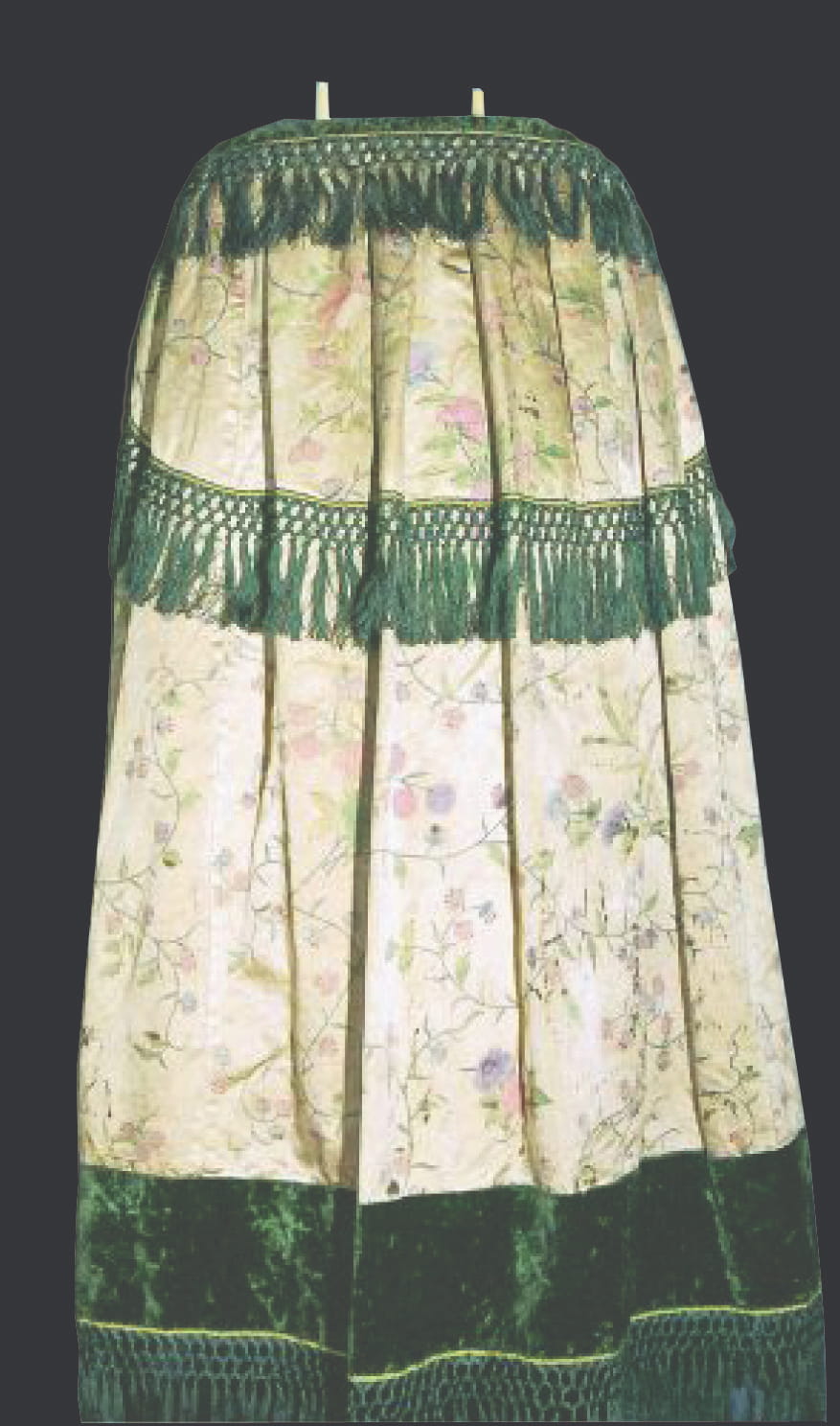
Torah mantle from the Montefiore Synagogue in Ramsgate, England, 1850 | Photo: Courtesy of the Montefiore Endowment
Not yet a Segula subscriber?
Access our full archive online, have print issues delivered to your door, and moreFeel free to share