The expulsion of Spain’s Jews coincided with its discovery of America, with profound consequences for North America’s first Jewish communities. On Sephardic, Ashkenazic, and converso Jews’ first steps in the New World

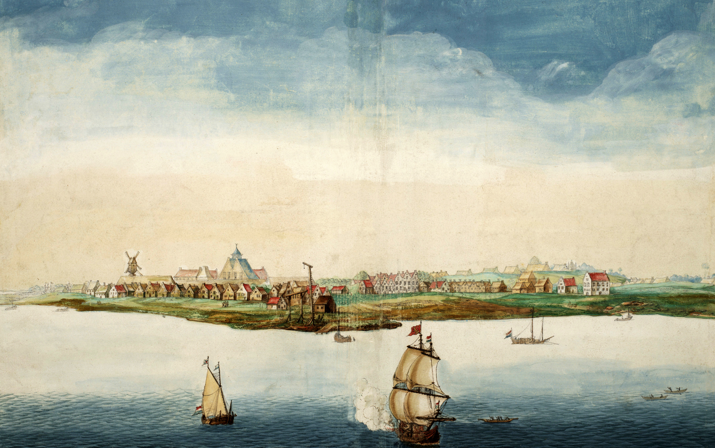
We don’t know much about the small ship that sailed from Brazil to New Amsterdam, soon to be renamed New York, in the mid-1600s. Aboard were the members of the city’s first Jewish community, little dreaming that the modest harbor town would become the undisputed capital of the Diaspora.
Despite evidence of continuous Jewish settlement in the area from the ship’s arrival until the establishment of New York’s first official congregations, the traces of their beginnings in the 17th century are dubious and few. The case grows a bit stronger in the 18th century, but the surviving documentation is sparse and adds mostly mundane details.
Similar communities were founded at around the same time in South America, in Recife and Curaçao (both now in Brazil). We know more about them simply because Jews were barred from the Spanish and Portuguese colonies, and the Inquisition left extensive records of these refugees as it hunted them down.

Two-Pronged Dispersion
In 1492, the Jews of Spain found themselves facing a fateful dilemma: either convert to Christianity or flee with whatever they could carry. Historians debate how many chose exile, but the consensus is that a significant proportion stayed put and became Christian. Most of the exiles settled in Portugal, only to be forced to convert five years later. Others headed for the welcoming Ottoman Empire. Generally, said Jews either joined existing communities or created new ones nearby so as to preserve their Spanish-Jewish (i.e., Sephardic) heritage.
A new wave of emigration from the Iberian Peninsula followed toward the end of the 16th century. Known as the Western Sephardic Diaspora, these transplants were descendants of New Christians (as the conversos were called), many of whom secretly maintained Jewish traditions. They were also mostly merchants, often trading internationally. Spain and Portugal (united under one monarch for just over half a century) encouraged them to expand their commercial reach by settling in new areas, especially western European port cities such as Amsterdam, Leghorn, Hamburg, and London. There, some of the newcomers reclaimed their faith.
These families had had no contact with Jews and Judaism for over a century. Even those who’d observed Jewish customs behind closed doors had grown up Christian. As their communities developed, some increased in importance – above all Amsterdam, which became a center of Jewish and Hebrew printing in the 17th century. Though very much belonging to the Jewish world, these enclaves were unusually well-integrated into their Christian surroundings.
This second wave of emigration reached the Americas too. The new arrivals were part of Europe’s colonial expansion long before any thoughts of independent states, which emerged only in the late 18th century.
Conversos in America
Columbus discovered America the same year the Jews were expelled from Spain. Many thus conjecture that some of the Spanish conquerors were Jews who’d converted after the decree of expulsion, but there’s not enough evidence to confirm that. From the mid-16th century, however, no few New Christians populated South and Central America’s numerous Spanish and Portuguese colonies – although, as stated, this influx was officially forbidden. There are abundant testimonies to Jews’ presence and activities in America as well as their influence in many spheres, particularly trade.
Whereas Spain had persecuted its conversos since the end of the 15th century – even before the Jews’ expulsion – the Inquisition didn’t reach the country’s American colonies until a hundred years later, and even then its hostilities were effective mostly in Peru and Mexico. Cartagena (today’s Colombia) fell victim only in the early 1600s.
Yet American Jewish life didn’t originate in the Spanish colonies. Beside the Catholic powers of Iberia, another major naval force was active in the Americas: the Dutch colonial empire.
In 1630, the Netherlands conquered Pernambuco (today in Brazil) from the Portuguese. As Calvinists rather than Catholics, the Dutch tolerated religious minorities, thereby making Jewish life possible in the New World. Historian Yosef Kaplan has pointed out that the Dutch West India Company courted settlers even before the conquest of Pernambuco. Circulars promised freedom of religion there, and the company repeatedly confirmed that in 1634 and 1636.
In 1637, Congregation Zur Israel (Rock of Israel) was established in Recife, capital of Pernambuco, followed shortly afterward by Magen Abraham (Shield of Abraham) in nearby Mauricia. Hundreds of Spanish and Portuguese Jews from Amsterdam joined their ranks, including such religious leaders as Isaac Aboab da Fonseca and Moses Raphael de Aguilar.
In 1654, however, Portugal reconquered Recife; its many Jews either returned to Amsterdam or settled on Curaçao and other Caribbean islands. In 1659, Congregation Mikveh Israel (Hope of Israel) was founded in Curaçao and soon became the Americas’ richest and most important Jewish community. Its synagogue was built in 1671 to resemble the Esnoga in Amsterdam (source of most of Mikveh Israel’s rabbis), complete with sand-strewn wooden floor.

Not yet a Segula subscriber?
Access our full archive online, have print issues delivered to your door, and moreFeel free to share