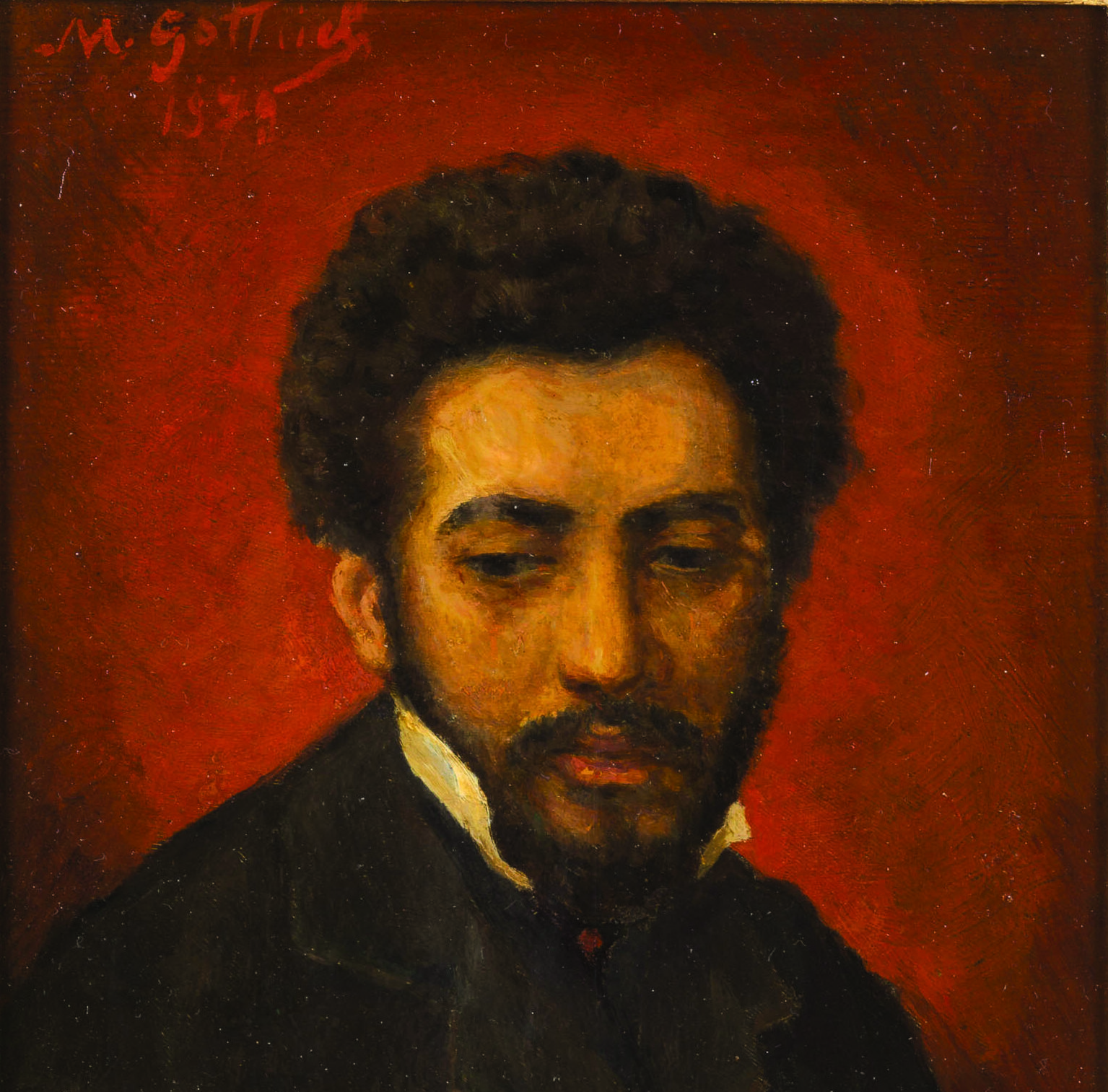
Maurycy Gottlieb aspired to be Polish Jewry’s national artist, changing its image with his brush and palette. His tragic death cut short his musings on Jewish identity

The iconic Jews Praying in the Synagogue on the Day of Atonement is the painting most widely associated with Polish Jewish artist Maurycy Gottlieb (1856–1879). Completed in 1878, it’s been reproduced more than any other modern Jewish work of art. Gottlieb literally immersed himself in the painting, planting at least four self-portraits among the figures gathered in the traditional synagogue on this holiest day of the Jewish year. This quartet reflects his life story and the dilemmas that haunted him. One of the four is a young man wrapped in a colorful prayer shawl, standing out from the traditional black and white stripes on the other worshippers’ garb. Another is the youth behind him, leaning forward in profile over a High Holy Day prayer book, and a third is a boy in a brocade coat, looking as if transplanted from an earlier time. The medallion hanging from his neck bears the Hebrew letters mem and gimmel, the artist’s initials.
Other members of Gottlieb’s family have also been incorporated into the painting. His father, on whose shoulder a fourth young Maurycy leans, is seated in the lower right-hand corner, and the artist’s fickle fiancée, Laura Rosenfeld, who broke their engagement (and his heart), appears in the unusually open women’s gallery.
The mantle on the Torah scroll in the foreground is inscribed in Gottlieb’s memory, adding an aura of mystery: “Donated in memory of the departed soul of our teacher Rabbi Moses Gottlieb, may his righteous memory be blessed, in the year 5638.” The year is the date of the picture’s completion, not Gottlieb’s death, but it’s oddly prescient. Gottlieb himself said that he felt a hidden hand guiding his brush as he painted the inscription. The subjects’ faces are all tinged with sadness, and the central figure – Moses/Maurycy himself, head in hand – exudes more than a hint of despair.
We’ll return to the story behind this famous painting, but guilt may well be one of the many emotions that charge it. Many years earlier, Gottlieb was studying in a Polish high school. Apart from history, art was the only subject Maurycy enjoyed. So, much to his Christian teachers’ and fellow students’ surprise, he showed up on Yom Kippur with his sketchbook and began drawing, while his family spent the day in synagogue without him. Thus he succumbed to “my first sin – a horrendous one” (Ezra Mendelsohn, Painting a People: Maurycy Gottlieb and Jewish Art, p. 22), which he later described:
“I returned home, with a guilty conscience, and when I was asked where I had been I turned red and pale and my eyes flooded with tears, that was my answer”. (ibid.)
These long suppressed pangs of conscience may have found their way into Gottlieb’s signature painting. On this Day of Atonement, far from being absent, the artist is present in synagogue in multiple images.

A Formative Moment
Gottlieb’s brief life began in Galicia, then part of an Austria soon to become the Austro-Hungarian Empire. He was born in the small, half-Jewish town of Drohobycz (now Drogobych, in Ukraine). The nascent oil industry boosted the town’s economy in the second half of the 19th century, and Maurycy was a child of the resulting hodgepodge of languages, religions, and ethnicities: Catholicism and Greek Orthodoxy; traditional Judaism alongside a secular, cultural Jewish identity; a babel of Polish, German, and Yiddish in the air; Poles and Ukrainians each forging rival national identities. Gottlieb was clearly torn, his personality split by his various names: Moishe for Jewish occasions, Moses or Moritz in a German context, but above all Maurycy, as he was known in Polish.
The Gottlieb family might today be described as “modern Orthodox”: observant but somewhat integrated within Polish culture. Moishe-Maurycy’s parents were proud Poles as well as proud Jews, so when their son abandoned Orthodoxy, they didn’t disown him. After all, the general education they’d given him had laid the groundwork. In fact, of the seven children of Fanny and Isaac-Itzik (a textile merchant turned oil refiner), four sons were artists, one became a lawyer, and one daughter was a teacher and amateur pianist. Another daughter married a non-Jewish Polish artist, which probably bothered her parents more. All but one of the Gottlieb children went by Polish names: Maurycy, Leopold, Marcin, Anna, Jadwiga, and Filip; Haim was the exception.
Though Maurycy began his education in a heder, where he learned to read Hebrew and studied basic Jewish texts, his parents sent him to a Christian elementary school and high school. There he was exposed to his classmates’ anti-Semitism. He transferred to a German high school in Lvov and was admitted to the prestigious Vienna Academy of Fine Arts in 1872, at the tender age of fifteen. He worked hard to be accepted among his fellow Poles, struggling to perfect his Polish, but like many of his Jewish contemporaries, it was much easier for someone whose mother tongue was German to integrate into German culture. Gottlieb rounded out his elementary knowledge of Judaism by reading voraciously on Jewish history. Like many of his generation, he devoured Heinrich Graetz’s path-breaking History of the Jews.
Gottlieb joined the Vienna Academy’s Department of Historical Art – then an extremely popular genre in which artists painted historical events and dramatic scenes from literary classics. He studied under many first-class artists, but it was a picture by Polish master Jan Matejko that truly inspired him. Matejko’s Rejtan: The Fall of Poland (1866) shows the fateful meeting of the Polish sejm, or parliament, in Warsaw in 1773, in which its members acceded to the first shameful division of Poland – a prelude to the complete loss of Polish independence. Delegate Tadeusz Rejtan has thrown himself to the floor, symbolizing his country’s fall into Russian, Prussian, and Austrian hands, while other political leaders look on and the king, impatient and helpless, steps away from his throne.
The emotional power coursing through this romantic, tragic work made an indelible impression on young Maurycy Gottlieb, who even then may have found the Polish nation’s fate not unlike that of his own long-suffering people. He stood hypnotized before the painting, “until the spark of art burned in his soul” (ibid., p. 30). There and then, reversing the path trodden by most aspiring Jewish artists of his era, Gottlieb decided to leave Vienna for the relative obscurity of Galicia, studying at the Kraków School of Fine Arts under Matejko himself.
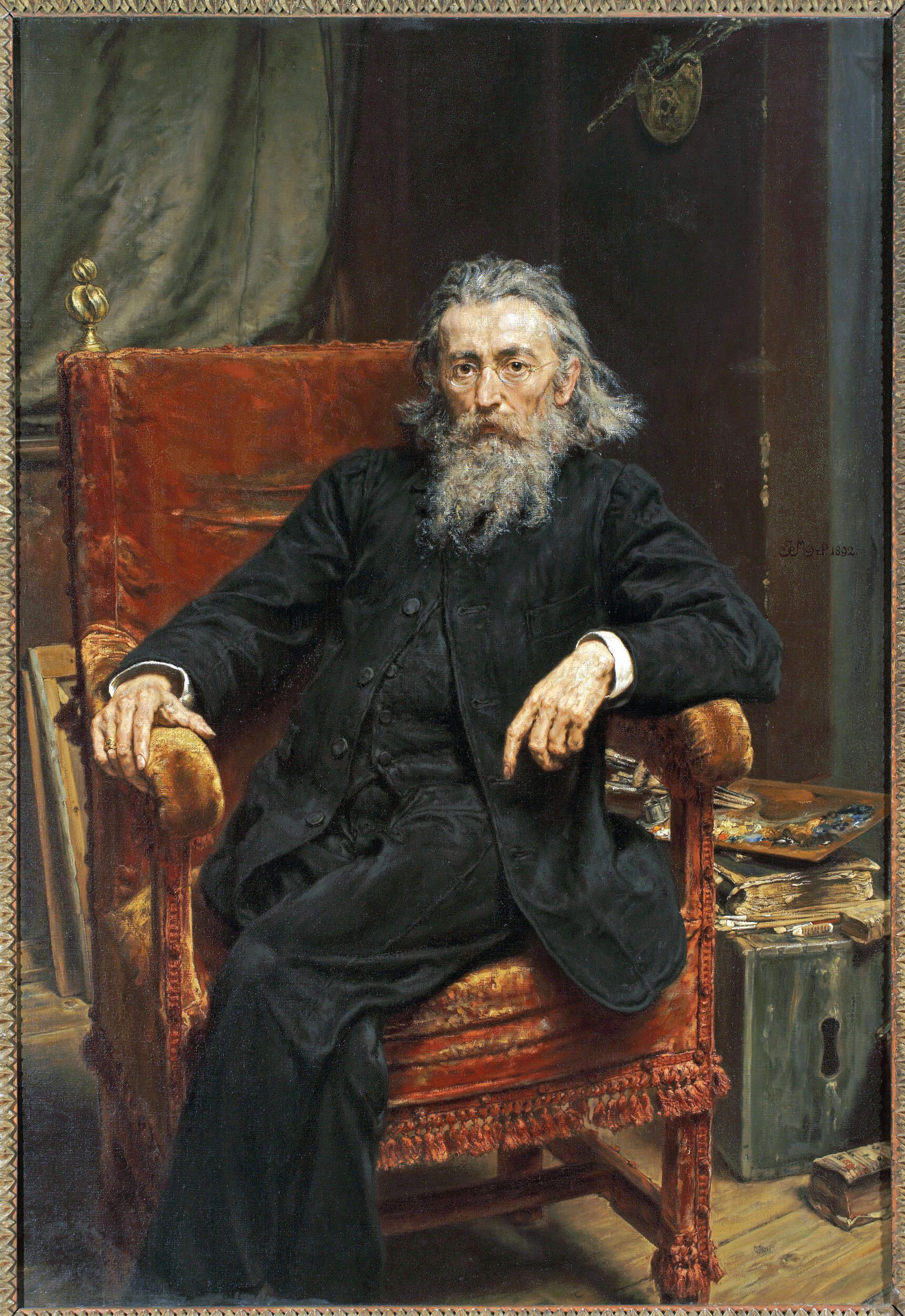
Polish artist Jan Matejko, profoundly influenced Polish nationalist paintings in the 19th century. Self portrait, 1892

Jan Matejko, Rejtan – The Fall of Poland, oil on canvas, 1866
Not yet a Segula subscriber?
Access our full archive online, have print issues delivered to your door, and moreFeel free to share