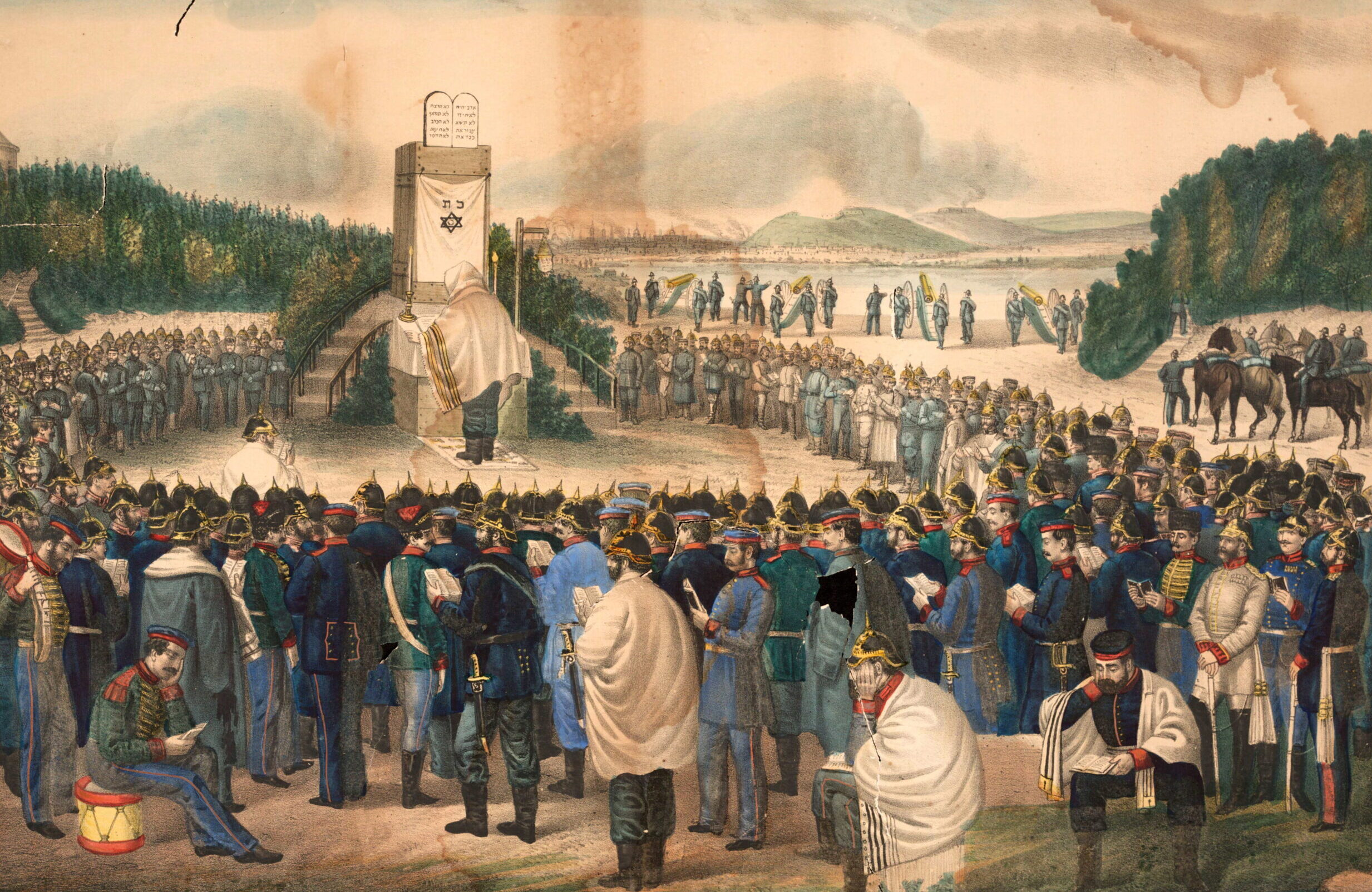

In the Middle Ages, wars were considered the province of kings and nobles, with the common folk seldom pressed into service. Only in the late 18th century, with the dawning of nationalism, did the military become a matter for all citizens. Including Jews? Some rulers thought so. In 1788, Holy Roman Emperor Josef II ordered the conscription of Jews throughout his dominions – a decree partially rescinded after his death in 1790 but reissued in 1804. And in 1827, Nicholas I drafted all subjects of the Russian Empire, Jews included.
Aside from the obvious danger of military service, most Jews viewed conscription as nothing less than an attempt to destroy Judaism. Cut off from their homes and Jewish communities, fighters were often forced to transgress such biblical commandments as the Sabbath, dietary laws, and the ban on shaving with a razor (Leviticus 19:27). At times, the Russian army even endeavored to convert Jewish soldiers to Christianity. Jews thus sought various ways out of conscription. Some young men appealed to the authorities; others paid dearly for a kvitentzia, a certificate consigning one to the reserves; some fled the country, and others even injured themselves slightly just to be declared unfit to serve.
Since draft quotas were imposed on communities, there were instances of kidnapping, primarily of children from poor families. Jewish leaders hired happers (snatchers) to provide the requisite number of soldiers without endangering the pedigreed. Those drafted were known as cantonists because of their subsequent training in military cantons (camp schools), where some also received a Christian education.
In 1874, communal fulfillment of conscription quotas was abolished in Russia. Instead, a new law imposed six-year service on every man over age twenty, with shorter stints for graduates of the Russian school system. Many parents promptly enrolled their children in official educational institutions, making sure they learned enough Russian to prove it. Quipped author Nikolai Minsky:
General army service did more to educate Jews than all the Jewish newspapers combined. (Yehuda Slutzki, “The Regulations of the General Draft, 1874, and Russian Jewry,” He-avar 21 [5735], p. 13)
Elixir of Exemption
Rabbinic literature attests to the challenges conscription posed for Jewish communities. Hagiographies contain dozens of miracle stories of Hasidic masters’ helping their followers escape the draft. Rabbi Yehuda Assad, head of a Hungarian rabbinical court, kept a vial of tears he’d shed during midnight prayers, and drinking a few drops was said to keep one out of the army. A similar legend concerns Rebbe David Twerski, founder of Talne Hasidism:
A father and son, simple folk, once came before our rabbi, the holy Rebbe David of Talne, may his memory protect us. The father sought a blessing for his son who’d been drafted. Our rabbi looked at the young man, who was tall and broad, hale and hearty, and asked him: “Have you learned anything in your life?” “No,” the young man replied. Our rabbi inquired again, “But a bit of Torah you know?” “No,” the fellow answered. “Do you know how to pray?” Again the young man said no. Our rabbi told him: “May you find [as little] favor in [the authorities’ eyes] as you have in mine.” And so it was that he was released from the army. (Yaron Amit, Wonders of the Righteous [Kfar Habad, c. 5780], p. 702 [Hebrew])
Other rabbis chose a completely different approach. For example, When young Jews from Prague were drafted in 1789, the local Jewish community was in anguish:
On Tuesday […], twenty-five members of our congregation were carted off to military service by order of the emperor, may his majesty be exalted, and there was a great outcry in the city streets. Mothers wept for their children, sisters for their brothers, and young women for their young husbands forced to leave their birthplace to battle our enemies. (“Current Events,” Ha-me’asef, Iyar 5549 [May 1789], p. 252)
Speaking to the conscripts, town rabbi Yehezkel Landau (known as the Noda BiYehuda) emphasized their obligation to obey their officers while faithfully observing the Sabbath and dietary laws and being as vigilant as possible about prayer, at the very least reciting the Shema daily. Landau also stressed that proper conduct and allegiance to the emperor and his army, even to the point of self-sacrifice, would sanctify God’s name in the non-Jewish environment in which they’d find themselves. The rabbi concluded with the biblical priestly blessing and other powerful verses promising protection from calamity. The event left everyone in tears.
Rabbi Landau’s remarks, delivered in high-level German, were published in full in the aforementioned issue of Ha-me’asef.
Not that the Noda BiYehuda supported Jewish conscription. On the contrary, a year later he participated in a delegation beseeching the new emperor, Leopold II, to abolish the practice of drafting Jews. Yet as long as mandatory service remained in force, he instructed conscripts to do their utmost to sanctify the name of Heaven and remain true to their faith.
Not yet a Segula subscriber?
Access our full archive online, have print issues delivered to your door, and moreFeel free to share