
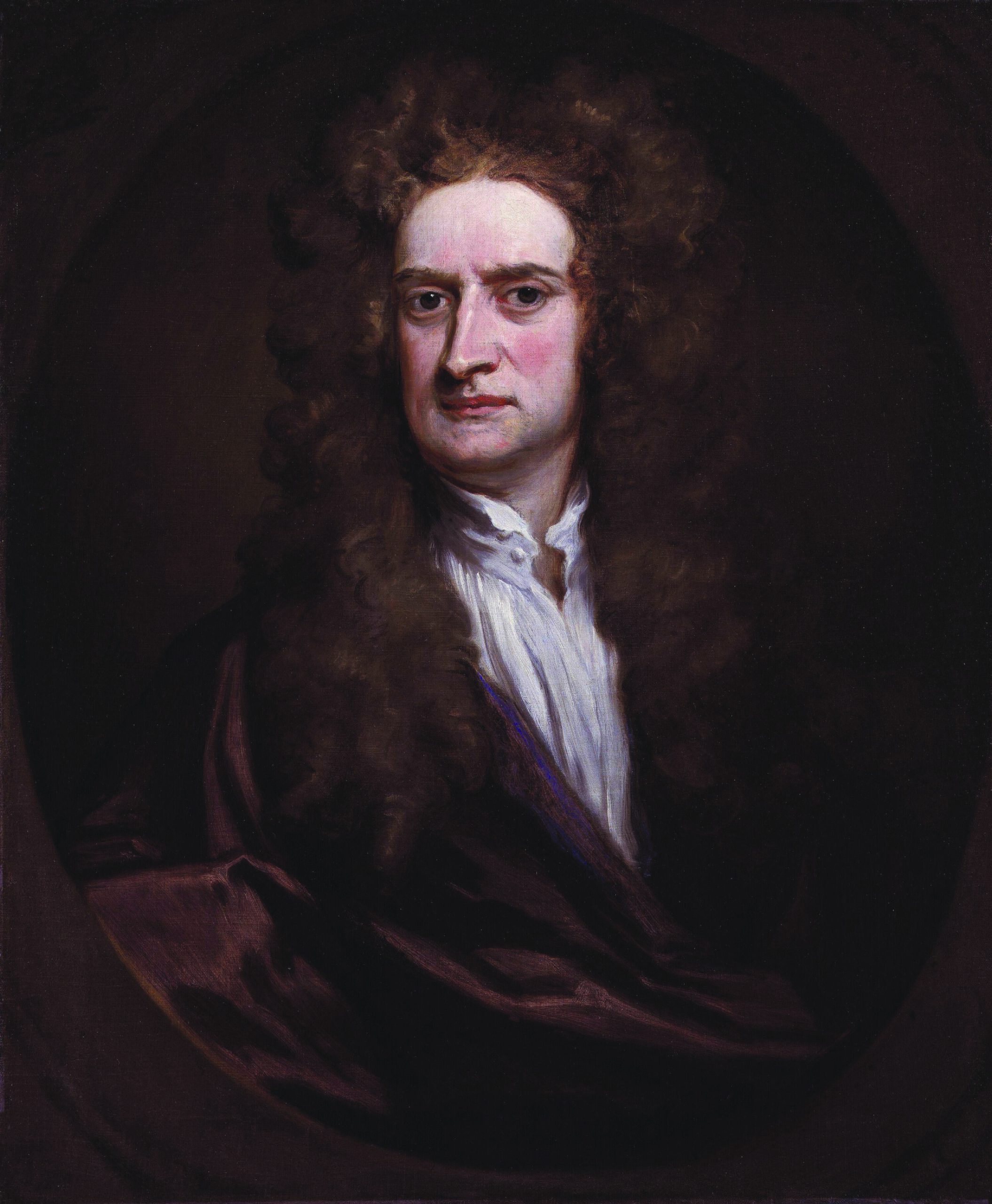
For Sir Isaac Newton, the laws of motion and mathematics were not personal discoveries, but divine gifts, encoded into the design of the Tabernacle

So then ’twas one designe of ye true systeme of ye first institution of ye true religion to propose to mankind by ye frame of ye ancient Temples, the study of the frame of the world as the true Temple of ye living great God they worshipped. And thence it was that ye Priests anciently were above other men well skilled in ye knowledge of ye true frame of Nature and accounted it a great part of their Theology. (Yahuda Manuscript 41 f. 7r, National Library of Israel, Jerusalem)
No mystic penned this passage; at least few would think him one. Nor was its author a prophet or priest, despite his veneration of the Temple. The writer? None other than Sir Isaac Newton, discoverer of the laws of gravity, mass, and motion. How does this quote fit our conception of the rational scientist analyzing the fall of an apple on his head? Was there more to Newton than meets the eye?

A Determined Infant
Isaac Newton was born in Woolsthorpe, in the English county of Lincolnshire, on December 24, 1642. His father had just died, and this last child of his was born premature, so tiny and weak that his mother didn’t believe he’d survive his first snowy night and left him to die quietly in the attic. Yet the baby screamed and cried so lustily that she relented, clasping him to her bosom for warmth. This child, she realized, fragile as he might look, was blessed with a great will to live. He might just make it.
Local legend had it that an orphan born on Christmas Eve was holy and destined for greatness. No such promise was evident in Newton’s early childhood, however. His mother remarried when he was three, and his stepfather, a local vicar, had no affection for the boy, so he was sent to his grandparents. The dislike seems to have been mutual, extending to his three younger half-brothers. He doesn’t seem to have gotten on particularly well with his grandparents either.
Newton’s mother brought him home at age eleven after she was widowed again. Sullen and solitary, he never grew close to the woman who’d twice abandoned him. She hoped that at fifteen, after three years at Kings School in nearby Grantham, her eldest would manage the family farm. But Newton’s efforts, if he made any, were a dismal failure, and his mother finally let him return to his beloved books. In 1661, at age nineteen, he entered Trinity College, Cambridge. He remained there for the next thirty-five years.
At first Newton supported himself by working for other students and lending money. After completing his first degree, he began teaching at Cambridge. The undergraduate curriculum was based on Euclidean geometry and Aristotle’s Ethics, but Newton was much more interested in the “New Science” of his day. He read extensively, immersing himself in the revolutionary concepts that were overturning “natural law” and geocentrism. Copernicus, Galileo, Descartes, Hobbes, and Boyle occupied Newton far more than his courses, although he found teachers (and later friends) in Cambridge alchemists Isaac Barrow and Henry More.
In 1665, a plague struck Cambridge and the university was closed. Newton continued his education at home in Woolsthorpe, where he delved ever deeper into mathematics and optics. He nearly blinded himself experimenting with light, began formulating what would later be called calculus, and – according to his own recollection – was once roused from contemplation beneath a tree by an apple falling on his head. Before the end of 1666, at age twenty-four, Newton had already developed the resulting eureka moment into a basic theory of gravity.
Not yet a Segula subscriber?
Access our full archive online, have print issues delivered to your door, and moreFeel free to share