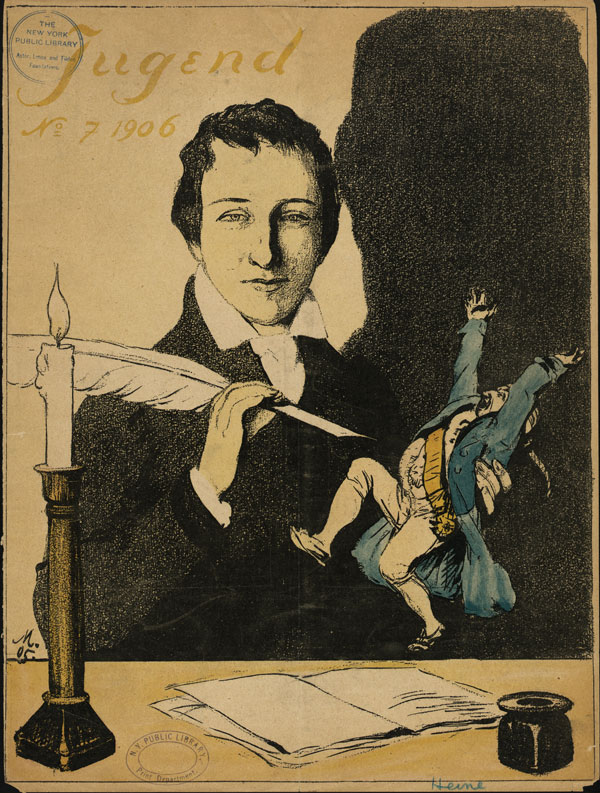
Though baptized at age twenty-eight, Heinrich Heine remained torn between Judaism and German nationalism, tradition and modernity

Poet, freedom fighter, and cosmopolitan in exile, Heinrich Heine bore the burden of an evolving modernity. A political prophet, Heine ranks among the European architects of modern Western thought. But how did his Jewish identity affect his singular career and intellectual world?
Born in Düsseldorf, Heine (1797–1856) was one of Germany’s greatest poets. His Buch der Lieder (Book of Songs, 1827) remains a best-selling poetry collection and has inspired thousands of melodies, most famously by Robert Schumann and Felix Mendelssohn. Heine’s Romantic expressionist poetry could soar to a sublime beauty few could resist. His influence on German literature has been immense, but his philosophy is universal.

A Prophet in Exile
Heine spent his last twenty-five years in France, where he contributed significantly to the evolution of 19th-century European intellectualism. With his sharp wit and even sharper quill, he fought tirelessly for the rights of the individual, constantly needling the bourgeoisie. Nonetheless, he sincerely believed in the borderless fraternity of mankind, and supported at least some of the economic and social ideas promoted by Karl Marx, with whom he later corresponded.
Heine’s last eight years are legendary. Always delicate, he succumbed to a chronic illness that left him bedridden and wracked with pain. With rare courage, he refused all opiates, lest they cloud his judgment and prevent him from writing.
To some extent, Heine foresaw the horrors perpetrated by Western civilization in the 20th century. A hundred years before the rise of Nazism and Communism, he realized the evil that the new secular ideologies sweeping Europe would bring. He alluded to the bitter fate awaiting the continent as a result of this ideological upheaval, fearing above all Germany’s craving for power:
Christianity … has somewhat mitigated that brutal Germanic love of war, but it could not destroy it. Should that subduing talisman, the cross, be shattered, the frenzied madness of the ancient warriors, that insane Berserk rage of which Nordic bards have spoken and sung so often, will once more burst into flame…. Do not smile at the visionary who anticipates the same revolution in the realm of the visible as has taken place in the spiritual. Thought precedes action as lightning precedes thunder. German thunder is of true Germanic character; it is not very nimble, but rumbles along ponderously. Yet, it will come and when you hear a crashing such as never before has been heard in the world’s history, then you know that the German thunderbolt has fallen at last. (Heine, The History of Religion and Philosophy in Germany [1834])
A few sentences later he warned:
A play will be performed in Germany which will make the French Revolution look like an innocent idyll. (ibid., quoted in Yigal Lossin, “Heine: His Double Life,” p. 58)
Heine also dreaded Communism. Despite his friendship with Marx while both were exiles in Paris, Heine wrote in 1855, the year before his death, in the preface to the French edition of his book Lutezia (“Paris” in Latin):
This confession, that the future belongs to the Communists, I made with an undertone of the greatest fear and sorrow…. Indeed, with fear and terror I imagine the time, when those dark iconoclasts come to power: with their raw fists they will batter all marble images of my beloved world of art … they will chop down my Laurel forests and plant potatoes and, oh!, the herbs chandler will use my Book of Songs to make bags for coffee and snuff for the old women of the future. (Lutezia [DHA edition], vol. 13/1, p. 294)
Gazing prophetically into the 20th century, Heine foresaw monsters that would surpass all malevolent beasts since antiquity. He hoped his contemporaries’ grandchildren would be born “with especially thick skin.”

Not yet a Segula subscriber?
Access our full archive online, have print issues delivered to your door, and moreFeel free to share