
Rooting the Rebbe’s far-reaching campaigns directly in the Baal Shem Tov’s ideology, a sociologist explains why the Lubavitcher Rebbe’s vision was best suited to and carried out from the land of the free

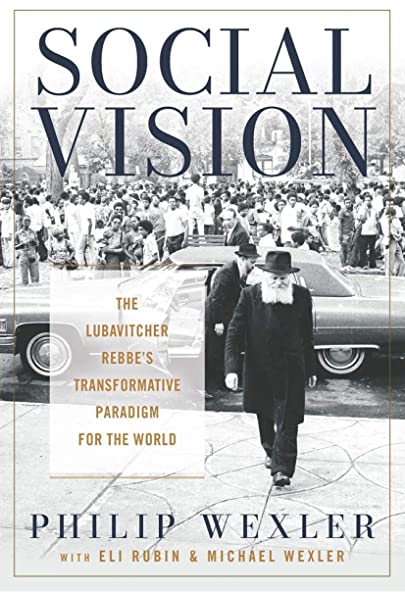
Social Vision: The Lubavitcher Rebbe’s Transformative Paradigm for the World
Philip Wexler with Eli Rubin and Michael Wexler
Herder and Herder, Crossroad Publishing Co., 2019, 265 pages
In this extremely erudite and fascinating book, Philip Wexler, an emeritus professor of sociology and education at Rochester University and the Hebrew University of Jerusalem, examines both the philosophy behind the activities of the seventh and last leader of Chabad Hasidism and how the goals he set for himself and his followers impacted his career.
Social Vision posits a deep affinity between Rabbi Menachem Mendel Schneerson and the U.S. after the Allied victory in World War II left it the acknowledged leader of the free world. Wexler begins by describing the “emotional trap” of the Protestant work ethic, to which many attribute America’s prosperity. The dread of economic failure as a sign of exclusion from God’s “elect” creates both an overriding determination to overcome obstacles and an obsession with the worth of the individual – as opposed to family and community. The author then presents the Rebbe not only as the embodiment of German sociologist Max Weber’s vision of charismatic leadership but as an antidote to the alienation generated by this ethos of thrift and industry. Schneerson’s depiction of God’s immanence in every aspect of creation and society is a source of immense joy, love, and brotherhood in which no one – Jew or non-Jew – is left behind.
Global Powerhouse
After demonstrating how deeply the teachings of Rabbi Israel Baal Shem Tov, iconic founder of Hasidism, were etched in every step of Schneerson’s career, Wexler shows that the Rebbe’s lifework was essentially a back-to-basics, grassroots movement. Collecting the broken remnants of Jewish communities destroyed in Europeand seeking refuge in America, he rebuilt them and their faith from the bottom up. Arriving in New York in 1940 as a fugitive from Paris, Schneerson quickly understood the American fixation on progress. He thus addressed the youth of his new homeland, not the elders. Promoting authentic Judaism rather than watering it down to suit an American lifestyle, the Rebbe spoke of transforming the world just as the beatnik revolution was getting under way.
Wexler points to greenhorn Schneerson’s uncanny grasp of the U.S. as a global trendsetter inasmuch as it was the only major political player whose postwar economy was intact. The Rebbe had his finger on the American pulse, sensing even the growth of “girl power.” Prefiguring women’s lib, he harnessed women and girls as agents of change in everything from candle lighting to conferences. As the Rebbe remarked (in Yiddish):
In America it is customary that the attitude regarding education is mainly determined by “the mainstay of the home” (Psalms 113:9), that is, the wife and the mother. Now, America is the nation to which the eyes of all are raised, since it is from here that both financial and spiritual resources are disseminated. Accordingly, the way that educational policy is to be established here, especially among Jews, will constitute a model for the education of young people wherever they live, including the Land of Israel. […] The nature of the world today is such that the nation that is the source of financial resources has the ability to be the opinion leader of greatest authority. (p. 58)
Not yet a Segula subscriber?
Access our full archive online, have print issues delivered to your door, and moreFeel free to share