What do Israel’s third president, businessman and publisher Salman Schocken, and Breslov Hasidic leader Rabbi Yisroel Dov Ber Odesser have in common? A pamphlet distributed in Jerusalem connects them all

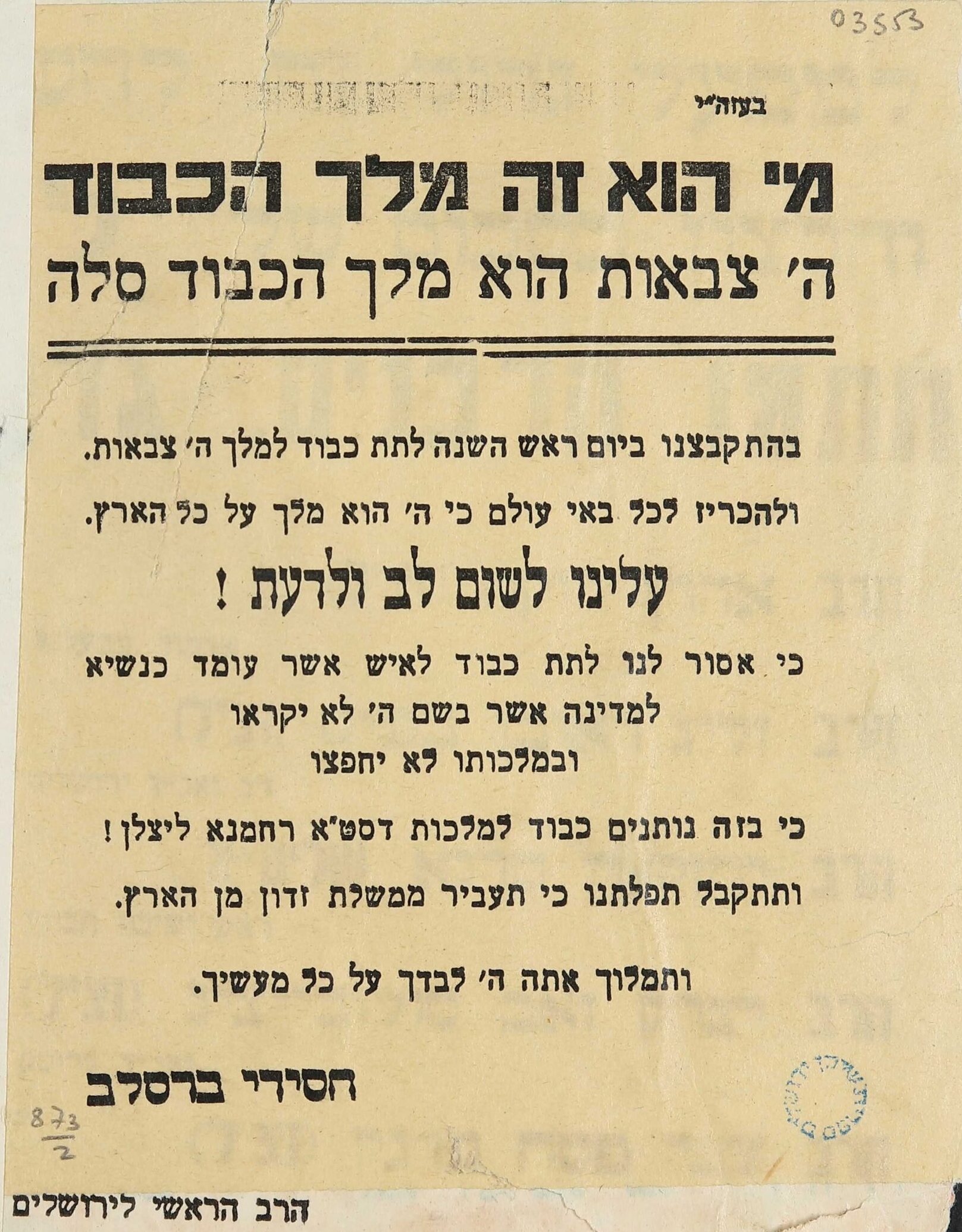
On the eve of Rosh Hashana in 1964, a pashkevil (protest poster) signed by “Breslov Hasidim” was hung in the streets of Jerusalem’s ultra-Orthodox Me’a She’arim neighborhood. Its contents contrasted the honor befitting the Master of the Universe, whose Kingship is the central theme of the Jewish New Year, with that of the president of Israel, who – as far as the authors were concerned – deserved no such honor. “We are forbidden,” they wrote, “to honor the man who stands as president of a country that neither calls on God’s name nor desires His Kingdom.”
In the 1960s, Breslov Hasidism had yet to impact Israeli society. Based in Bnei Brak and Jerusalem, the small, poor, and insular sect was still recovering from its expulsion from the Old City by the Jordanian Legion in Israel’s War of Independence. What, then, did this group of Hasidim want with Israel’s president – and why now?
No Stranger
The previous year, as mentioned in an article published in the Maariv daily, President Zalman Shazar had walked from his home in Jerusalem’s Rehavia district to the Breslov shul in Me’a She’arim for the New Year evening service. Accompanied by two policemen, he was warmly welcomed by both the regular Hasidic worshippers and onlookers who’d come to see him.
In 1964, however, Shazar received a very different reception. A few Hasidim, utterly opposed to sharing sacred space with the ultimate representative of the State of Israel, handed him the pashkevil and sent him packing. That was the last time President Shazar prayed at the Breslov shul on Rosh Hashana, as he’d done since the 1950s, long before his presidency.
Schneur Zalman Rubashov, who’d Hebraized his name to the acronym Shazar, had always been deeply connected to Hasidism. Born in 1889 to a Chabad Hasidic family, he was named for the sect’s founder, Rabbi Schneur Zalman of Liadi. Shazar and his siblings received a secular education, which they deemed in no way contradictory to their Hasidic leanings. Yet as he became more involved in Jewish nationalism and the Zionist movement, Shazar moved away from Chabad.
The president later reconnected with Lubavitch leader Rabbi Menachem Mendel Schneerson and his followers in New York and Kfar Chabad and stayed in close touch. At the same time, he was smitten with Breslov Hasidism and forged a firm friendship with Rabbi Yisroel Dov Ber Odesser, who originated the well-known Breslov chant “Na-nah-nahma-Nahman-me-Uman” (which he claimed to have received from Breslov founder Rabbi Nahman, who’s buried in Uman, in Ukraine). It was Rabbi Odesser who, as a leader of the Breslov community, had invited Shazar to join the faithful for Rosh Hashana prayers in Me’a She’arim.
Shazar had been interested in Jewish studies since his youth, when he joined the first cohort of the Academy for Jewish Studies in St. Petersburg alongside such future luminaries as the Hebrew University’s Prof. Yehezkel Kaufmann and American Jewish historian Prof. Solomon Zeitlin. Refusing to see Zionism as an alternative to Diaspora Judaism, he emphasized the movement’s role in bridging tradition and innovation. As minister of education and culture, Shazar therefore worked to strengthen ties between foundational Jewish texts and the new Hebrew culture.
As president, Shazar founded a study group focused on Diaspora Jewry and hosted a Bible study circle established by David Ben-Gurion. Shazar’s Judaism wasn’t necessarily halakhic, but he was committed to preserving and passing on Jewish tradition, culture, languages, and literature both in Israel and beyond.

Remade by Breslov
A copy of the pashkevil denouncing Shazar found its way into publisher Salman Schocken’s library. A German businessman, Zionist, and philanthropist, Schocken had been a cornerstone of the German Jewish renaissance between the world wars. His relationship with author S. Y. Agnon (whom he supported financially) led Schocken to branch out into Hebrew publishing. In 1934, Schocken relocated to Jerusalem and entered public life in the pre-state Jewish community. He also began moving his extensive library from Berlin to his new home.
For both Schocken and Shazar, Judaism was as much a culture as a religion. Although very different in character and in their attitude toward religion, these two men believed wholeheartedly that secular, Zionist Judaism had to be rooted in Jewish history and tradition. The pair also shared a special kinship with Breslov Hasidism.
Not yet a Segula subscriber?
Access our full archive online, have print issues delivered to your door, and moreFeel free to share