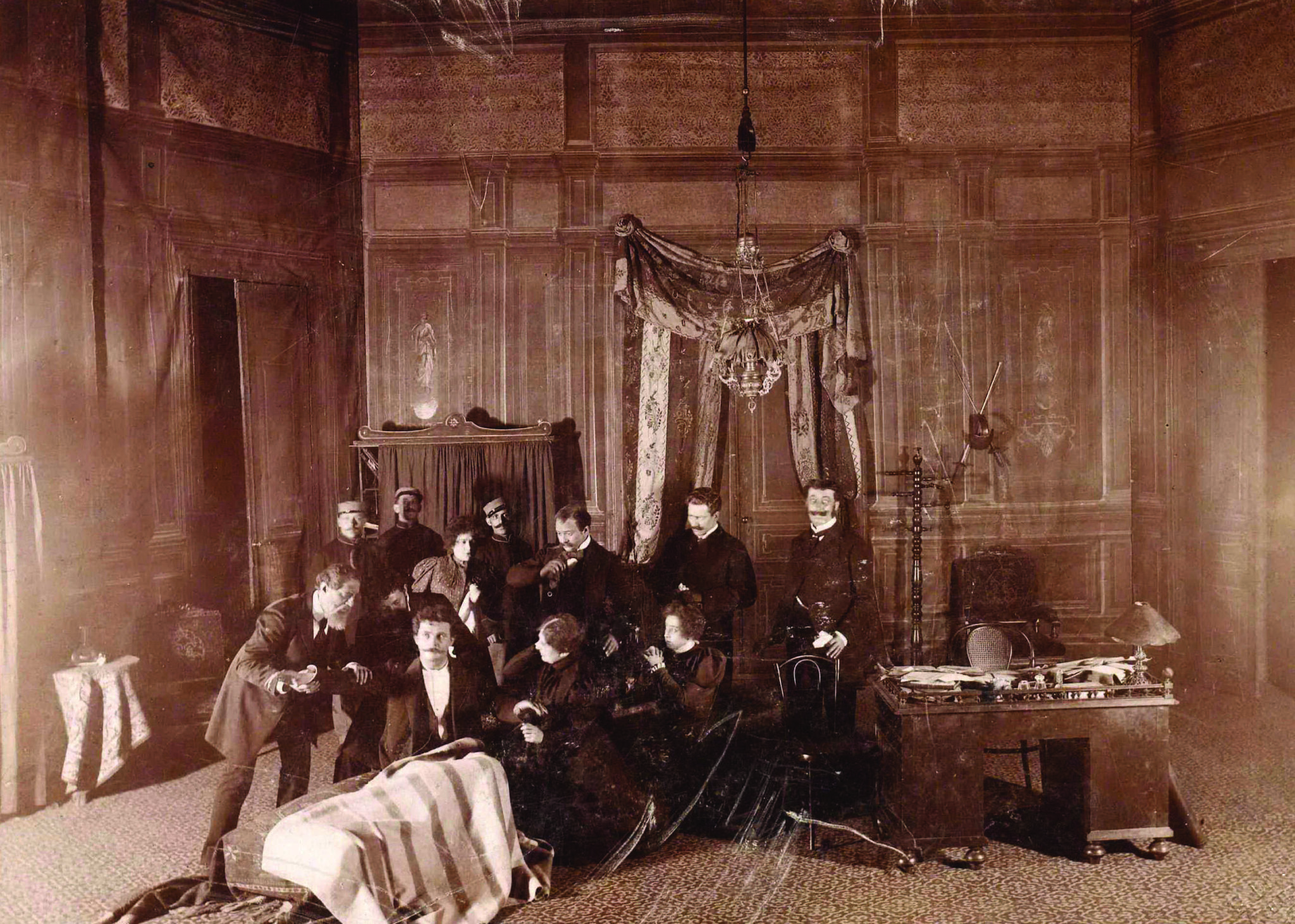
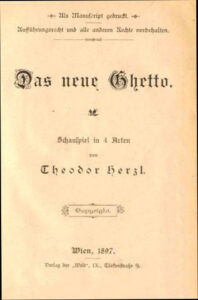
Writing The New Ghetto clearly changed Theodor Herzl. Could this forgotten play have been the crucible that forged The Jewish State?

Surprisingly, prior to October 1894, even Theodor Herzl didn’t think a Jewish state was possible. On October 17, reviewing a play for his longtime employer, Vienna’s Neue Freie Presse daily, Herzl slammed the production for its unrealistic premise of a Jewish return from exile. In the illustrious drama critic’s eyes, the Jewish character in Alexandre Dumas the younger’s La Femme de Claude (1873) was beyond belief:
The good Jew Daniel wants to find the old tribal home and lead his brethren back to it. But a man like Daniel would know that the Jews have nothing to do anymore with the historic homeland. It would be childish to go looking for its geographic location; any schoolboy knows where to find it. But if the Jews were ever really to “return,” they would discover the very next morning that they had long ago ceased to be one people. For centuries they have been rooted in diverse nationalities, different from one another, their similarities maintained only as a result of outside pressure. All oppressed people have Jewish characteristics, and when the pressure lifts, they behave like free men. (quoted in Ernst Pawel, The Labyrinth of Exile, p. 198)

Internal Eruption
A mere month later, after penning The New Ghetto in just seventeen days (October 21–November 8, 1894), an astounded Herzl reflected in his journal:
I had thought that through this eruption of playwriting I had written myself free of the [Jewish] matter. On the contrary, I got more and more deeply involved with it. The thought grew stronger in me that I must do something for the Jews. For the first time, I went to the synagogue in the Rue de la Victoire and once again found the services festive and moving. Many things reminded me of my youth, and the Tabak Street temple at Pest. (Theodor Herzl, The Complete Diaries of Theodor Herzl, trans. Harry Zohn, vol. 1, p. 11)
Herzl was a week into The New Ghetto when news broke of Alfred Dreyfus’ arrest on October 29. Like everyone else, the playwright presumed Dreyfus guilty. The infamous trial began in December, when the play had been finished for over a month. In late April 1895, mere weeks after completing his second draft, Herzl sat down and almost manically dashed off The Jewish State. Herzl’s diaries scarcely mention the Dreyfus trial and subsequent campaign, which took off only when new evidence of the defendant’s innocence emerged in 1896, well after publication of The Jewish State.
So it seems to have been The New Ghetto, not the Dreyfus Affair, that transformed Theodor Herzl. Both historian Jacques Kornberg and author Georges Yitzhak Weisz have suggested as much. But how did that change come about?

The synagogue in Paris’ Rue de la Victoire reminded Herzl of his Budapest childhood | Photo: FLLL

Encountering the idea of a return to Zion in a play by Alexander Dumas the younger, Herzl rejected it out of hand. Dumas the younger, portrait from Vanity Fair magazine
Dueling to the Death
Few know that aside from being a Zionist visionary, Theodor Herzl was a recognized playwright, whose works – usually fairly light and amusing – were performed in Vienna’s greatest theaters. From ages twenty to thirty-five, Herzl wrote almost one play a year; His Majesty (1886), The Poachers (1889), and What Will People Say? (1890), to name a few. But after the failure of The Lady in Black (1890), he lost confidence. His first child, Pauline, was born at this time, and shortly afterward, his close friend Heinrich Kana committed suicide.
Overwhelmed by the changes and crises in his life, Herzl abandoned the stage and accepted an offer from the Neue Freie Presse to serve as its Paris correspondent. Seeking new direction, he found it in covering a financial scandal then electrifying the French capital and involving the Panama Canal Company.
This French project, pioneered by Ferdinand de Lesseps on the heels of the celebrated Suez Canal, was financed by stock options. But the canal works went way over budget, resulting in the company’s 1889 bankruptcy and heavy losses to most investors. Until then, middlemen bribed a slew of politicians to keep the project afloat with further bond issues. Many Jews were party to the corruption, including one Jacques de Reinach, who gave newspaperman Édouard Drumont a list of the politicians implicated – and then committed suicide.
Drumont had authored the virulently anti-Semitic La France Juive, published in 1886 to great acclaim. Riding on his success, he founded La Libre Parole (Free Speech), an obscure daily that became famous overnight thanks to its revelations regarding the wheeling and dealing surrounding the Panama Canal.
Despite a months-long prison sentence intended to silence him, Drumont continued naming names, prolonging the agony by publishing a new one every day. La Libre Parole’s sales soared – an achievement Drumont repeated with his paper’s scathing coverage of the Dreyfus Affair two years later.
The Paris air crackled with anti-Semitism. On May 25, 1892, editors of La Libre Parole and the Marquis de Morès, founder of the Anti-Semitic League of France, crashed Juliette de Rothschild’s wedding at the Synagogue de la Victoire. They insulted the guests, threw acid on women’s dresses, and distributed anti-Jewish pamphlets while screaming, “Death to the Jews!”
Days later, La Libre Parole called for the exclusion of Jews from the French army. Indignant protests followed, to which Drumont coolly responded: “Let the Jewish officers offended by our articles designate a number of delegates, and we will oppose them with an equal number of French swords” (quoted in “Mayer, the Forgotten Dreyfus,” Le Nouvel Observateur, July 1993).
Indeed, many partisans of Drumont, often aristocrats, provoked Jews into duels, forcing them to risk their lives against all odds.
In one such confrontation, the Marquis de Morès, a quasi-professional swordsman, engaged Armand Mayer, a young Jewish captain in the French army’s Engineering Corps and an engineering instructor at the prestigious École Polytechnique. Mayer sustained a fatal chest wound. His funeral on June 26 attracted unprecedented crowds, incensed by the officer’s pointless death. Two years afterward, Herzl used the incident as the basis of The New Ghetto.
Not yet a Segula subscriber?
Access our full archive online, have print issues delivered to your door, and moreFeel free to share