
The product of two worlds, New Christian Diogo Pires secretly delved into Jewish mysticism even as he rose through the ranks of Portuguese society. Then a visitor from the kingdom of the ten lost tribes of Israel tipped him over into outright messianism, and all was lost

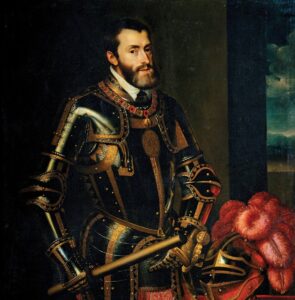
Despite the freezing December weather, crowds filled the alleyways leading to Mantua’s main square. The grisly climax of Charles V’s historic visit promised to be the best show in town. Holy Roman Emperor and ruler of Spain since age nineteen, Charles now held sway over much of the globe thanks to the Spanish maritime discoveries of the Americas and the East Indies. Frederico Gonzaga, the marquis recently promoted to duke in recognition of his many years of service to the crown, had gone out of his way to ensure that his royal guest receive every possible honor, and Charles’ stay in Mantua had exceeded all the emperor’s expectations.
This morning Frederico would receive his reward. Charles had made Mantua the seat of his final judgment on the handsome youth whose oratory had held the masses spellbound just a year earlier. Dressed like a Portuguese noble, confident in the pope’s protection, the fellow was rumored to have death-defying powers. Yet the stake erected during the night left no doubt as to the verdict, and the emperor had no intention of leaving anything to fate. As the prisoner was led to the platform, a hush fell over the throng. His hands and feet were bound, and his mouth muzzled, lest he escape by uttering some incantation, as he was said to have done before.
Who was this comely stranger, and why did his death so urgently concern the Holy Roman Emperor? Why did he attract such attention both in life and after his demise? Even in the Ottoman city of Safed, the angelic maggid who spoke God’s word from the throat of Rabbi Joseph Karo promised the great halakhist:
You’ll merit public martyrdom in the land of Israel in sanctification of My name, accepted as a worthy sacrifice upon My altar … as was Solomon My chosen one, who was named Molkho. (Maggid Meisharim [Vilna, 1880], pp. 92–3 [Hebrew])
Jews in All But Name
Solomon Molkho was born to a converso family in Portugal in 1501, four years after Jewish life there had suddenly ended. The country’s Jews were never driven out – they were too precious a resource for King Manuel I. Instead, though he issued an expulsion edict in 1496, he held onto them through forced conversion. (See “Once Bitten, Twice Shy – Portugese Jewry”.) For the next few decades, the king ignored whatever Jewish practices his New Christian subjects continued in private. Yet he did all he could to integrate conversos into Portuguese society, encouraging his favorite courtiers to marry into their ranks and recruiting them for a wide variety of royal positions.
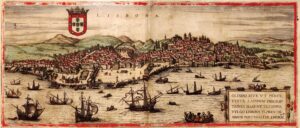
Molkho, whose given name was Diogo Pires, was born during this grace period, but his parents didn’t circumcise him. The family lived not far from Lisbon, then the cosmopolitan capital of a great empire stretching from the African coast all the way to India. The boy grew up against this vibrant cultural and political backdrop.
In 1521, at the tender age of twenty, Pires was made a judge of the appeals court, the highest recourse of Portuguese justice, which traveled with the king wherever he went. Pires’ selection reflected Manuel’s determination to embed his formerly Jewish subjects (many of whom had fled Spain in 1492) in Portuguese society while displacing certain elites, mainly the nobility. Pires’ writ of appointment calls him “Doctor Pires,” so presumably it was his winning combination of higher education and Jewish origins that gained him entry into the royal court.
Alongside his extensive legal knowledge, Pires was well-versed in Jewish law and literature. Unburdened at first by Christian supervision, Portugal’s conversos remained observant Jews behind closed doors, maintaining their customs in detail. One Portuguese refugee noted the painstaking observance of eruv tavshilin, a ceremony making it permissible to cook on a festival for the Sabbath immediately following. This Jew describes his community as learned, with a leader steeped in Jewish mysticism and magic. So not only was basic Judaism still passed down in Portugal in the years after forced conversion, but kabbalistic texts were still studied, and one could acquire a Jewish education both deep and broad. In fact, soon after Pires openly returned to Judaism, his knowledge amazed all who met him. Gedaliah ibn Yihye, the 16th-century Jewish historian, wrote:
… he would lecture in all the Italian and Turkish [Jewish] communities, uttering awesome insights into both the oral and written law – both mystical interpretations and superb and even surprising literal ones. No one had ever heard the like, and no one understood how [he could do so]. (Shalshelet Ha-kabbala [The Chain of Tradition] [Jerusalem, 1962], p. 103 [Hebrew])
Yet Pires remained uncircumcised well into adulthood. He lived between two worlds, not entirely at home in either. Though part of Portugal’s new political and social elite, he secretly delved ever deeper into Jewish mysticism. Yet he was in no hurry to take on the trappings of Judaism, symbolized by circumcision. All of that changed with the arrival in Portugal of David Ha-Reuveni.
Not yet a Segula subscriber?
Access our full archive online, have print issues delivered to your door, and moreFeel free to share