

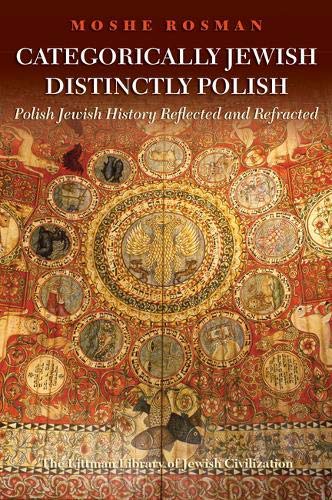
Categorically Jewish, Distinctly Polish
Polish Jewish History Reflected and Refracted
Moshe Rosman
Littman Library of Jewish Civilization, 2022, 523 pages
In a rare and fascinating overview of his field, Moshe Rosman evaluates changes in the study of Polish Jewry and the perceptions altered by his own distinguished research as well as others’. He shows where and why his research has diverged from the norm, the most obvious distinction being generational. Thus, Dubnow, Dinur, Buber, and Scholem are contrasted with current research methods and focus, and material produced by European Jewish scholars in the aftermath of the Holocaust is differentiated from postwar output in the U.S. and Israel.
The sea change, Rosman points out, has been a move away from viewing the Jewish experience as unique and therefore analyzing its fluctuations solely within the context of Jewish communities. (This shift has been facilitated by post–cold war access to Polish archives, which led Rosner to the discovery for which he himself is rightly famous: Polish census data listing Israel Baal Shem – the first historical proof of the existence of Hasidism’s legendary founder.) Instead, scholars are now examining Polish Jewish communities as part of a colorful and complex Polish society. This multiethnic approach allows non-Jewish Polish speakers into the academic discussion, and research involving Polish and Israeli academics as well as Americans has transformed some of the field’s assumptions.
For example, researchers now think that Jewish life in Poland was basically stable and secure, albeit rudely interrupted by periods of violent persecution. The fact that these attacks were the exception rather than the rule is key to understanding that Jews in Poland were often better off, better educated, and better able to protect their interests than many other, larger segments of the populace. This leverage also explains Polish Jewry’s impact on its surroundings, such as in interactions between the Polish Sejm, or parliament, and the Council of the Four Lands, which represented the Jews.
All these new academic approaches to Polish Jewry have been the subjects of Rosman’s own research, examples of which follow in chapters on the authority of the Council, and Jews in Sejm, women in the Jewish community, and the rise of Hasidism.
Not yet a Segula subscriber?
Access our full archive online, have print issues delivered to your door, and moreFeel free to share