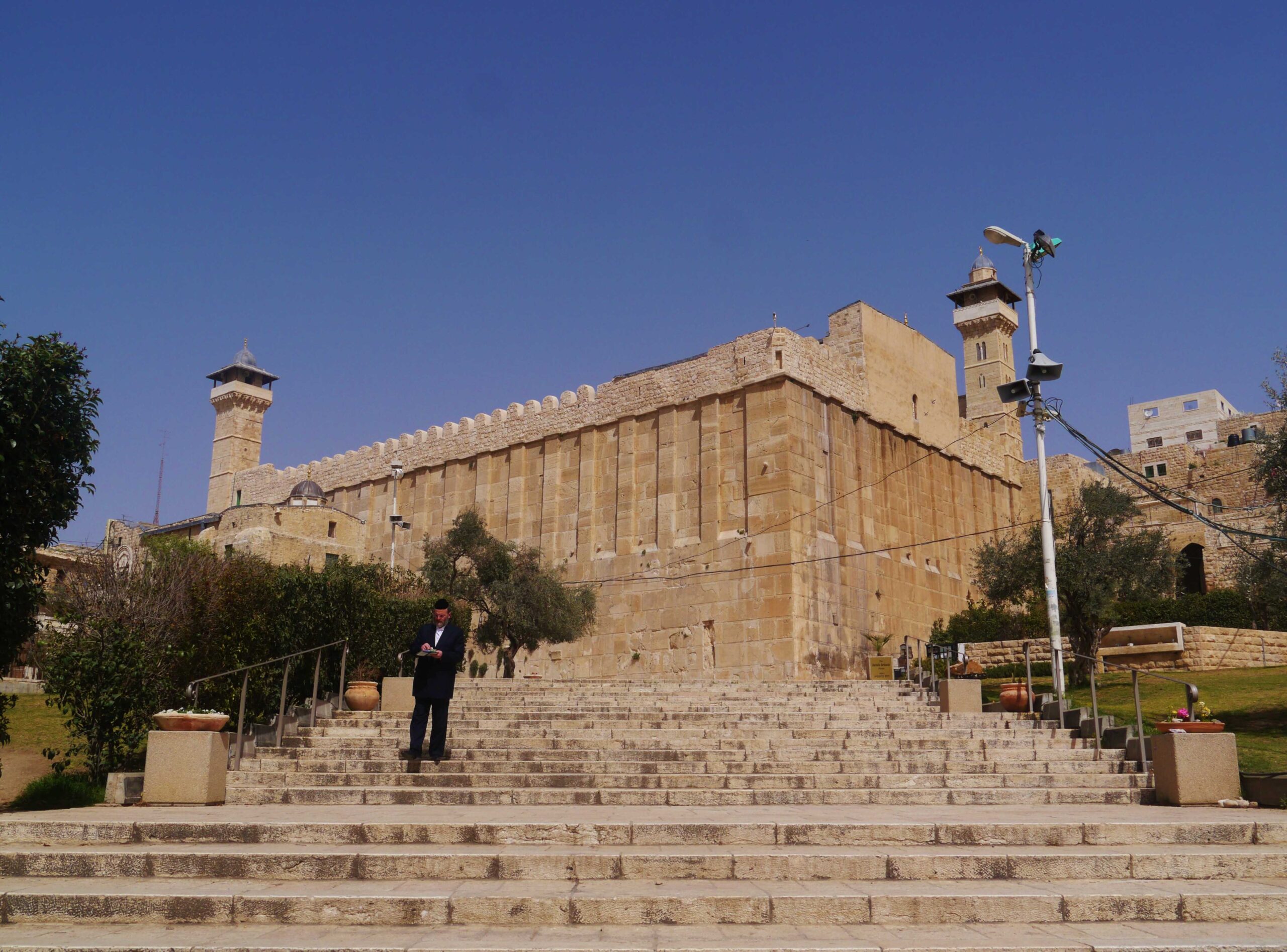
Generations of rulers and believers have added layers of construction to the Tomb of the Patriarchs in Hebron, but mystery still shrouds the original cave’s dark depths

Where To?
Cave of the Patriarchs
Sacred historic site in Hebron

Few in the Israeli religious school system complete first grade without learning about the biblical Abraham’s insistence on paying Ephron the Hittite cash for the Cave of Machpelah, in Hebron, as a burial site for the patriarch’s dear departed wife, Sarah. Wiley Ephron, offers the cave as a gift, but ultimately charges an exorbitant four hundred silver shekels and then pretends he’s the one being shafted. The lesson generally concludes with the well-known Talmudic comment that, ironically, Ephron did lose out, for Abraham’s investment in effect gave him a hold over the land of Hebron for eternity:
Rabbi Judah son of Rabbi Simon said: This is one of the three places regarding which the nations of the world cannot taunt Israel and say, “Ye have stolen them.” These are they: the Cave of Machpelah, the [site of the] Temple, and the sepulchre of Joseph. (Genesis Rabbah [Soncino] 69:7)
With the land deed firmly in hand, our ancestors have worshipped for generations at the graves of Abraham and Sarah, Isaac and Rebecca, and Jacob and Leah, all resting in peace in the depths of the cave of Machpelah (whose Hebrew name means “double,” alluding – according to Rashi – either to the cave’s two stories or to the couples buried there).
In the Second Temple period, Herod erected a magnificent edifice over the site, whose hewn-stone walls resemble those of his Temple complex in Jerusalem as well as another monumental structure he built just north of Hebron, home since the end of the First Temple era to his fellow Idumeans. All three landmarks feature signature Herodian elements too: enormous, smoothed ashlars with dressed borders, courses of stone slightly inset one atop another, and square pillars dispersed at regular intervals along the upper walls.

Between Cross and Crescent
With the onset of the Byzantine period, in the fourth century, it became painfully clear that other nations recognized neither the aforementioned transaction nor the rabbinic assertion of its legal effect. Instead, the site’s Jewish watchman was summarily dismissed, the building above the cave was divided in two, and an impressive basilica was built at its eastern end. Entry to the church was forbidden to Jews, but they retained access to the western side of the complex, as noted by an Italian traveler of the era, known only as the Piacenza Pilgrim. His sixth-century travelogue mentions Jews streaming into the Cave of Machpelah through a separate entrance.
In due course, the Byzantine basilica was conquered by Muslims, who converted it into the Mosque of Abraham. A few hundred years later, the Christians returned with a vengeance as Crusaders, only to be expelled in turn by a victorious Saladin at the close of the 12th century.
As the tombs changed hands, Jewish access depended on the whim of whoever ruled. Sometimes Jews were freely admitted and even permitted to add a few more bones to those already interred in the subterranean chambers hewn into the bedrock. Other times we were banned and could only gaze longingly from a distance in the direction of our forefathers. Famed Jewish medieval tourist Benjamin of Tudela visited the Holy Land in 1170, at the height of Crusader power, and described Christian misconceptions regarding the sacred tombs and the building’s upper and lower levels:
The Gentiles have erected there six tombs, respectively called those of Abraham and Sarah, Isaac and Rebekah, Jacob and Leah. The custodians tell the pilgrims that these are the tombs of the Patriarchs, for which information the pilgrims give them money. If a Jew comes, however, and gives a special reward, the custodian of the cave opens unto him a gate of iron, which was constructed by our forefathers, and then he is able to descend below by means of steps, holding a lighted candle in his hand. He then reaches a cave, in which nothing is to be found, and a cave beyond, which is likewise empty, but when he reaches the third cave behold there are six sepulchres, those of Abraham, Isaac and Jacob, respectively facing those of Sarah, Rebekah and Leah. […] A lamp burns day and night upon the graves in the cave.
One finds there many casks filled with the bones of Israelites, as the members of the house of Israel were wont to bring the bones of their fathers thither and to deposit them there to this day. (Nathan Adler, The Itinerary of Benjamin of Tudela: Critical Text, Translation and Commentary [Feldheim, 1907], pp. 41–42)
Up to the Crack in the Wall
This uneasy arrangement between Jews and Christians continued until the the 13th century, when the Mamluk dynasty conquered the land of Israel in, booting both groups out of the Cave of the Patriarchs.
The Mamluks added their own traditions to the site’s rich history. To prove that Joseph too was buried here, they named a cenotaph for him at the southwest end of the building. They also extended the complex by constructing another mosque at its northern edge, erected minarets that still pierce the Hebron sky, and divided the central structure into separate halls.
Not yet a Segula subscriber?
Access our full archive online, have print issues delivered to your door, and moreFeel free to share