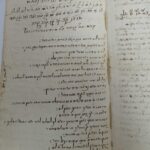

Nestled in the botanical gardens on the Hebrew University’s Mount Scopus campus is a small burial cave dating from the Second Temple period. A century ago, this ancient site briefly came to life

Where To?
Nicanor’s Cave
Second Temple tomb where Leon Pinsker and Menahem Ussishkin are buried

Though the Mount Scopus Group sounds like a network of professors working out of the Hebrew University campus located on said mountain in northern Jerusalem, the term actually describes a geological layer running (mostly) through southern Israel. “Only” a few dozen million years old, the stratum stretches from the northern Negev to the Upper Galilee and is named after a Jerusalem mountain composed entirely of the white limestone that typifies the city’s modern construction. Known in full as the gloriously obscure “Senonian-Palaeocene Mount Scopus Group,” the rock is distinguished mostly by its chipping and flaking. This property makes it more or less useless, unless you want to dig out a cave relatively easily. That’s why generations of Jerusalemites encountered the Mount of Olives Ridge, including Mount Scopus, only at the end of their lives – unless they happened to be cave diggers.

Whose Bones in the Box?
This lengthy introduction is necessary to explain an ancient Jewish burial cave in a small clearing in the Hebrew University’s botanical gardens on Mount Scopus (not to be confused with the much larger, more impressive, and better maintained botanical gardens adjoining the university’s second campus, on Givat Ram). The cave’s five adjoining rooms served as a family plot, boasting enough comfortable niches to accommodate the blessed remains of generations of expired grandparents. The ceiling at the entrance to some of these cozy chambers has collapsed, as is to be expected of limestone, but the pillars once supporting the facade stand firm.
So what lucky family secured the best view in Jerusalem for their deceased?
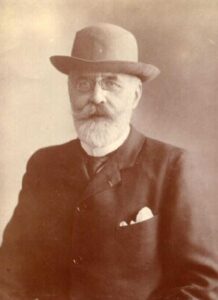
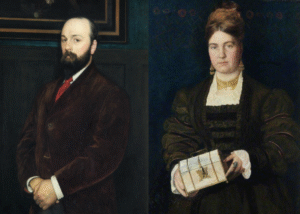
Way back in October 1902, Mount Scopus was graced by a winter estate belonging to a Protestant couple from Liverpool. John Gray Hill was a lawyer and lover of the Holy Land with a soft spot for Zionism. His wife, Caroline Emily, was a gifted artist and photographer. That fateful winter, their staff prepared the mansion for their imminent arrival, including cultivating a small, adjacent vegetable patch.
The result should have been nothing more than a few pumpkins, but while digging, one of the servants stumbled upon the cave. Everyone gathered round, was suitably amazed, and quickly telegraphed the Gray Hills that they were now the proud owners of an ancient crypt. John immediately contacted the British consul in Jerusalem, John Dickson, and asked him to arrange an exacavation. Seeing a historic opportunity, Dickson turned not to one of Jerusalem’s antiquities specialists but to his own daughter, a budding archaeologist.
Gladys Dickson assumed that graverobbers had long since beaten her to the spot, so the tomb would be empty. Imagine her astonishment when no fewer than seven stone ossuaries presented themselves (see “By the By,” p. 67). Three were ornamented with plant motifs, and three were unadorned. Most remarkable, however, was the final ossuary, bearing an ancient Greek inscription plus two words written in Hebrew. The young scholar concluded that this was a Jewish tomb from the first century ce, i.e., the end of the Second Temple period.
Miss Dickson’s discovery caused quite a stir. Robert Alexander Stewart Macalister, director of the Palestine Exploration Fund, immediately stopped excavating Tel Gezer and raced to Jerusalem. Brushing Gladys off, Macalister took over, sending a photo of the inscription to Charles S. Clermont-Ganneau, a world-famous French Orientalist. Clermont-Ganneau’s interpretation rocked the Jewish world: the ancient ossuary bore a Greek greeting straight from a famous Talmudic passage – “These are the bones of Nicanor of Alexandria, who made the doors.” Beneath this line, the Hebrew characters spelled “Nicanor Alexa.”
A beloved Talmudic legend tells of a rich Jew named Nicanor who lived in Alexandria in Second Temple times. One fine day, he decided to up and leave the fleshpots of Egypt and journey to the land of his forefathers. To beautify the Temple, he brought with him two enormous, wooden doors encased in burnished copper. These fabled portals stood for many years at the entrance to the court of the Israelites in the Temple, even when all the other doors were upgraded to solid gold. That’s because of the miraculous arrival of these two gifts in Jerusalem:
When Nicanor brought them from Alexandria, in Egypt, a great wave arose in the sea to drown them. One [door] was taken and flung into the sea, and [the sailors] were about to cast off the other, but Nicanor stayed their hand. “If you throw in the other,” he told them, “throw me in with it!” He grieved constantly [over the lost gate] until he came to the port of Jaffa. When they reached the Jaffa shore, [the door] floated up and surfaced from under the ship […]. And when Nicanor reached the port of Jaffa, [the sea] spat it out onto the land. (Tosefta, Yoma 2:3–4)
Not yet a Segula subscriber?
Access our full archive online, have print issues delivered to your door, and moreFeel free to share