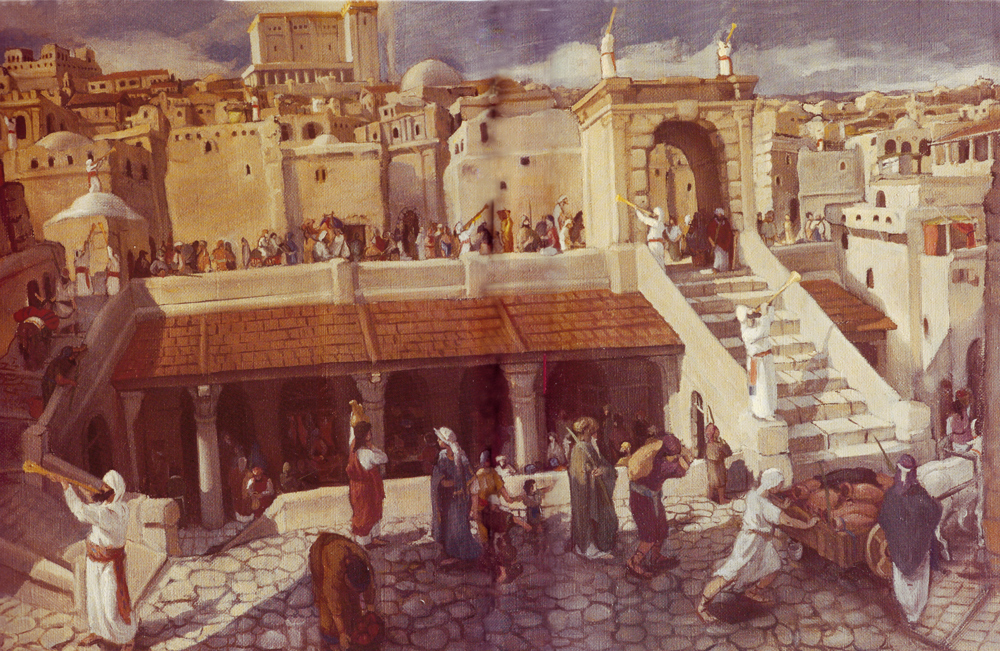
As we follow in the footsteps of the Second Temple period pilgrims, the archeological remains of ancient Jerusalem bring their experience vividly to life. The roads they travelled, the ritual baths, the steps they climbed – all still bear poignant witness to the vibrant pageant of the pilgrims’ progress

It is difficult for us to imagine how the Biblical command of Aliya LeRegel, or pilgrimage, impacted on the lives of Jews some two thousand years ago. When we picture Pesach, we think of the family seated around the Seder table. Sukkot brings to mind the backyard booth filled with relatives and neighbors. Shavuot is blintzes and all night learning. But if we were to transport ourselves back to the times when the Temple was standing, preparation for the holiday season would not consist of frantic shopping, cooking and cleaning. Rather we would be packing our tent and saddling up the family donkey as we set out on our journey to Jerusalem.
Actually, once the Jewish people spread throughout the Diaspora, it was impractical for many people to embark on the pilgrimage that often. The trip from Babylonia could take up to three weeks. Imagine arriving home three weeks after the end of Passover, only to have to turn around again and return for Shavuot! Yet despite the fact that many Jews could not go for every holiday, all Jews attempted to go to Jerusalem when they could. And for those who couldn’t make it one year, the law provided a vicarious way to be involved – the half shekel tax.
Donate and Partake
The pilgrimage “season” officially began with the holiday of Pesach. Six weeks prior to that, at the start of the Hebrew month of Adar, preparations would begin: “On the first of Adar, they would announce the gift of shekalim…” (Mishna Shekalim 1:1)
All Jewish adult males were required to give an annual tax to the Temple. Although this idea originated in the book of Exodus, when money was used as a method of counting the people, by the late Second Temple period the amount was fixed at a half a silver shekel per household. Since the value of coins in the ancient world fluctuated, the rabbis mandated that the only coin that could be used to pay the tax was a silver half shekel minted in Tyre (in Lebanon of today), a city that was known to have a reputable mint. These coins, which had a striking design of an eagle on one side, have been discovered on the ancient streets of Jerusalem. Caches of them have also been discovered elsewhere, for example in the Druse village of Ussafiya near Haifa. This makes sense since, as the Mishna explains, the coins were purchased at local moneychangers throughout the country:
On the fifteenth of Adar, moneychangers would sit in the country (outside Jerusalem), on the twenty-fifth they would sit in the Temple. (Ibid, 1:3)
The money collected for the half shekels was used for the many needs of the Temple and its service, but another goal of the tax was to enable all Jews, even those who lived too far away to make the pilgrimage on a regular basis, to feel a connection to the Temple.
The Way to Jerusalem
What was Aliyah LeRegel like for those who did make the trip? Piecing together the text of the Mishna with information from the archaeological finds of the past few decades, we can reconstruct the pilgrim experience. Jews would arrive in Jerusalem, often with whole families in tow, from all over the Diaspora as well as the Land of Israel. Jews living in Egypt, Babylonia, Asia Minor, even as far away as Rome would mingle with Jews from the land of Israel. Imagining a typical pilgrim and his family, we can follow in their footsteps as they make their way to the Temple.
The Sanhedrin was charged with preparing the roads for the travelers: “On the fifteenth of Adar… they repair the roads… and the ritual baths… and mark the graves .” (Ibid, 1:1)
Everyone was allowed to ascend to the Temple Mount with the proviso that he or she was ritually pure. Therefore, working ritual baths were crucial, as was the clear marking of graves so that those travelers who were already pure were not defiled by accidentally stumbling upon a grave. A beautiful illustration of this mishna was discovered a few decades ago between the towns of Alon Shvut and Elazar in Gush Etzion. Derekh HaAvot, the Path of the Patriarchs, wends its way from here towards Jerusalem. This is the ancient north-south road through the center of the country, leading from Beersheba to Jerusalem via Hebron and continuing north towards Shechem (Nablus). Recent theories suggest that it was part of a system of paths made and maintained specifically for the use of pilgrims headed for Jerusalem.
By the time any pilgrim coming from the southern part of the country reached this portion of the road, they were about a half-day’s journey from Jerusalem. Here, at the roadside, with no settlement nearby, the most impressive ritual bath in Israel was discovered.
The installation is enormous, with two arched entrances and two separate staircases leading to the pool, one for those descending in an impure state, and one for those ascending, purified and prohibited from contact with anyone still impure. Such a large and elaborate mikveh in such a location could only be intended for the use of travelers, and it is a poignant reminder of the vibrant scene here two thousand years ago.

The Pool of Meeting and Greeting
When our pilgrim family arrived in Jerusalem, their first stop was likely to have been the Siloam (Shiloach) Pool at the southern edge of the city. This pool is fed by the Gihon Spring, the only spring in Jerusalem. The water had been diverted to the pool by King Hezekiah in First Temple times, but a new and more impressive structure was built in the late Second Temple period. The large rectangular structure with steps leading down to it on all sides was discovered about ten years ago by Ronnie Reich and Eli Shukron, two archaeologists working in the City of David, who happened to be present when municipality workers mending a broken pipe, came upon the beautifully carved steps. Reich and Shukron excavated the pool and then continued to excavate, following the paving stones from the pool to uncover the street leading up to the Temple.

Not yet a Segula subscriber?
Access our full archive online, have print issues delivered to your door, and moreFeel free to share