
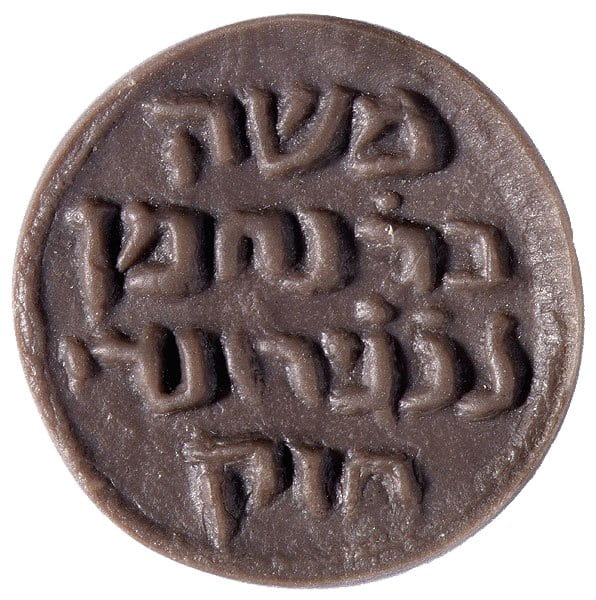
Two letters sent by Nahmanides to his sons provide a glimpse of his personal life
Nahmanides’ scant surviving personal correspondence includes the following two letters to his sons, Nahman and Shlomo (Solomon).
Writing to Nahman in 1267, his father tells of his arrival in the land of Israel and the conditions he found there. The letter reflects its author’s deep melancholy at the ruinous state of the Holy Land, ravaged by recent conflict between Crusaders and Islamic forces as well as a Mongol invasion. Nahmanides concludes with greetings to his brother-in-law and an interesting aside.
The letter to Shlomo is one of a pair of bequests to Nahmanides’ sons. The bequest to Nahman, known as “Nahmanides’ Epistle,” urges this pious son to embrace humility, fear God, and honor his fellow man. By contrast, Nahmanides’ farewell to Shlomo, quoted below, beseeches him not to neglect more basic duties such as daily prayer and chastity in his role of attendant to the king.
Letter to Nahman: Rebuilding the Ruins
May the Lord bless you, my son Nahman, to “see the goodness of Jerusalem” (Psalms 128:5). May you see grandchildren, and may your table be as [welcoming] as that of our forefather Abraham.
I write you [. . .] from the holy city of Jerusalem. Praise and thanks be to the Rock of my Salvation, I was privileged to arrive safely on the ninth of the month of Elul and will stay [here] in peace until the day after the Day of Atonement, when I plan to go to Hebron, burial city of our patriarchs, and prostrate myself before them and dig myself a grave there, God willing.
What shall I tell you of the land? Desolation and ruin abound. Generally, the holier the place, the greater its neglect. Jerusalem is the most desolate of all (and the Judean Plain more than the Galilee), yet in all its devastation it is still goodly and has close to two thousand inhabitants. Some three hundred are Christians, refugees from the sultan’s sword. There is no [Jewish community] within [the city walls], for the Jews all fled when the Tartars [i.e., the Mongols] came, and some [Jews] were killed by their swords. Only two [Jewish] brothers, dyers, have purchased a dyeing license from the governor, and up to a quorum of [ten] worshippers are added to pray on Sabbaths and festivals in their home.
Behold, we encouraged them and found a derelict house with marble pillars and a fine dome, which we took for a synagogue (for the entire city is unclaimed property, and whoever wishes to secure any of the ruins can acquire them). We raised funds to repair the building, and they’ve already started sending word to Nablus to bring the Torah scrolls smuggled there from Jerusalem when the Tartars came. Thus the synagogue will be established, and [Jews] will worship there. For many come to Jerusalem on a regular basis, men and women from Damascus and Aleppo and all over the land, to see [the site of] the Temple and weep over it.
May He who graced us to see Jerusalem in its destruction grant us the privilege of seeing it restored and rebuilt, when the glory of God’s Shekhina returns to it. May you, my son, your brothers, and your father’s house all be blessed with the goodness of Jerusalem and the comfort of Zion.
[Signed] Your father who worries and forgets, sees and rejoices,
Moses son of Rabbi Nahman, may he rest in peace
And send my greetings to my “son” and pupil Rabbi Moshe son of Rabbi Shlomo, your mother’s brother. Tell him from me that I climbed the Mount of Olives where it faces the Temple Mount nearby, with only the Valley of Jehoshaphat between them, and there opposite the Temple I recited [Rabbi Moshe’s] verses, weeping copiously just as he “prophesied.”
May He who made His name dwell in the Temple increase and multiply your welfare and that of the entire congregation of your holy and honorable city, and may your peace increase forever and eternally, Amen. (Nahmanides, Writings, ed. H. D. Chavel, vol. 1, pp. 367–68 [Hebrew])
Letter to Shlomo: Keep My Likeness Before You
“As a father punishes his son, so the Lord your God afflicts you” (Deuteronomy 8:5). May He bless you, guard you from sin, and save you from retribution.
Behold, our lord King David bore a wise and understanding son like none before or since, yet he commanded him, saying: “And keep the charge of the Lord your God, walking in His ways [and] observing His statutes, commandments, judgments, and testimonies, as written in the law of Moses, that you may prosper in all that you do and wherever you turn” (I Kings 2:3). And he also told him, “And you, Solomon my son, know you the God of your father, and serve Him with a perfect heart and a willing mind; for the Lord searches all hearts and understands the thoughts of every creature; if you seek Him, He will be found by you; but if you forsake Him, He will cast you aside forever” (I Chronicles 28:9).
My son, measure yourself against Solomon, and you will find that you are a worm, not a man (Psalms 22:6), a creeping thing from the vermin of the earth. Nevertheless, if you seek Him, He will raise you up from on high and make you great, and if you forsake Him, you will surely be thrown aside and forsaken.
My son, take care to recite the Shema morning and evening and pray three times a day. Say a blessing over your food before and after eating, according to the law. Under all circumstances, my son, read the weekly Torah portion every Sabbath without fail, and keep an accurate copy of the Pentateuch with you wherever you go. Let it not depart from your mouth, and pore over it day and night. Then your path will be successful, and you will be wise.
My son, “Cast your burden on the Lord” (Psalms 55:23), and consider that which is within your grasp as if it were far beyond your reach. Know that even your mouth is not your own, and even your hands are not in your control, but all is in the hands of God. Let your heart always be aware that “unless the Lord builds a house, its builders labor in vain” (Psalms 127:1), but if the Lord builds it, its destroyers labor in vain. “Unless the Lord guards a city, the watchman stays awake in vain” (ibid.), but if the Lord guards a city, the watchman’s care is for nought.
Know that the early sages compared a king to fire. Take care to stand in the court in fear and uprightness. Be very wary of the young men, and never, ever follow in their ways.
Know that our God despises promiscuity. Evil Balaam found no better way to do evil to Israel than through the daughters of Moab, for whoever copulates with the daughters of the nations profanes the covenant of our patriarch Abraham.That is the reason for circumcision, and [he who violates that commandment] removes himself from the congregation of Israel, the people of the God of Abraham, and is called a traitor to God […], guilty […], a sinner […], and an abomination. He has desecrated God’s beloved holy ones and makes Heaven hate him.
My son, remember me always. Keep my likeness before you and never turn from it, and whatever you know that I abhor, my son, do not do. Be with me always, observe the commandments, and live. Let this verse always be upon your lips: “I am a stranger in the land; do not hide Your commandments from me” (Psalms 119:19).
May the good and beneficent God increase your peace and lengthen your days pleasantly, and may your honor and glory be as great as your desire and as I, your father who bore you, desires.
[Signed] Moses son of Nahman, may he rest in peace (ibid., pp. 369–71)
Feel free to share