Of all King Herod’s grandiose projects, the port of Caesarea was the most ambitious, especially from an engineering point of view. Why did Herod build it where there was no natural bay, and how did the port disappear in just one generation?

Wending its way up the Mediterranean coast, and weighed down with its cargo of Egyptian wheat, the great merchant ship was headed for Rome and its bustling grain markets. But why not detour, thought the Greek shipmaster, and see if the rumors of a new port on the shores of the kingdom of Judea were true? Even from a distance, he had to be impressed; the sudden appearance of a deepwater harbor where there was no natural bay was an engineering feat unprecedented in the ancient world.
As his barge entered the calm waters and laid anchor, the captain blinked at what he saw. Ship after ship, the vessels were ranged along the jetties and unloaded simultaneously. The port’s facilities were remarkably sophisticated, while the new city beckoned just beyond, its markets, circuses, and amphitheater tempting sailors ashore. His crew deserved a day or two to enjoy them, the shipmaster told himself, and his wheat might even fetch a good price. The city he’d discovered, Judean Caesarea, was everything it was cracked up to be and more.
These paragraphs are pure imagination, of course, but Caesarea probably indeed dazzled its first visitors. When was this port built and why, and how did it come to be destroyed so quickly?

The Royal Harbor
The story of Caesarea begins in the Hellenist period, when Alexander the Great’s successors ruled his vast empire. The city started out in the third century BCE as a small trading post named for Abdashtart, king of the Phoenician city of Sidon, on today’s Lebanese coast. Jewish sources called the town Shorshan Tower, while the Greeks used their version of its founding monarch’s name, yielding Strato’s Tower. The place is also mentioned in the Zenon Archive, a collection of papyruses left by an Egyptian official who traveled all over the ancient Near East on business in the mid-third century BCE. He describes a walled settlement with a sheltered anchorage and a secondary port to its north.
The Hasmonean king Alexander Janneus captured the town in 90 BCE, and Jewish rule continued until the Romans conquered Judea in 63 BCE. They upgraded Caesarea to a polis, a self-governing city, but the real turning point came after they installed Herod as king, and he embarked on a series of ambitious building projects. Caesarea was designed as a classic Roman metropolis, complete with an amphitheater, circuses, Roman baths, pagan temples, a theater, and the jewel in the crown – Herod’s mighty port.

Construction began in 22 BCE and was largely completed by 15 BCE, when Herod’s friend Mark Agrippa arrived for a royal tour. The last stone was in place five years later. Administered separately from the town, the harbor was directly controlled by Herod, and the fees and duties exacted from its customers flowed straight into his treasury. While scholars debate whether Herod’s rule (40–4 BCE) was benign or otherwise, all agree that when it came to impressing his Roman patrons, money was no object. But his endeavors had to be paid for – by heavy taxation and outright confiscation of property from Jerusalem’s wealthier citizens, including seizure of the Hasmonean palaces – facts that have made Herod decidedly unpopular among Jewish historians. None, however, would deny that his greatest technical achievement was the port of Caesarea and the surrounding township.
Given Herod’s Roman education and extensive diplomatic ties abroad, the port was crucial to his international strategy for Judea. Open seas were essential to his foreign policy, allowing him to place his kingdom at the center of a vast network of trade and diplomacy. He named the port Sebastos – a Greek translation of Augustus, the name taken by Julius Caesar’s successor – and dedicated it to the Roman emperor.
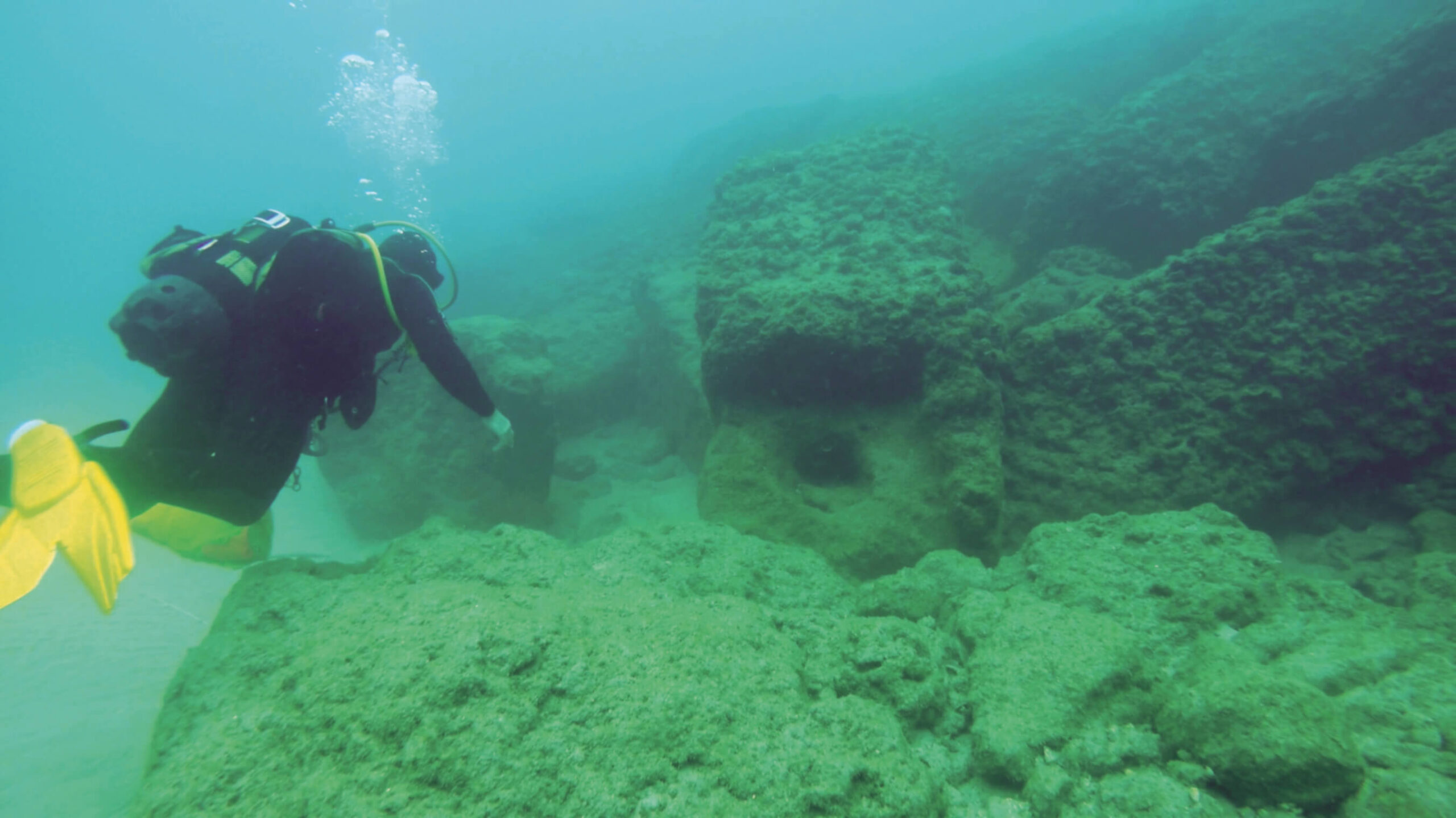
Herod’s vision could never have been realized without Roman technology, especially the mixing of hydraulic cement for underwater building. The method was described by Marcus Vitruvius Pollio, one of the greatest engineers of the time, in his book On Architecture, and the port of Caesarea is the earliest known example of the technique’s large-scale use. For the Jewish historian Josephus, the port confirmed Herod’s tactical brilliance in recognizing the necessity of Roman patronage for his kingdom’s development. The sheer mass of imports employed in constructing the artificial harbor, together with its phenomenal cost and extravagant inauguration, sent a message loud and clear – Judea was oriented first and foremost toward Rome.
His [Herod’s] notice was attracted by a town on the Caesarea coast, called Strato’s Tower, which, though then dilapidated, was, from its advantageous situation, suited for the exercise of his liberality. This he entirely rebuilt with white stone, and adorned with the most magnificent palaces, displaying here, as nowhere else, the innate grandeur of his character. (Josephus, The Jewish War [Loeb Classical Library, Harvard University Press, 1997], vol. 1, p. 193)

King Herod’s patron. Augustus, Julius Caesar’s adopted son, succeeded him as ruler of the Roman Empire and established the first Roman imperial dynasty. Augustus of Prima Porta, first century, now in the Vatican Museums | Photo: Till Niermann

Herod the Great | Etching, provenance unknown
Not yet a Segula subscriber?
Access our full archive online, have print issues delivered to your door, and moreFeel free to share