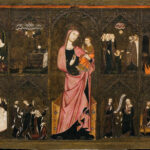

Once a Jewish hub with an international ambiance, now a Ukrainian provincial capital: a group of Israeli youths searching for the vestiges of Czernowitz’s Jewish glory found spectacular murals in what is today an Evangelical church.

Over the last eight years, groups of students have been setting off, under the auspices of the Zalman Shazar Center, to research the heritage of Jewish communities throughout the world. The goal is to document what remains of Jewish life in these places from an architectural, communal, cultural, human and historical perspective.
In August, 2009, a delegation traveled to Czernowitz, capital of the Bukovina region and formerly the easternmost district of the Austro-Hungarian Empire. Three weeks of photographs, measurements, sketches, and interviews resulted in a map of the community’s landmarks before World War II. Their work was also based on the comprehensive research previously undertaken in Czernowitz – but for the first time, that research was translated into an accessible format, enabling every visitor to identify the sites on a map.
People from Czernowitz say that when a local was asked what country he lived in, he answered, “I don’t know, I haven’t read the papers yet today…” During the twentieth century alone, Austro-Hungarian Czernowitz (or Csernovic) became Romanian Cernăuţi, Russian Chernovtsy, and finally, Ukrainian Chernivtsi. Yet in the historic Jewish memory, it remains Czernowitz – “the Vienna of the East” – with its small cafes, bustling cultural life and majestic synagogue. This is the Czernowitz whose native sons include Aharon Appelfeld and Avigdor Arikha, German-Jewish poet Paul Celan, and Yiddish poet Itzik Manger, all of whom were active there. It was a city of Zionists and anti-Zionists, Bundists and bourgeois, Orthodox and Reform, Hasidim and their opponents. Today, Bukovina is divided between different countries, and Czernowitz is no longer German-speaking; it is now a drab provincial capital in southern Ukraine.
Hasidism and Jewish Theater
At the dawn of the twentieth century, the Jewish community constituted over a third of the city’s population. Under the Habsburg emperors, the Jews gained rights and economic status. One expression of their prosperity was the gradual exodus of residents of the “Lower City” and its Jüdenstrasse (Jewish Street), historically the community’s main thoroughfare, to the “Upper City,” Czernowitz’s cultural and commercial center. The community’s majestic buildings adorned the town square and its wealthier neighborhoods. Jewish professionals enjoyed high social and political standing. Jewish theater, newspapers, and literature flourished alongside Hasidic courts and a traditional lifestyle.

This tremendous momentum ended with the outbreak of World War II. The Jews of Czernowitz were banished to the Lower City, which served as a ghetto. Thousands were murdered, and tens of thousands more were deported to concentration camps in Transnistria. Almost twenty thousand local Jews were saved by the Romanian mayor, Traian Popovici, who succeeded in convincing the regional governor that the Jews were important to the city’s economy.
To date, in the summer of 2009, the glory of Ukrainian Chernivtsi is still “Czernowitzian”; the city has been renovated beyond recognition for its 600th year anniversary celebrations. The Upper City’s stylish streets remind passersby of Central Europe’s elegant urban spaces. Yet almost no trace remains of the bustling cultural life in which Jews played such a leading part. The public Jewish buildings are still there, but have undergone major changes. The majestic synagogue in the city center has been turned into a movie theater. Not far off, in the city square near the opera house, the imposing Jewish communal edifice still stands; a small room at the building’s entrance serves the Jewish community as a museum, but the rest of the building belongs to the municipality. The iron railing running up the stairs attests to the vicissitudes the building has undergone: the stars of David that adorned it were lopped off by the Soviet regime. In recent years, the original railing was restored, but a number of truncated Jewish stars remain in place. The Jewish theater building in the Upper City served the community until 1950 and now stands deserted.
Not yet a Segula subscriber?
Access our full archive online, have print issues delivered to your door, and moreFeel free to share