Nothing fazed the potential immigrants from the bustling port of Thessaloniki (Salonica) – neither the draconian union contract they had to sign nor the possibility of working on the Sabbath, which they’d never done back home. Was their absorption into Palestine’s Jewish workforce a success story or sheer exploitation?

“The coast of Palestine rose on the horizon on a spring morning following one of the mild, soft nights common in the eastern Mediterranean. They stood together on the bridge of the yacht and stared steadily through their telescopes for ten whole minutes, looking always in the same direction.
“I could swear that that was the Bay of Acco over there,” remarked Friedrich.
“I could also swear to the contrary,” asserted Kingscourt. “I still have a picture of that Bay in my mind’s eye. It was empty and deserted twenty years ago. Still, that’s the Carmel on our right, and to our left is the town of Acco.”
“How changed it all is!” cried Friedrich. “There’s been a miracle here.”As they approached the harbor they made out the details with the help of their excellent lenses.
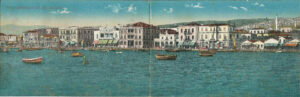
Great ships, such as were already known at the end of the 19th century, lay anchored in the roadstead between Acco and the foot of the Carmel. Behind this fleet they discerned the noble curve of the Bay. At its northern end, the gray fortress walls, heavy cupolas, and slender minarets of Acco were outlined in their beautiful ancient Oriental architecture against the morning skies. Nothing had changed much in that skyline. To the south, however, below the ancient, much-tried city of Haifa on the curve of the shore, splendid things had grown up. Thousands of white villas gleamed out of luxuriant green gardens. All the way from Acco to Mount Carmel stretched what seemed to be one great park. The mountain itself, also, was crowned with beautiful structures. Since they were approaching from the south, the promontory at first obscured their full view of the city and the harbor. When, at last, the landscape was revealed to them in its entirety, Kingscourt’s “Devils!” became legion.A magnificent city had been built beside the sapphire-blue Mediterranean. The magnificent stone dams showed the harbor for what it was: the safest and most convenient port in the eastern Mediterranean. Craft of every shape and size, flying the flags of all the nations, lay sheltered there.
Kingscourt and Friedrich were spellbound. Their twenty-year-old map showed no such port, and here it was, as if conjured up by magic. Evidently the world had not stood still in their absence.” (Theodor Herzl, Old-New Land, trans. Lotta Levensohn [New York: Bloch Publishing Co. and Herzl Press, 1941, pp. 37–8)
After a twenty-year absence, Kingscourt and Friedrich, the two heroes of Herzl’s utopian novel, revisit the Promised Land. They realize how much has changed when their ship approaches Haifa Bay – and its new port.
Herzl published Altneuland (Old-New Land) in 1902. Though no urban planner, he realized that a modern port could make Haifa the economic engine driving the Jewish state. Twenty years later, in 1922, British engineer Sir Frederick Palmer confirmed Herzl’s intuition. Sent by the Mandate government to choose the most appropriate location for a modern deepwater port, he selected Haifa Bay.
Whose Port Is It Anyway?
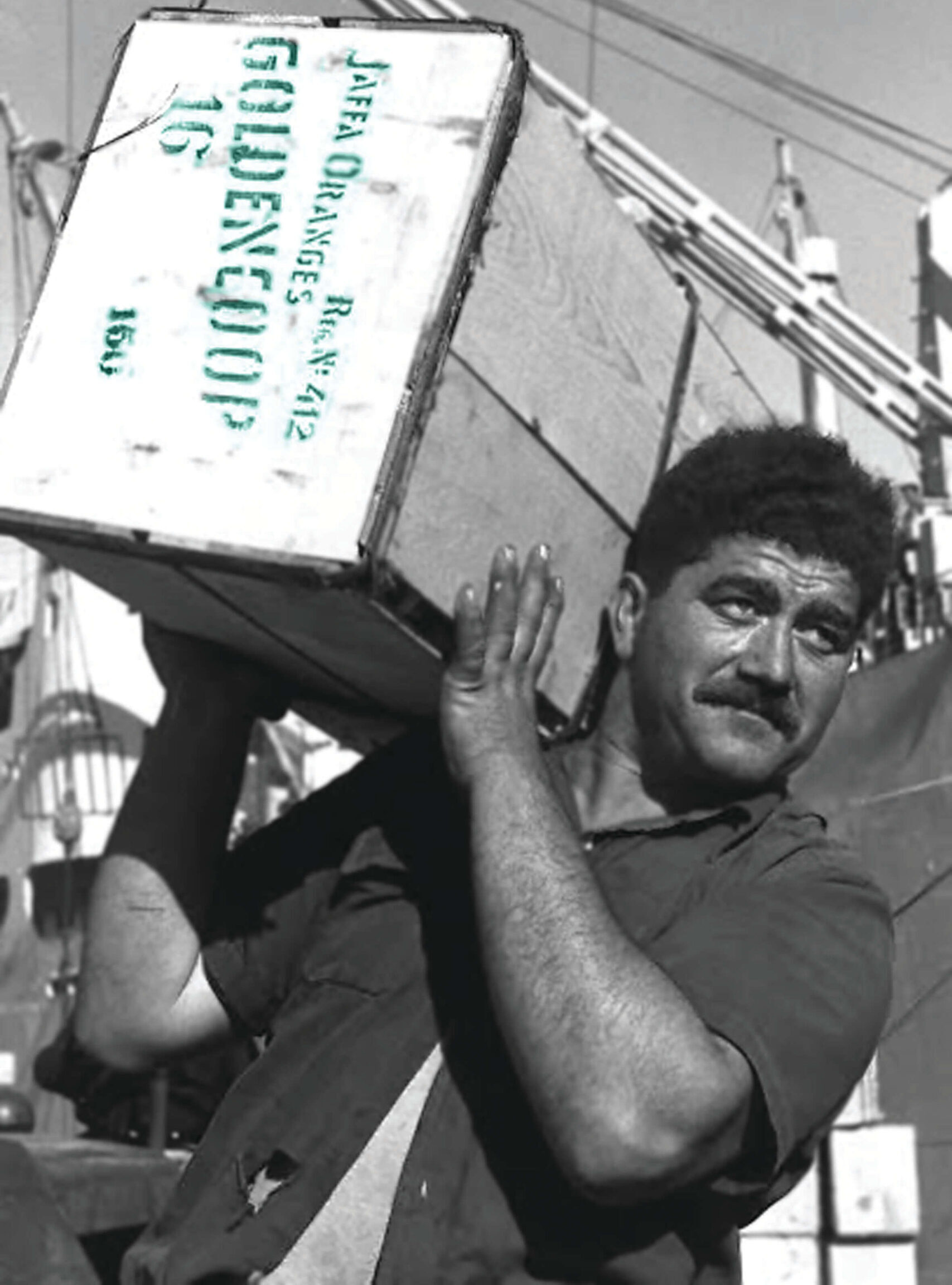
Construction began in 1927. The many tons of sand extracted from the seabed to deepen the harbor near the shoreline were used as landfill, creating a strip of solid ground on which the port’s warehouses and machinery were built. Haifa Port became the gateway to the Promised Land, just as Herzl had projected. In the first years of the British Mandate, the port employed relatively few, mainly Arabs. Jaffa remained the primary port, until the government moved most shipping northward.
The Zionist leadership understood that if the country’s ports were dominated by Arab labor, Jewish imports and exports could easily be cut off by nationally motivated industrial action. Immigration too was at the mercy of the port workers. For any kind of Jewish economy to be viable, Haifa Port had to be run by Jews. But by the end of the 1920s, the Zionist labor organizations had still made no headway in this direction.

In 1926, political activist Abba Hushi left his home in Kibbutz Beth Alpha to head the Haifa Workers’ Union. From that moment until his death in 1969, his vision of Haifa as a booming, port-based metropolis became synonymous with his uncompromising personality. Hushi was elected mayor in 1951, having already transformed the port. He established Haifa as a “red city,” where labor unions reigned supreme, creating a culture of workers’ rights and secular values that profoundly influenced the rest of the country.
Hushi’s efforts to introduce Jewish labor at the port while it was still under construction were a dismal failure. He recruited kibbutz members waiting in Haifa until they could set up new settlements, but these workers balked at the heavy lifting, especially as stop-gap employment. Seeking a creative solution, Hushi found one in Thessaloniki (Salonica).
Greco-Jewish Docks
On September 22, 1931, the Haaretz daily ran an article titled “Jewish Immigrants from Thessaloniki – Bother or Blessing?” The author, Thessaloniki native Barukh Uziel, had arrived in Palestine in 1914 and been working with immigrants from his hometown for over a decade. He suggested that Jewish dockworkers from Greece could solve Haifa’s labor problems.

Jewish exiles from Spain and Portugal had first settled in Thessaloniki after the Ottoman conquest in the 16th century, their capabilities and culture creating a vibrant and fairly autonomous community. The bustling port of Thessaloniki was famous for its Jewish dockworkers; unable to function without them, it closed on Saturdays as well as Jewish holidays.
This golden age ended in 1912, when Greece defeated Turkey in the Balkan Wars preceding World War I. During the next two tumultuous decades, the community’s position deteriorated rapidly. Population exchanges between the two squabbling countries flooded Thessaloniki with thousands of Greek nationals, upsetting the delicate balance between Jews and other locals. Many of the newcomers were fisherman, competing directly with the Jews, who also lived off the sea.
Then a terrible fire broke out in 1917, destroying most of the Jewish area. Rebuilding was both expensive and complicated by ethnic tensions. New legislation compounded the Jewish community’s difficulties. First and foremost, Sunday became the official day of rest, forcing Jews to choose between Sabbath observance and their jobs. Needless to say, the port no longer closed on Saturdays.
The Great Depression of 1929 intensified Greek nationalism, and Jews were blamed for the republic’s economic woes. During the 1931 Camp Campbell pogrom, two thousand rioters ravaged this Jewish neighborhood for four days, leaving five hundred families homeless and one Jew dead.
Uziel’s article appeared late that summer, after Yom Kippur:
We must entrench ourselves in every field of economic endeavor in the land of Israel, and the conquest of the sea is vital for several reasons. No Jews are as capable when it comes to seagoing professions, and none could occupy these positions as swiftly, easily, and naturally – and inexpensively – as the Jews of Thessaloniki. (Shai Srougo, From the Port of Thessaloniki to Haifa Port – Immigration of Dockworkers from Thessaloniki to Palestine between the Two World Wars [master’s thesis, University of Haifa, 2003], p. 88 [Hebrew])
The article was clearly a Zionist’s honorable solution to his home community᾽s problems. At first neither that community nor the Zionist leadership picked up the gauntlet Barukh Uziel had thrown down. Jews had begun leaving Thessaloniki but not for Palestine, and in nothing like the numbers Uziel had envisaged.
A year and a half later, feeling that time was running out, Uziel set up a “Maritime Council” to bring as many dockers as possible from Thessaloniki. The council included members of the Committee for Haifa and leaders of the Thessalonikan Jewish community in Palestine, but Uziel realized he needed Abba Hushi in order to get anywhere. He knew Hushi was desperate for Jewish manpower at Haifa Port. Furthermore, though the Mandate government’s White Papers of 1922 and 1930 had limited Jewish immigration to a trickle of Jews from fascist regimes, Labor Party member Hushi could surely obtain permits for the Jews of Thessaloniki.
Not yet a Segula subscriber?
Access our full archive online, have print issues delivered to your door, and moreFeel free to share