For generations, the Jews of Ethiopia renewed God’s covenant with an annual pilgrimage to a sacred mountain. What remains of that ritual in Israel today?

Etthiopia, on the eve of 29 Heshvan. From widely scattered villages, Jews flock to the foot of a designated mountain. Purified by bathing in the nearby river, after seven days of abstinence and no contact with non-Jews, they will dedicate the following day to fasting and prayer. This is Sigd, the pilgrimage holiday unique to Ethiopian Jewry.
An Uphill Procession
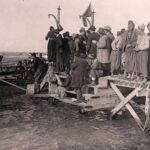
Sigd begins with a long procession. Dressed in white, led by priests bearing sunshades, Jewish villagers ascend the mountain. First in line are priests carrying the books of the Orit, the Torah in the Ethiopian language of Amharic, which are laid carefully in a sanctified area draped in white cloth and meant to resemble the Temple’s Holy of Holies. The shrine has been prepared by villagers a week in advance. Now, bearing stones on their heads as a sign of humility, they follow the priests up the mountain together with the rest of the community. On the mountaintop, a priest reads the verses from the book of Exodus describing the revelation at Mount Sinai, including the Ten Commandments, and the book of Nehemiah’s account of the renewal of that covenant in Jerusalem after the exiles’ return from Babylonia. He addresses the entire community, men and women alike. The verses are proclaimed in Ge’ez, the language of all Ethiopian holy books, and then translated into Amharic.

Sigd was celebrated in different locations around Ethiopia, with each cluster of villages selecting its own mountain. Hills with burial complexes or buildings sacred to other religions could not be used, while significant sites in the lives of founding leaders of the Beta Israel community – as Ethiopian Jewry is known – were favored. Thus, four of the mountains selected were way stations for Abba Sabra and Saga Amlak as they fled the vengeful Emperor Zara Yaqob in the 16th century (see “Abba Sabra, the Founding Father,” Segula 4).
The ceremony ends with a sermon delivered by the kess, the high priest, after which the crowd sings and dances its way down the mountain, carrying the Orit books back to the village synagogue. The fast is broken with a festive meal of beef slaughtered the previous evening, and the following day is devoted to socializing and consultations among the elders. Other Sigd customs include collecting charity for priestly use, and an Amen ceremony, in which wheat is scattered on the sacred ground, prayers are said, and the names of deceased members of the congregation are pronounced.
The name Sigd comes from the Hebrew word segida, denoting worshipful prostration before God. The holiday is also known as Mehlella, “supplication.” Its origins are mysterious. Several hypotheses link the pilgrimage to ancient historical events – the destruction of the First Temple, or the revelation at Sinai. Alternatively, the day may be a tribute to Jeremiah the prophet. A more locally based tradition suggests that Sigd was a day of prayer entreating God to protect the Beta Israel from tyrannical Ethiopian rulers. In that case, the holiday would date back to the “years of survival,” the black days of Christian persecution of Ethiopian Jewry, culminating in the 15th century. This theory would also explain the custom of carrying stones up the mountain, symbolizing the submission of kings and leaders before a conqueror.
Clearly, the renewal of the Jewish nation’s covenant with God plays a central part in the festivities. Many of the rituals echo the ceremony held at the time of Ezra and Nehemiah. And Sigd’s mountaintop setting signifies purity and the wish to return to Zion, the hilltop city of Jerusalem, as well as recalling Mount Sinai.
In Israel, the holiday is also known as the “Festival of Yearning for Zion.” This motif probably developed as part of a 19th-century attempt to connect the Beta Israel with world Jewry. Since then, Jerusalem, always one of Sigd’s most powerful symbols, has dominated the day’s prayers.
Not yet a Segula subscriber?
Access our full archive online, have print issues delivered to your door, and moreFeel free to share