If Jewish sources are anything to go by, Herod’s Temple in Jerusalem was one of the most magnificent edifices ever built. After years of painstaking archaeological research, sifting through rubble illegally removed from the Temple Mount, we can now reconstruct the tiled floor of the Temple courtyard and judge whether – at least at ground level – the sages were right

As a Jew trying to tell the history of his people to a non-Jewish audience, Josephus, the Jewish historian of the Second Temple period, was clearly in a delicate position. At the very beginning of The Jewish War, Josephus testified:
In these circumstances, I – Josephus, son of Matthias, a Hebrew by race, a native of Jerusalem and a priest, who at the opening of the war myself fought against the Romans and in the sequel was perforce an onlooker – propose to provide the subjects of the Roman Empire with a narrative of the facts, by translating into Greek the account which I previously composed in my vernacular tongue and sent to the barbarians in the interior. (Josephus, The Jewish War, I, Loeb Classical Library [hereafter LCL], p. 3,)
Modern researchers’ interface with ancient texts is always fraught, as the authors frequently interwove fact and fiction in their “histories.” Josephus Flavius – who adopted the name of his Roman patrons, Vespasian’s Flavian dynasty – is an extreme case. It sometimes seems as if criticism of the turncoat Jewish historian has only sharpened over time.
Limestone or Marble?
As an archaeologist, I couldn’t ignore the challenges posed by Josephus’ breathless descriptions of Judea. Most glaring was his reference to the marble used in Herod’s construction projects. Six times, Josephus refers to marble structures – in Banias, Herodium, Antioch, Hebron, and Jerusalem. Yet excavations of Herodian sites have unearthed no marble. My inescapable conclusion: Josephus had amateurishly mistaken local limestone for marble. Indeed, in his later writings, Josephus no longer mentions marble. In Rome, apparently, he learned the difference between various types of stone.
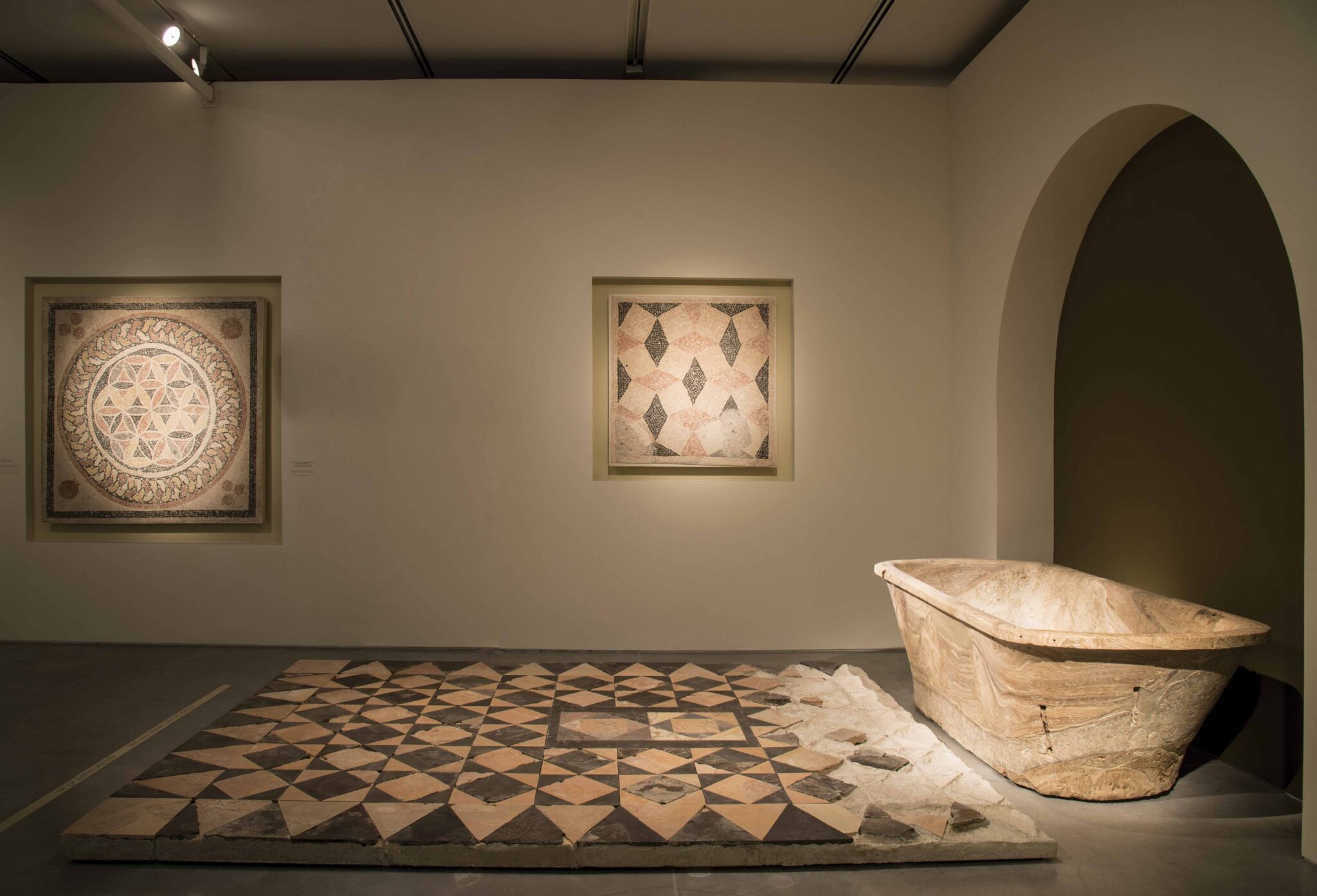
Nevertheless, I found myself wondering whether there might not be some measure of truth in Josephus’ accounts. Marble was imported into Herod’s Judea, but it was reserved for opulent colored floors, tiled using a method known as opus sectile.
In Latin, opus means “work,” and sectile, “cut” or “divided.” In opus sectile, then, large stone slabs of various colors are cut in geometric shapes and combined to form patterns. The technique first appeared in the Hellenistic world in the fourth century BCE, mostly in fairly simple designs. These became more complex, sometimes including plant or animal shapes. Opus sectile graced lavish residences and public buildings, especially baths, from the Roman period onward. As the most expensive flooring available, it was clearly a status symbol.
Herod, a well-known admirer of Roman architecture, invested heavily to bring opus sectile to Judea. Importing marble and other types of stone from all over the Roman Empire, he included these geometric patterns in his palaces around the Holy Land. Though most of the stone has been stolen and the floors haven’t survived, you get the idea from the small sections still remaining and from impressions in the plaster. Examples have been found in Herod’s third palace in Jericho, in the bathhouses at Masada, Herodium, and Cypros, in the Jewish Quarter of Jerusalem’s Old City, and even in Jordan, in the bathhouse at Machaerus and in a room in the Dead Sea oasis of Callirrhoe. Opus sectile is also visible in the remnants of a manor in Zikhron Yaakov as well as in a structure in Banias.

Stone of Many Colors
Suddenly these fragments began forming a pattern of their own. Excavating the Ophel area south of the Temple Mount, Prof. Benjamin Mazar came across an inscription in Greek, though one corner was missing. Dating from 17 BCE, the twentieth year of Herod’s reign, the find was essentially a donor’s plaque, recording the donation of stone flooring by a native of Rhodes:
In the twentieth year [of Herod’s reign], in the high priesthood of [x], Paris son of Akson [who dwells/is in] Rhodes [donated] for the floor tiles [x sum of] drachmas. (Benjamin Isaac, “A Donation for Herod’s Temple in Jerusalem,” Israel Exploration Journal 33, [1983], p. 86)
Josephus described the magnificent floor adorning the courtyard of the Temple Mount: “The open court was from end to end variegated with paving of all manner of stones” (Jewish War, V, LCL, p. 257). This depiction strengthens Prof. Benjamin Isaac’s assumption that the donation pertained to this flooring. But did the floor feature opus sectile tiling or something a little less exotic, such as the plain but well-crafted flagstones used to pave open streets in Herodian Jerusalem?
Not yet a Segula subscriber?
Access our full archive online, have print issues delivered to your door, and moreFeel free to share