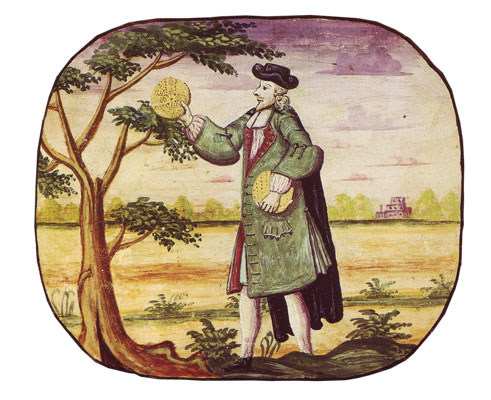
Today most people buy their matza in the supermarket, but before machine-made matza was invented, there were almost as many types of matza as there were Jewish communities. And when war made Passover necessities hard to come by, creative solutions brought their own innovations to the age-old order of the Seder

Eager to leave Pharaoh’s bondage, the Hebrew slaves freed from Egypt approximately 3,300 years ago baked the dough they had hastily kneaded before it had time to rise. That act gave the holiday of Passover its character – and its other biblical name: the Feast of Matzot.
Mix flour and water, bake it within eighteen minutes, and presto, you have matza, the unleavened bread eaten on Pesach. Matza is one of the few utterly Jewish icons left. Ever since the Exodus, Jews everywhere and of all stripes have baked or procured matza for Passover. So central was matza to the Jewish people that many medieval illuminated manuscripts contain hand-painted images of matza-making.
And not just any matza. It must be kosher for Passover.
The matzot eaten at the Seder, the festive holiday reenactment of the Exodus, must be made of wheat, spelt, barley, oats, or rye. From the moment it’s harvested, this grain is guarded from moisture, lest it begin to leaven. Likewise, the flour made from this grain is protected from contact with water until the two are mixed to form dough. According to tradition, the water should be drawn from a spring (as opposed to tap water) and must not be warm, lest it speed up the leavening process. Therefore, the water is drawn the evening before baking and stored in a cool room.
Even when to bake the matza has been a concern. For much of Jewish history, matza was preferably baked on the afternoon before the Seder. This custom was so entrenched that the 11th-century Ma’aseh Ha-Geonim records the shocking story of someone who baked his matza in the morning instead, only to find that most rabbinic authorities prohibited its use at the Seder. Fortunately, two leading rabbis from Magence agreed that while one should avoid such scandalous practices, the matzas were permitted after the fact. The custom of baking on Passover eve is still observed by some today, often accompanied by joyous singing.

Preparing matza. Illustrations from the Rothschild Miscellany, commissioned by Moshe ben Yekutiel Hakohen and dated to 1479, reflect the rich manuscript illumination of the Italian Renaissance

Instruments used to perforate matzas, as pictured in The Jewish Encyclopedia (New York, 1901–6)
All Shapes and Sizes
For thousands of years, matza was made by hand. The flour was measured, the water drawn, and a timer was set for eighteen minutes. Then, amid excitement, song, and camaraderie, the dough was kneaded for the sake of the mitzva and rolled into circles. In some communities it was also perforated, so the steam would escape during baking (before the dough swelled into a pita). Finally, the dough was placed in a hot oven.
Each Jewish community made its matza slightly differently. Jews in Arab countries baked soft, thick, laffa-like matzot, slapping the dough onto the oven walls and peeling it off when brown. Iranian matzot were huge, close to a meter in diameter. The Iraqis marked the edges of theirs with one, two, or three “pinches” to show in which order they should be used during the Seder ceremony. The soft matzot of the Yemenites turned stale fast and were therefore baked fresh daily, whereas the thin, crackerlike Ashkenazic matza stayed crunchy all week.
The conversos, crypto-Jews of Spanish and Portuguese descent, developed means of keeping their matza incognito to avoid the long arm of the Inquisition. In Mexico, then still known as New Spain, these forced converts to Christianity found a unique local version of matza – the tortilla, a thin, unleavened flatbread made from finely ground maize or wheat flour. Despite several reports of Mexican matza baking, most conversos subsisted on this flatbread throughout Pesach. Coincidentally or not, the bread was traditionally eaten in Mexico during the Christian period of Lent (which coincides with Pesach) and is also known as pan de semitas, or Semitic bread.
Passover 1144 marked history’s first blood libel, in which the Jews of Norwich were accused of baking matza with Christian blood. Despite its absurdity, and despite Vatican denunciations, this charge has persisted, even appearing in upstate New York in 1928. It spread throughout the Muslim world in the 20th century, and surfaced as recently as 2007 in the Ukraine.
Not yet a Segula subscriber?
Access our full archive online, have print issues delivered to your door, and moreFeel free to share