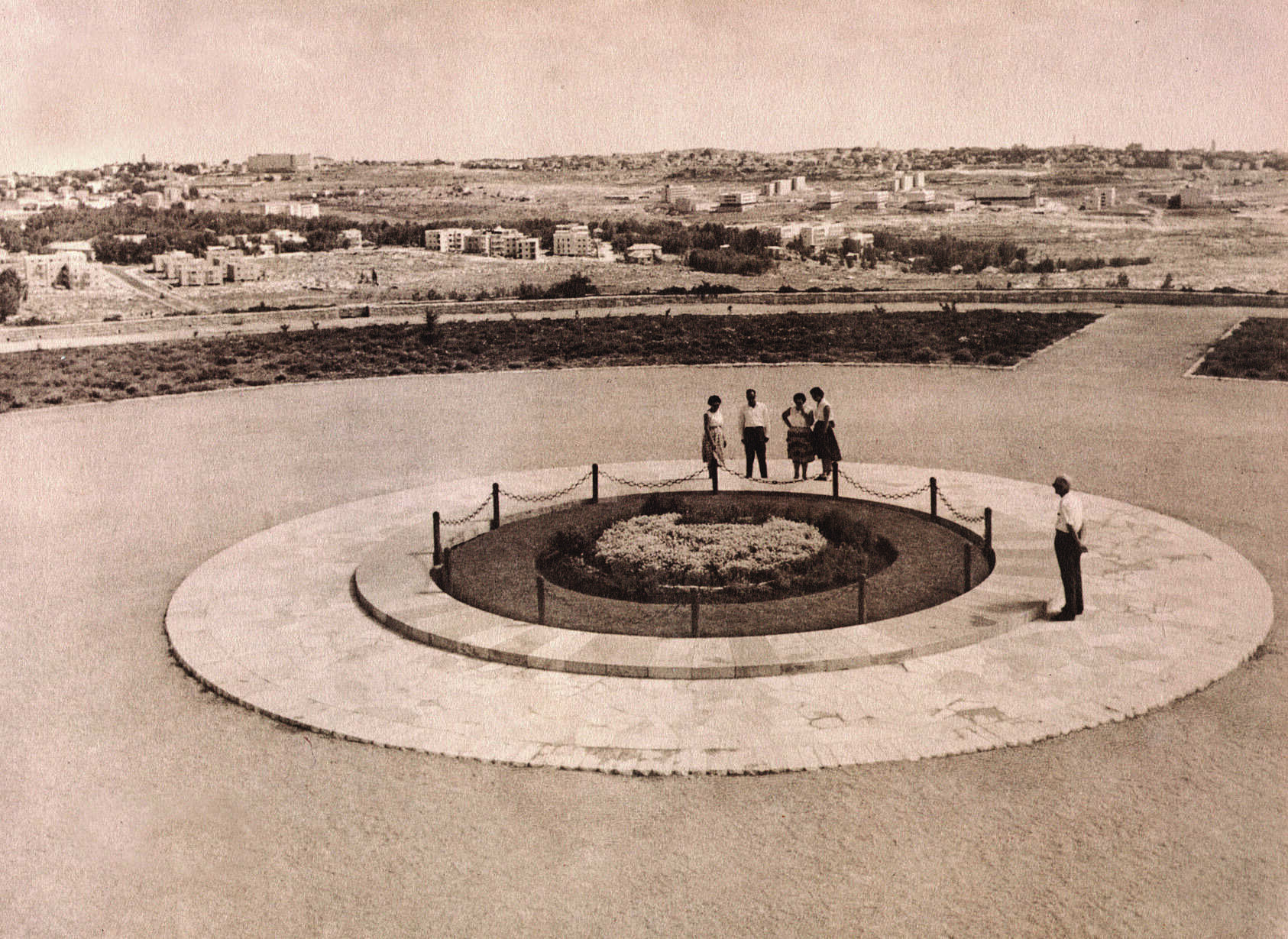
Herzl’s tomb and the nearby military cemetery have become central locations in the celebration of Israel’s national holidays. Why did this hill in modern Jerusalem supersede more traditional sites? And what does that choice reveal about the ongoing tension between Zionist values and Jewish tradition?

A political leader named David transports a national relic through the Judean Hills to Jerusalem, placing it at the crest of a hill as a “spiritual center” for the new capital. But when? In the 11th century BCE – or the 20th CE?
Two strikingly similar stories, separated by nearly three thousand years, describe the establishment of a Jewish capital in Jerusalem. The first, of course, is the story of King David and the Ark of the Covenant; the second, lesser-known episode involves Prime Minister David Ben-Gurion and the bones of Theodor Herzl, which were brought from Vienna to Jerusalem for re-interment in the summer of 1949.
There are remarkable parallels not only between the events, but in the motivations behind them. While David’s goals in turning the centrally located Jebus into a national religious center – the City of David – are well known, Ben-Gurion’s motives are less familiar. But they could just as easily have been voiced by King David. When Minister of Police Bechor Shitrit suggested burying Herzl in Haifa (as some thought was his request), Interior Minister Yitzhak Gruenbaum replied:
I think that specifically now, when our intention is to strengthen Jerusalem and make it into a spiritual center … the most appropriate place for Herzl’s tomb is Jerusalem. (Israel government protocols, May 10, 1949, p. 26, Israel State Archives [Heb])
It is no secret that the Zionist leadership harbored reservations about the role of Jerusalem in the state-to-be, as had Herzl himself before actually setting foot in the city. His visit induced mixed emotions and resulted in a new vision for Jerusalem, which he set out in his novel Altneuland. Ben-Gurion did not visit the city until two years after his arrival in Palestine, and others waited far longer.
A Secular Shrine
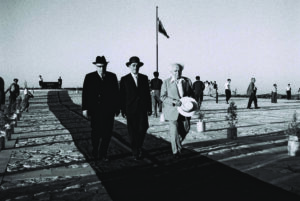
Herzl is buried atop the hill that bears his name. Heads of state, Zionist leaders and thousands of fallen soldiers are buried in the military cemetery on the hillside. Yad Vashem, Israel’s Holocaust museum, occupies the western slope. The plaza in front of the tomb hosts the annual Independence Day ceremony, while the Memorial Day service preceding it is held nearby, at the burial plot of the nation’s leaders. While Ben-Gurion was originally unenthusiastic regarding the choice of Mount Herzl, a hill then on the outskirts of western Jerusalem and far from the city’s inaccessible historical center, the site rapidly became a national shrine. Its location on the opposite side of Jerusalem (and of the Jordanian border for the first years of the state) from the ancient holy sites may even have made it more desirable as a center of secular ritual for the new state.
From 1948 until 1967, such traditional holy sites as the Western Wall in the Old City and the ancient Jewish cemetery on the Mount of Olives were off-limits. While this inaccessibility may have contributed to the evolution of Mount Herzl as an alternative sacred space, other factors were at work as well.
According to the bylaws governing the area of Herzl’s tomb, public ritual in Israel has some very “religious” aspects. Entry to the site is limited during the Independence Day ceremonies, which must take place several meters from the tomb itself.
In August 1949, a member of a Ministry of Religious Affairs public committee complained to the Prime Minister’s Office about the selling of refreshments close to the tomb and protested against the site’s accessibility by vehicle. Comparing the tomb to the Western Wall, he huffed, “You can’t make a pilgrimage in a vehicle” (ISA, G 5595 file 4717 [Hebrew]).
Gruenbaum added his voice in similar protest, calling upon Ben-Gurion to guard “the sacred of the nation.” This idea of restricted access is unexpectedly similar to the traditional Jewish approach to the Temple and its Holy of Holies.
Not yet a Segula subscriber?
Access our full archive online, have print issues delivered to your door, and moreFeel free to share