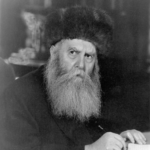

Though synonymous with Hasidic Jewry, the shtreimel was originally more of a status symbol than a religious one. And not only for Jews, or for men, for that matter

The Israeli legislature has been debating the legality of the local fur trade since 2009, when the Prevention of Cruelty to Animals Law (Amendment 8) was submitted to the Knesset.
Demand for fur is very limited in Israel’s hot climate, but had the law passed, the Jewish state would have set an example for the world by becoming the first country to ban fur trafficking. (Other jurisdictions have since adopted such legislation.) Politics killed the bill, however. Among other sticking points, Haredi (ultra-Orthodox) Knesset members objected that such a law would prohibit the manufacture, import, and sale of Hasidic headwear: the shtreimel (plural: shtreimelekh), spodik, and kolpik.
Religious Markings
One mark of Hasidic communities is the distinctive garb worn by males. Over and above the various frocks, socks, and sashes, the fur headdress of the Hasidic faithful features across museum exhibitions, portraits, and art installations. The regal-looking headgear is worn by men on the Sabbath, festivals, and other significant occasions, such as weddings – regardless of the weather.
Hasidic fur hats come in different styles. Broadly speaking, Hasidic groups originating in Ukraine (where Hasidism began), Russia, Galicia, Hungary, or Romania don the short, wide, brown shtreimel, traditionally made from animal tails. These courts include the Boyan, Munkács, and Sanz Hasidim.
Groups that trace their roots to Congress Poland (annexed by Russia in the 18th century) wear the taller, narrower, and darker spodik, made from pieces of black fur (sometimes dyed that color) and therefore cheaper. Gur, Amshinov, and Aleksander Hasidim sport a spodik.
Less well-known is the kolpik – colored like a shtreimel but shaped like a spodik. The kolpik is worn by some Hasidic masters to mark the anniversary of a saintly ancestor’s death and other occasions. In certain Hasidic courts, the kolpik is also donned by the rebbe’s unmarried sons and grandsons.
These rules have their exceptions. There are non-Hasidim who wear a shtreimel: the Perushim, descendants of the disciples of Rabbi Elijah, the Gaon of Vilna, who arrived in the Holy Land (mainly Jerusalem) in the 18th century. And there are Hasidim who don’t: the Lubavitchers, whose felt fedoras resemble those of the non-Hasidic ultra-Orthodox. And spodik wearers call their hats shtreimelekh, confusing everyone.
The First Shtreimel
Fur hats are mentioned nowhere in the Bible, Talmud, or classic codes of Jewish law. So how did the shtreimel become mandatory for most Hasidim?
According to one legend, the shtreimel began as an anti-Semitic ploy of Sigismund I (1467–1548), king of Poland, who ordered Jewish men to wear animal tails on their heads on the Sabbath, thereby repelling their wives. As the original reason for the practice faded from memory, the tails became a mark of distinction to be donned on special occasions.
This colorful account was advanced by many, including scholar of Hasidism Ahron Marcus (1843–1916), Nobel laureate S. Y. Agnon (1888–1970), and Rabbi Yekutiel Yehuda Halberstam of Sanz-Klausenberg (1905–1994), who founded the Sanz community in Netanya. Yet the story has no historic basis.
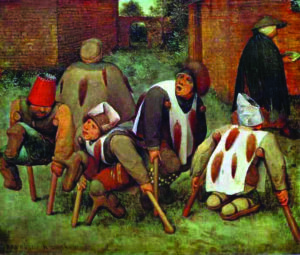
True, Jews were obliged to wear special hats, and animal tails were used to debase people, as depicted in Pieter Bruegel the Elder’s 16th-century painting The Beggars. But Sigismund I was far from anti-Semitic: immediately upon ascending the throne, he cancelled his brother’s edict of Jewish expulsion. Moreover, there is no evidence of any decree requiring Jews to wear fur hats.
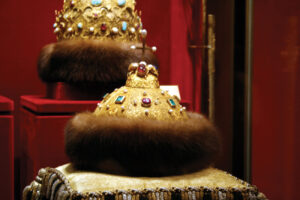
In stark contrast to this tale of humiliation, the shtreimel also resembles the sable-trimmed Russian Imperial crown known as Monomakh’s Cap, apart from its bejeweled cap topped with a cross. Designed in the 13th or 14th century, this princely attire is preserved in the Kremlin armory in Moscow.
Others have argued that the furs were merely standard winter gear in the frigid local climate.
Communal legislation, prenuptial agreements, and other documentation dating from the 17th century indicate that some form of shtreimel predated even the spiritual father of Hasidism, Rabbi Israel Baal Shem Tov (circa 1700–1760).
For example, in the memoirs of the first recorded rabbi of Kutno, Poland – Rabbi Moshe Yekutiel Kaufman – the author describes how he fled his home in 1682 after being falsely accused of murder: “I changed my clothes and adjusted my shtreimel, so they wouldn’t recognize me.” Whatever this adjustment was, it’s unclear how it masked his identity.
Another shtreimel appears in a 1694 document – but not on the head of a Jew. The Jews of Opatów, Poland, kept a log beginning in 1666. Sadly, this record was lost during the Holocaust, but there are scholarly copies. One entry lists a communal expense: “For the deacon’s shtreimel : thirty gold [coins]” (Nahum Sokolow, “The Opatów Community Log,” He-asif 6 [5554], p. 142 [Hebrew]).
Status Symbol
Shtreimelekh were also fashion accessories and status symbols. In the early 18th century, the Jewish community of Boskovice, Moravia, regulated the wearing of fur hats by women whose husbands paid minimal communal taxes:
Anyone who doesn’t remit two coins to the [communal] fund – his wife is not permitted to go around with a shiny scarf or a Prague hat. Rather, she may wear only a shtreim hat with marten-fur trimmings. (Yehuda Leib Bialer, ed., Min Ha-genazim [From the Vaults], vol. 2, p. 119 [Hebrew])
(Thanks to its diminutive final lamed, the word shtreimel means a small or otherwise distinguished shtreim, or fur hat.)
Like many other communal bylaws – in Boskovice and elsewhere – this rule was intended to prevent low-income households from overspending on women’s apparel due to social pressure. The regulation may also have aimed to avoid unwanted attention from hostile gentile neighbors. In any case, headwear indicated one’s tax bracket within the Jewish community and hence his economic standing. A shiny scarf or a hat from Prague was clearly more prestigious than a common, locally manufactured shtreim.
A communal ordinance enacted in Śniadowo, Poland, and transcribed in 1768, distinguishes between shtreimel and spodik – this time atop male heads – as a reflection of the wearer’s scholarship and attendant social status:
Not everyone who wishes to take a crown for his head may take [it]. For this reason, we legislated this ordinance so every person will crown himself according to the honor he deserves. That is, someone who knows how to study a chapter of Mishna may wear a hat known as a shtreimel […].
The less learned had to make do with a cheaper head covering:
[…] and the aforementioned tradespeople, who aren’t permitted to wear a shtreimel, may also not attend synagogue on the Sabbath and festivals wearing any hat besides […] a spodik. (Shlomo Eidelberg, “The Śniadowo Log,” Gal-ed 3 [1976], pp. 307–8 [Hebrew])
Clearly, in the 18th century, shtreimel and spodik divided rich from poor and laymen from intellectuals.
Once established as a status symbol, the shtreimel naturally became rabbinic garb. This “promotion” took place well before the Hasidic movement gained momentum. Witness the fur hats in likenesses of rabbis as early as Yehezkel Landau (1713–1793), chief rabbi of Prague, author of the Noda Bi-Yehuda responsa, and – ironically – an early opponent of Hasidism. Another rabbi depicted with a shtreimel is Mordechai Banet of Nikolsburg (Moravia, 1753–1829). And the ex libris of the Davidson family shows patriarch Rabbi Haim Davidson (1760–1854), chief rabbi of Warsaw, and his son Naftali, both wearing fur hats.
Admittedly, these representations could be anachronistic, implying only that these men’s descendants thought their ancestors underdressed without a spodik. Yet shtreimelekh also appear in rabbinic portraits painted in their subjects’ lifetime and in photographs of rabbis in no way associated with Hasidism. Evidently, for 18th- and 19th-century rabbis, a shtreimel went with the job.
Not yet a Segula subscriber?
Access our full archive online, have print issues delivered to your door, and moreFeel free to share