Liturgical poetry, or piyut, plays a major role in the Sephardic heritage but has long been considered an exclusively male enterprise – until the recent discovery of a female poet from Morocco, whose life story was legend and whose poems spread far and wide

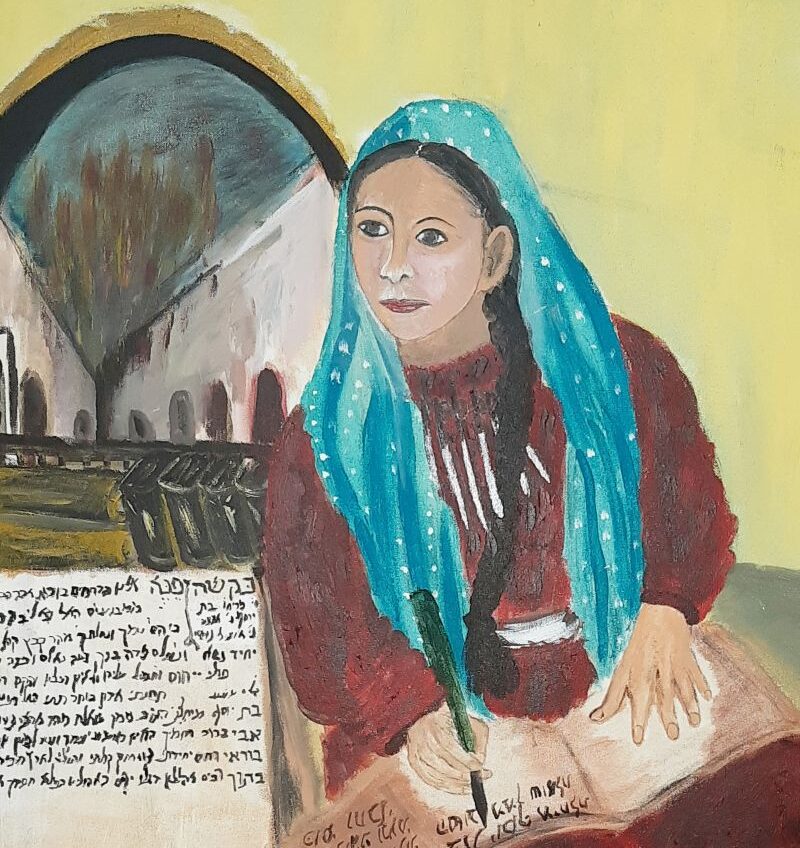
Among the hundreds of Hebrew poets active in Morocco over the generations, Friha, daughter of Rabbi Avraham ben Adiba, holds a special place. Not only is she the only female poet known to us from North Africa, but both her erudition and her tragic end add color and poignancy to her story.
Hidden Signature
My search for this lost poetess began with a manuscript I discovered in Strasbourg, France, belonging to a family originally from Meknes, Morocco. The document contained liturgical poems, including one composed in the style known as bakashot (implorations) – rhyming prayers for pardon and salvation. Like many such compositions, this bakasha – which begins, “Turn to us in mercy” – featured an acrostic signature revealing its author. However, whereas most Jewish liturgical poetry is signed with men’s names, the work in question spelled out the female name Friha, meaning “little joy” – an appellation frequently bestowed on a baby girl born after the loss of another child in the family.
The sixth stanza opens with “the daughter of Yosef” expressing her innermost hopes and prayers – all in the first person female:
The daughter of Yosef longs, Seeks goodness from You alone; Soon her land will be given, Restored from the Ishmaelites’ hand[.] (trans. Peter Cole)
The copyist used heavier ink to emphasize the initial letters of the first five stanzas, spelling out the name Friha. He used the same technique to draw attention to the words “daughter of Yosef.” Apparently he knew that these constituted the author’s signature. Yet he evidently didn’t notice that the signature continued in the final three stanzas, hidden in the initials of sequential words. The poet’s full name thus emerges as Friha, daughter of Avraham son of Yitzhak ben Adiba. Nonetheless, she calls herself “daughter of Yosef,” anticipating the speedy arrival of the Messiah descended from the biblical Joseph, who in Jewish tradition prefigures the Davidic Messiah. The poem’s penultimate line includes the acrostic hazak (be strong), generally appended to an acrostic signature.
Moroccan communities customarily recited liturgical poems before morning prayers. Each stanza of “Turn to Us in Mercy” thus ends with the refrain “Hear my voice in the morning.” Such bakashot traditionally centered on two subjects: yearning for redemption from the misery of exile; and the poet’s inner discourse, in which he addresses both his own soul and his Maker, begging for repentance and the strength to follow God’s commandments.
Most of Friha’s prayer is dedicated to the redemption of Israel – the ingathering of the exiles, the return to Zion, the rebuilding of the Temple, and the renewal of its sacrifices and other rituals – but she concludes by requesting forgiveness for her own sins.

Swansong
Fourteen years later, I found the next clue to the identity of the mysterious poetess in an article in Al-Yahudi, a Judeo-Arabic newspaper published in Tunis in 1936–38. Dated November 26, 1936, the piece told the story of a female Torah scholar who came to Tunis from Morocco with her father, Rabbi Avraham ben Adiba. The author, Yosef ben Avraham Bijaoui, claimed that she’d produced – in the quiet of her extensive personal library – not only liturgical poetry, but scholarly Jewish literature as well. He referred to her as Rabbanit (an honorific traditionally reserved for rabbis’ wives or erudite women), praised her lavishly, and then described her tragic death in the massacres perpetrated by the elite Ottoman infantry units known as the Janissary guards during their invasion of Tunis from Algiers in 1756.
Bijaoui cited a snippet of Friha’s poetry, including her acrostic signature:
Raise up my steps, O Lord, my savior, Let me go to my land in good grace! I’ve been pursued by an ignorant foe Who thundered into my face. Bring me anon to my Galilean hill, Send fury and wrath at their cry. There show me Your light, let me don my crown; Then will I say, now I can die. [Hebrew]
Of all the thousands of North African Jewish poems on exile and redemption, this must be one of the most direct, succinct descriptions of yearning for the land of Israel. Its author turns to her Creator with a heartfelt, personal plea to help her reach the Holy Land at the earliest possible opportunity. Yet hers is also a national prayer, beseeching God to restore the children of Israel’s crown of independence.
Not yet a Segula subscriber?
Access our full archive online, have print issues delivered to your door, and moreFeel free to share