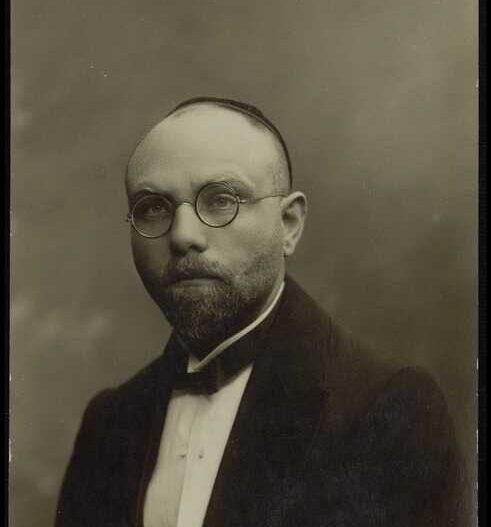
Though Jacob de Haan’s assassination at the entrance to Jerusalem’s Shaare Zedek Medical Center shocked the Jewish world, the victim himself elicited little direct sympathy. What prompted London-based rabbi and maverick journalist Joseph Shapotshnick to publicly make himself the exception to the rule?

The article dominating the front page of the first issue of Rabbi Joseph Shapotshnick’s London Jewish Free Press on July 11, 1924, was headlined simply: “Dr. de Haan.” Just two weeks earlier, the Jewish world had been rocked by the June 30 assassination of Jacob Israel de Haan, a Jerusalem-based Dutch journalist who had adopted the anti-Zionism of the city’s strictly Orthodox community. De Haan had become a proactive political nuisance for the Zionist leadership in British Mandate Palestine. As a result, many suspected that the murder had been commissioned by Zionist leaders in the land of Israel, who were eager to silence their opponents as the British struggled with their conflicting commitments to a Jewish sovereign state and Arab nationalist aspirations in the region.
Shapotshnick (1882–1937) was hardly new to controversy. After moving to London from his native Odessa in 1913, he had earned a reputation as a maverick who said and did outrageous things – even if only for notoriety’s sake. Among his favorite outlets were short-lived newspapers and pamphlet series, published at his own expense and featuring his own verbose pronouncements on contemporary topics of Jewish interest, usually in Yiddish or Hebrew and occasionally in English – with a few other scholarly contributors thrown in for good measure.
In late 1927, for example, a storm erupted over his exempting any childless Jewish widow from the biblical requirement of levirate marriage, thereby enabling her to remarry without first performing the ritual releasing her from matrimony with her late husband’s brother. The brouhaha over Shapotshnick’s spurious rulings dragged on for months, resulting in a remarkable, published condemnation signed by more than six hundred rabbis worldwide, including some of the era’s most respected such figures.

Apparently, Shapotshnick was intent on distinguishing himself from the mainstream right from the start of the London Jewish Free Press. The paper lasted just four issues, and most of its content was standard Shapotshnick fare, expressing contrarian views regarding talking points pertinent to the local Jewish community.
So what prompted Shapotshnick’s foray into the murky world of interwar Jewish politics and Zionist intrigue, particularly Jacob de Haan’s controversial role therein? Why was this story the lead item in the premiere issue of his publication? On the face of it, the two men couldn’t have been more different.
Radical Shift
The de Haan piece marked a significant departure from opinions espoused earlier by Shapotshnick, and the article’s prominence in this first issue of what the author clearly hoped would be a widely circulated, long-lived Jewish newspaper indicated the importance he attached to publicizing that shift.
Shapotshnick had addressed the matter of Zionism almost a decade earlier, in another of his periodicals, Rashei Alfei Yisrael (Leaders of the Legions of Israel), which had appeared during the First World War. He’d sympathized with both political and practical steps leading to Jewish autonomy in Palestine. His views had leaned toward the religious Zionists, despairing of their secular counterparts and attacking the worst excesses of the latter’s leadership, although always as a fellow Zionist.
Following the Balfour Declaration in November 1917, Shapotshnick devoted the first seven pages of Rashei Alfei Yisrael to “My Opinion on Zionism,” with a subheading promising a “nonpartisan” position (issue 13 [January 1918], p. 1). Astutely observing that the British presence in Palestine was extremely positive for Jews both politically and economically, Shapotshnick deemed the British a vast improvement on their Turkish predecessors. The Ottoman Empire was spent, he maintained, and a Jewish state would never materialize under the Turks.
Despite Shapotshnick’s major reservations about political Zionism and its leaders, he also critiqued the strictly Orthodox community’s vehement opposition to Zionist objectives. Rather than reject Jewish nationalism as a hostile intrusion on Jewish life, Shapotshnick urged Orthodoxy to embrace the movement, telling his readers: “I declare that all devout Jews must become Zionists!” (ibid.). Now that the Balfour Declaration had made Jewish statehood in Palestine all but inevitable, he argued, Orthodox Jews’ denunciation of secular Zionist leaders was a grave strategic error. Instead, Shapotshnick encouraged the Orthodox to take over Zionism from within, a suggestion far removed from the stance of Jacob de Haan and the militant anti-Zionism of Jerusalem’s separatist ultra-traditionalists.
So what prompted Shapotshnick’s sudden adulation of the Dutchman and his colleagues? The answer may lie in a deeper understanding of the highly controversial and complex de Haan.

After becoming disillusioned with the Zionists, De Haan joined the Haredi community. Dr. Moshe Wallach, founder of Shaare Zedek Hospital and emissary of the Amsterdam Clerks’ Committee

Rabbi Yosef Chaim Sonnenfeld, Head of the Ashkenazi City Council
From Zaandam to Zion
Jacob Israel de Haan was born into an Orthodox Jewish family in Smilde, Holland, in 1881. Shortly afterward, his father, Isaac, a religious functionary, moved the de Haans to Zaandam, a province with a tiny but very traditional Jewish community. Jacob was a difficult and precocious child; as he grew, he drifted away from observant Judaism, flirting with anarchism, socialism, and even Christianity. He studied law but never practiced, preferring to write and teach.
In 1904 and 1906, de Haan published two homoerotic, semi-autobiographical novels. The backlash lost him his teaching job and hindered his legal career, perhaps even leading to his marriage to a non-Jewish woman nine years his senior, Dr. Johanna Belia Cornelia Jacoba van Maarseveen (1872– 1946).
Before the First World War, de Haan returned to Orthodoxy and was heavily involved with the religious-Zionist Mizrahi party. But after moving to Palestine in February 1919, having left his wife behind in Holland (they never divorced, remaining in regular contact until his death), de Haan soon grew disillusioned with political Zionism, particularly its secular leadership.
Unable to find regular work as an academic or a writer, probably because of his unbridled self-importance and strident views, de Haan was drawn to Jerusalem’s separatist, anti-Zionist Orthodox community, quickly becoming its chief spokesman and publicist as well as a close confidant of its leader, Rabbi Yosef Hayyim Sonnenfeld.

Having initially interviewed Rabbi Sonnenfeld for a newspaper in the Netherlands, de Haan was struck by the elderly rabbi’s deep piety, firm convictions, and down-to-earth intelligence. By March 1920, the Dutch Jew had joined the seventy-strong Ashkenazic City Committee – as opposed to the Zionist-sponsored Jerusalem City Committee – to represent its constituents to the British authorities. De Haan was by far the group’s most sophisticated member: fluent in several languages, he had a doctorate in law and was an accomplished public speaker. As a result, he rapidly developed into a trusted adviser to its leadership, advocating on its behalf with foreign officials and other international figures.
Yet de Haan didn’t just toe the party line. On the contrary, he developed into both a leading ideologue and a wily backroom strategist for Mandate Palestine’s traditionalist Orthodox community, the Old Yishuv. He preached aggressive noncooperation with the Zionists while developing an agenda acceptable to local Arabs, who were increasingly concerned at the prospect of a Jewish state in Palestine. This approach spoke to a growing number of international statesmen and opinion makers, particularly those in Great Britain, who had begun regretting the Balfour Declaration and the whole idea of a Jewish national home.
Anti-Zionist Press
As an overseas correspondent, de Haan dispatched anti-Zionist reports from Jerusalem that frequently appeared – to devastating effect – in European newspapers as well as in memos to British Mandate authorities, senior British officials in London, and diplomats at the newly formed League of Nations. But worse was to come.
In February 1922, de Haan insinuated himself into the entourage of British press baron Alfred Harmsworth, first Viscount Northcliffe (1865–1922), who was visiting Jerusalem after a health crisis. De Haan complained bitterly to Northcliffe about “Zionist tyranny” against those Jews in Mandate Palestine who rejected the Zionist enterprise.
Northcliffe, who considered the Balfour Declaration a grave diplomatic error, was intrigued by de Haan’s advocacy of official recognition of a non-Zionist Jewish sector. De Haan contended that this faction was simply a continuation of Jerusalem’s generationsold pre-Zionist Jewish community, and his argument struck a chord. Northcliffe’s coterie of journalists similarly lapped up de Haan’s narrative, introducing anti-Zionism into the mainstream British press. De Haan himself was promptly ensconced as Middle East correspondent for the Daily Express, the British Empire’s most popular tabloid, which transformed him from an insignificant gadfly into a thorn in the Zionist establishment’s side.
In May 1923, de Haan received a death threat signed by an organization known as “The Black Hand.” He reported the harassment to the police but otherwise changed none of his habits, writing in his journal on May 25, “How innocent is the twenty-fifth when one is not assassinated on the twenty-fourth!”

Diplomatic Dividends
On behalf of the separatist community, De Haan initiated and cultivated high-level contacts with Arab nationalists in both Mandate Palestine and Transjordan. In the early summer of 1923, he headed to the newly formed British protectorate of Transjordan to meet its ruler, Emir Abdullah (1882–1951). The two men discussed a possible coalition of nationalist Arabs and anti-Zionist Jews that would lobby for an independent, Muslim-controlled Palestine offering the Jewish community full civic rights and some form of political standing. Also at the meeting was Abdullah’s brother, King Faisal of Iraq (1885–1933), possibly as a moderating influence.
For de Haan, the talks could not have gone better. Emir Abdullah insisted that he would never support a Jewish state in Palestine and that the Orthodox anti-Zionist separatist community and Arab nationalists were natural allies. In addition, Abdullah signed a declaration welcoming Jewish immigrants to Palestine as long as they rejected Zionist aspirations. This document was a diplomatic sensation, and de Haan translated the choicest parts to be read aloud by Agudath Israel’s Jerusalem representative, Rabbi Moshe Blau, at the organization’s first Grand Congress (Knessia Gedola), held in Vienna in August 1923.
Yet this breakthrough paled in comparison to the meeting arranged by de Haan between a delegation from the anti-Zionist community (which included Rabbi Sonnenfeld) and Hussein bin Ali, sharif of Mecca (1854–1931), who controlled the Muslim holy sites in Mecca and Medina.
Despite threats from Arabia’s Wahabi Al-Saud family (which ousted Hussein only months later), power in the Middle East rested largely with bin Ali and his sons Abdullah and Faisal, bolstered by steadfast British support.
Hussein bin Ali visited the Trans-jordanian capital of Amman in February 1924. Although a Zionist contingent was also there to greet the world’s most senior Muslim figure, it was de Haan’s separatist mission that received the red-carpet treatment.
Faisal, who saw himself as representing the international Arab movement (including Palestinian Arabs), told the separatists that all Arabs recognized the historic rights of Jews in Palestine but were very concerned by the Zionists. As partners in government, he preferred the ultra-Orthodox Jews over the secular, as they could be trusted not to destroy the traditional foundations of Arab education: respect and modesty.
Not only did de Haan extract a royal promise to partner with the anti-Zionist community, he also solicited a significant financial donation from Hussein to fund separatist institutions in Jerusalem. Yet the lobbyist wasn’t satisfied. Returning to Amman several months later, he persuaded bin Ali to publicly denounce “the anti-religious Zionist movement” for its gross mistreatment of faithful Muslims, Christians, and Jews.
Desperate Measures
By now, the Zionists were beside themselves; de Haan’s diplomatic activities and media presence threatened to derail the entire Zionist agenda. In the late spring, the Zionist leadership learned that de Haan was planning to visit British officials in London at the helm of another anti-Zionist delegation. It was therefore decided to assassinate him as a traitor to the Jewish people.
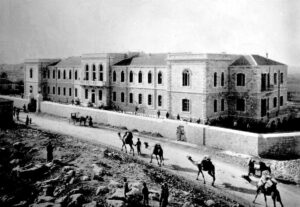
The execution took place on June 30, 1924, at 7:35 pm. As de Haan emerged from evening services at Jerusalem’s Shaare Zedek Hospital, Hagana operative Abraham Tehomi (1903–1990) pumped three bullets into his target’s chest at point blank range, killing him instantly. Tehomi was never apprehended, but despite the Zionist executive’s vehement denial of any involvement with de Haan’s death, most people believed otherwise. (Many years later, Tehomi confessed and even implicated Israeli premier Yitzhak Ben-Zvi as the source of the fatal order. Ben-Zvi had headed the Zionist National Council at the time.)
On July 4, immediately after the assassination, the Jewish Telegraphic Agency reported that de Haan had been slated to travel to England together with Dr. Moshe Wallach (1866–1957), founder and director of Shaare Zedek. They were to present a memorandum to formally “protest against the ordinance of the Palestinian Government granting communal autonomy to the Jewish communities of Palestine, under the leadership of the Vaad Leumi [National Council].” That council, they claimed, was governed by “non-religious elements,” to which they could never submit. This document was the last work of Jacob Israel de Haan.
Jewish reactions to de Haan’s murder varied, but plenty of Jewish writers and leaders sympathized with its intent. For much of the Jewish world, the separatists were living in the past, vainly trying to survive a fast-changing reality by committing perfidy against their coreligionists. As the public face of these anti-Zionists, de Haan was thus widely perceived as a traitor and reviled by vast segments of Jewry both in and out of Palestine.

King Abdullah of Jordan | Courtesy of Library of Congress collection

Hagana operative Avraham Tehomi admitted to pulling the trigger on de Haan. Tehomi as a young man
About-Face
Agudath Israel, however, hailed de Haan as a martyr. For these Orthodox antiZionists, his assassination confirmed Zionism as a travesty of Judaism leading inevitably to cold-blooded fratricide. Remarkably, Shapotshnick fell firmly into this camp, a striking departure from his previous views.
By the time de Haan was murdered, Shapotshnick had – not unlike the victim himself – evolved from a Zionist sympathizer into a cynical critic of political Zionism. This change might be rooted in his growing friendship with Rabbi Sonnenfeld, leader of Jerusalem’s Ashkenazic City Committee, starting in the early 1920s. Shapotshnick corresponded with the rabbi regularly, sending him donations and seeking his assistance with various charity cases.
While Shapotshnick perhaps naturally felt the need to publicly address the assassination of his correspondent’s protégé, he eagerly exploited the murder to express his own political agenda and vent his hostility.
What particularly offended Shapotshnick was the partisan nature of so much of the Jewish media reaction to this horrific incident. Ever the iconoclast, he saw this broad, almost blind support for those he believed were the perpetrators of the murder as evidence of something fundamentally wrong. The Jewish press was, in his estimation, way out of line for casting aspersions on de Haan’s character and motivations.
Shapotshnick blamed this blatant bias on corruption, ignorance, and an urge to please the masses. All three were an utter disgrace, he said, marginalizing good people from mainstream Jewish life simply because they opposed the views of a particular party. De Haan wasn’t the monster depicted in the “filthy partisan newspapers,” wrote his defender. Rather, he had been an “ardent Jew who devoted his life to Judaism with enormous sacrifice and commitment.” Hasidic rebbes visiting Palestine from Poland had treated him like a brother, Shapotshnick added, and he was “the best friend any Orthodox rabbi could have ever had” (London Jewish Free Press, July 11, 1924, p. 1).
The third issue of the Press devoted a full page to “The truth about Professor Dr. de Haan,” summarizing two articles in the Jerusalem-based, anti-Zionist periodical Kol Yisrael (issue 42, 24 Tammuz [July 26] 1924). The first was a sympathetic obituary followed by an emotive attack on those who had sought to besmirch the martyr. It also detailed the prominent and well-attended public eulogies delivered in Jerusalem by Rabbi Sonnenfeld and other senior anti-Zionists, all stressing de Haan’s unique qualities and unquestioning dedication to Orthodoxy. The second assailed the objects of de Haan’s singular struggle to free the strictly observant from control by sinners and heretics – i.e., Zionists.
Shapotshnick followed this piece with his own, castigating the London rabbinate for organizing no memorial of de Haan. Without naming names, he accused his colleagues of preventing such an event and denounced their hypocrisy:
Here in London the preachers and rabbis, and even one of the beloved local yeshiva heads, all seem preoccupied with how to ensure that eulogies are not delivered [for de Haan], while for any [random] person who eats forbidden foods [or is] a Sabbath desecrator […], as long as they get their little tip […], [rabbis] will deliver the eulogy. (London Jewish Free Press, August 29, 1924, p. 3)
Yet economics almost certainly had nothing to do with de Haan’s treatment. Rather, the whole episode was divisive and politicized, and – despite Shapotshnick’s protestations to the contrary – any idolization of the Dutchman in the wake of his murder would have seemed partisan and provocative both within and beyond London’s East End Jewish community.
Dismissing such concerns, Shapotshnick paid tribute to de Haan – a man he had never met – at his synagogue on Fieldgate Street on September 15, 1924. The final issue of the London Jewish Free Press declared the effort a success, with near-capacity attendance that included locals as well as visitors – but none of Shapotshnick’s rabbinic colleagues.
De Haan, wrote Shapotshnick, had uniquely combined secular scholarship, religious devotion, and love of the land of Israel. As such, his death was a devastating loss for observant Jewry, which had relied so heavily on him in its struggle against outside influences. He had died, the author concluded, as a martyr in sanctification of God’s name (ibid., October 26, 1924, p. 5).
Shapotshnick clearly identified with de Haan. In his eyes, both were vilified and marginalized despite their sterling credentials and determination to create a positive future for the Jewish world while staying true to the Jewish faith. Indeed, Shapotshnick considered himself a revolutionary who’d never gotten anywhere in his bold efforts to change things for the better. Just as de Haan’s rejection and murder had stemmed from mistreatment by the mainstream Jewish leadership and its media lackeys, Shapotshnick’s failure was the fault of these same actors. Shapotshnick saw himself as a martyr equal to de Haan, snuffed out by the shadowy forces that controlled the Jewish world.
Jacob Israel de Haan’s chilling murder forever silenced probably the most controversial Jewish activist of the interwar period. Shapotshnick’s take on the assassination likely made little impact beyond his limited readership within London’s immigrant Jewish community. Yet it sheds light on the reaction to the crime in real time, and from an unexpected source: a nonconformist Hasidic rabbi living in London whose anti-establishment perspective adds color and nuance to an historic event that reverberates to this day.

De Haan’s funeral in Jerusalem, attended by Zionist representatives as well as the ultra-Orthodox

The monument to De Haan near the Rembrandt Museum in Amsterdam | Photo: Wysocki
Further reading:
Lucy Giebels, “Jacob Israel de Haan in Mandate Palestine: Was the Victim of the First Zionist Political Assassination a ‘Jewish Lawrence of Arabia’?” Jewish Historical Studies 46 (2014), pp. 107–29; Harry Rabinowicz, A World Apart: The Story of Chasidim in Britain (London, 1997), pp. 56–66; Matthijs van der Beek, “From Zionist to Anti-Zionist: The Tragic Fate of Jacob Israel de Haan in Palestine Reconsidered” (University of Haifa, 2016); Shlomo Nakdimon and Shaul Mayzlish, De Haan: The First Political Assassination in Palestine (Modan, 1985), pp. 21–26, 207–18 (Hebrew).
Feel free to share