The people and animals in the Dura-Europos murals might reflect a community’s disregard for rabbinic strictures but can’t be seen as evidence of non-rabbinic Judaism in third-century Syria

Since its discovery in 1932, the Dura-Europos synagogue has appeared in countless research works. Yet many mysteries still surround its structure, murals, and inscriptions. All three of these elements must be compared to other synagogues from the same and similar periods.
Agreeing to Disagree
Whereas the dating of most synagogues requires sifting through sometimes sparse archaeological evidence, Dura-Europos’ year of construction (or, to be exact, the year of its predecessor’s expansion) is recorded in a dedicatory inscription: “In the year 556, the twelfth year of Philipus Caesar.” According to the Seleucid calendar, accepted throughout Syria – and used by certain Diaspora communities to date official documents (a system known as minyan shtarot), 556 was the year 245 CE, the second year of the reign of Roman emperor Philip the Arab. An earlier synagogue on site, originally part of a home, was evidently expanded and upgraded after a few decades to create the remarkable building excavated in 1932.
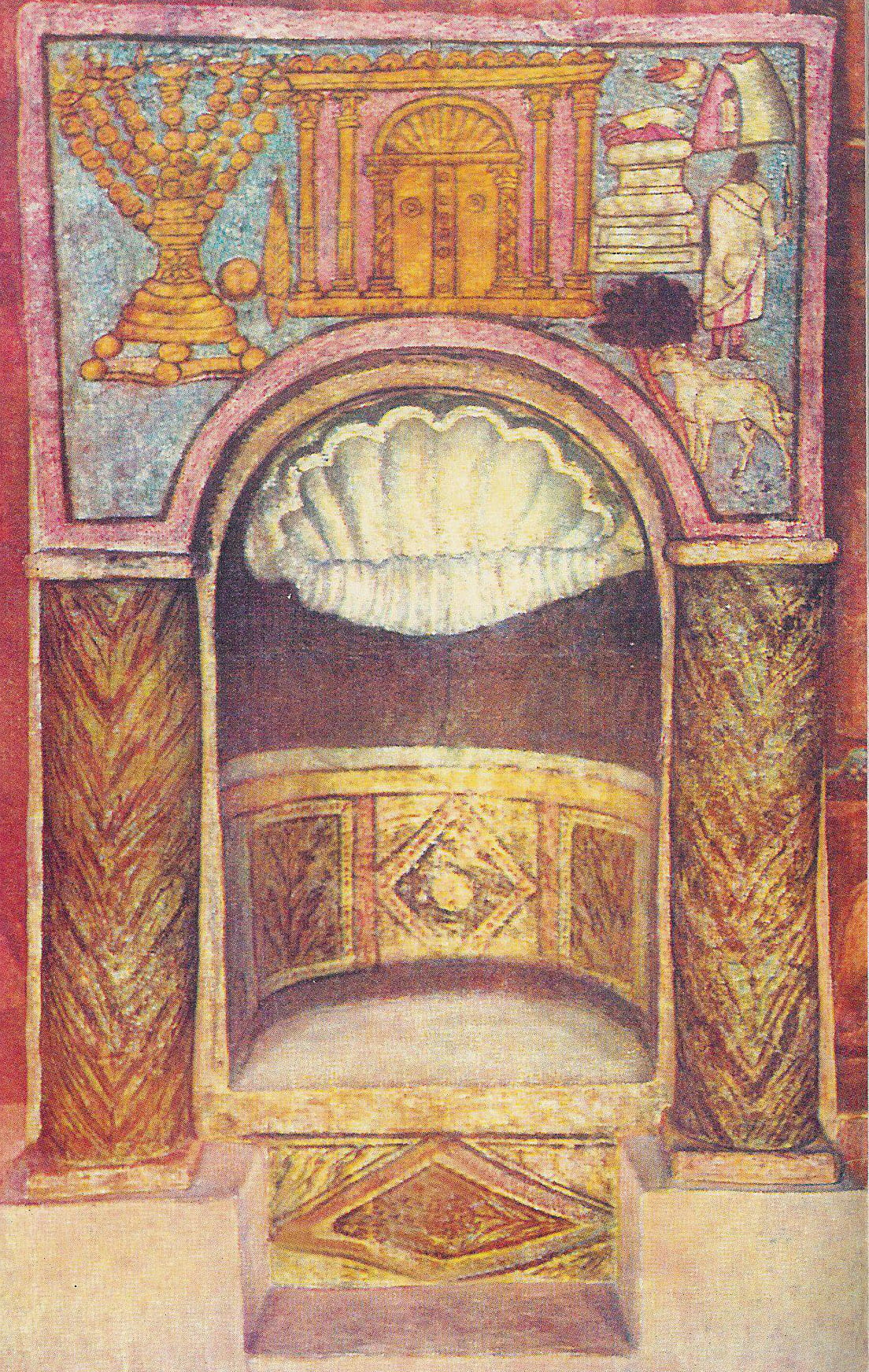
It seems that Diaspora synagogues preceded those in the land of Israel. Although there’s considerable disagreement regarding the dating of the oldest houses of worship in Judea and the Galilee, many authorities place them no earlier than the Byzantine period. The Greek word synagoga, appearing in Jewish sources from the Second Temple era, denotes any place used for spiritual pursuits, including Torah study. The famous Theodotos son of Vettenus inscription, discovered in Jerusalem in 1913, refers to a structure built “for the reading of the law and the teaching of the commandments.” But in Dura-Europos, the wall niche facing Jerusalem apparently indicated the direction of prayer, signifying not a house of study but a house of worship.
The Jerusalem Talmud implies that the décor here, incorporating figurative art, reflected a trend:
In the days of Rabbi Yohanan, they began painting on walls, and he didn’t object. (Avoda Zara 3:3)
As the context of this passage reveals that the rabbis did indeed object to graven images, early communities in the land of Israel evidently weren’t run along the lines dictated by the sages. Yet many of these rabbis prayed in such synagogues, while other scholars expressly disapproved of overly lavish houses of prayer. There has frequently been a gap, often accompanied by communal tension, between rabbinic instruction and facts on the ground – and not only where synagogues are concerned. Arguments between lay leaders and rabbis have long been part of Jewish life.
Beyond the Bible
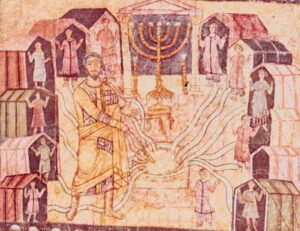
Many biblical scenes adorn the synagogue of Dura-Europos, some inscribed with the names of their protagonists. These works span the entire biblical period: from the covenant with Abraham and the binding of Isaac to the infant Moses being drawn from the Nile (and in the Dura-Europos version, either Pharaoh’s daughter or her handmaiden appears stark naked), the burning bush, the parting of the Red Sea, and the Tabernacle, along with King David, Ezekiel the prophet and the revival of the dead, Ezra the scribe, and the book of Esther.
The location of Dura-Europos, bordering the Roman and Persian empires, finds expression in the costumes featured in these paintings. Some Persians in the book of Esther illustrations wear togas, while the warring Israelites and Philistines are in Persian gear, though Philistia was in fact an Agean/Hellenic civilization. Experts surmise that at least two artists, one Hellenist and the other Persian, created the murals.
Interestingly, the paintings incorporate details absent from the biblical text. Some are drawn from midrashic literature, such as the idea that each of the twelve tribes trod its own path through the Red Sea and drank from its own rivulet from the rock that miraculously produced water in the desert. Similarly, in the depiction of Elijah’s struggle with the prophets of Baal on Mount Carmel, a figure hidden inside the pagan altar is bitten by a snake. According to the Midrash, King Ahab’s protégé, Hiel of Bethel, planned to light a fire on the altar and so win victory for the priests of Baal, only to die of snakebite as he crouched beneath the structure.
Not yet a Segula subscriber?
Access our full archive online, have print issues delivered to your door, and moreFeel free to share