Aaron Krikheli immersed himself in recording the history and culture of Georgia’s Jews just as the powers that be set about obliterating Jewish identity throughout the Soviet Union. One man’s struggle against officially mandated amnesia

Though largely unknown, Aaron Krikheli literally made history. A scholar of Georgian Jewish history and culture, Krikheli was appointed director of the Historical-Ethnographical State Museum of the Georgian Jews – located in Tbilisi, today capital of Georgia – in 1934. He held the post until 1948, when he was arrested by the Soviet secret police, convicted of Jewish nationalism, and exiled to the gulag.
Krikheli was one of numerous victims of zigzags in Soviet policy. In the 1920s and early 1930s, the Communist Party needed to win over minorities in the many Soviet republics, so his and others’ research into minority cultures was encouraged – as long as it reflected a strictly Marxist, anti-religious slant. By the late 1930s, the emphasis had shifted to attempts to achieve uniformity and assimilation through reliance on a core Russian identity. Spearheads of the previous policy of indigenization (korenizatsiia) were now “enemies of the state,” including many Jewish intellectuals all over the USSR.
Georgia was no exception. Conquered by the Red Army in 1921 in the struggle between the Bolsheviks, the Georgian Menshevik government, and Turkey, Georgia was subjected to anti-religious legislation from the mid-1920s. Great efforts were made to secularize and communize the region’s Jews. Most were highly traditional and resisted Soviet schooling. The intelligentsia tended to be more pro-Soviet, seeing no real contradiction between Jewish identity and a secular, Russian cultural education, as long as children could still learn Hebrew, Jewish history and literature, and respect for their religious leadership. The Soviets were typically more tolerant in the outlying districts of the southern states, lest a heavy hand spark uprisings that could cost them control of what they perceived as a primitive, superstitious population.
The Jew from Tskhinvali
Aaron Krikheli was part and parcel of the educated Jewish class that sprang up in Tbilisi, capital of Georgia, in the late 1920s. Born in 1906 to the scholar Meyer Krikheli, Aaron was exposed to Hebrew in his Georgian hometown of Tskhinvali from an early age:
My father was well-versed in Hebrew […]. In those years, there were seven synagogues in Tskhinvali. Hundreds of Jews gathered on Sabbaths and holidays to hear his sermons […]. I acquired my first knowledge of Hebrew in my father’s house and from the heder next to the synagogue. (Moshe Margalit, “Aron Khriheli – khranitel istorii evreev Gruzii,” Nasha Strana, February 1, 1974, p. 11)
Ever since Rabbi Avraham Halevi Khvoles (originally of Kovno) had set up a Talmud Torah in 1906, teaching in Hebrew (Georgian Jews didn’t speak Yiddish), Tskhinvali had been a Georgian Jewish center. Identifying strongly with the proto-Zionist Lovers of Zion movement, Khvoles profoundly influenced young Aaron, as did the rabbi’s students, who frequented the Krikheli household.
Aaron received a general education as well as a Jewish one. After graduating from a Russian high school, he studied economics at Tbilisi State University. Krikheli joined the Communist Party as a student and in 1928 was appointed director of the literature department within Georgia’s Commissariat of Higher Education. By 1929, he was in charge of the Evkombed (the Georgian Jewish welfare organization) cultural club in Tbilisi. In 1930, the club had 175 members.
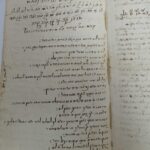
Long fascinated by his community’s history, Krikheli diligently documented its past. So when the Commissariat decided to repurpose one of Tbilisi’s synagogues as a museum of Georgian Jewish history and ethnography in 1933, he was its natural director.
Between Hammer and Sickle
Even in the late 1930s, when Jewish cultural activities were often misinterpreted as anti-Soviet and nationalistic, Krikheli remained at his post. His position was fraught with difficulties: his required “fieldwork” was essentially a cover for expropriation. Krikheli was charged with collecting “ethnographic material,” which amounted to confiscating Torah scrolls, certificates, clothes, ritual objects, and household items. He frequently met with hostile resistance by Jews who dismissed anyone associated with the Historical-Ethnographical State Museum of the Georgian Jews as a Soviet agent lacking respect for religious tradition. Sometimes they were right, as when the police helped Krikheli’s workers seize Torah scrolls dating from the 12th and 15th centuries.
Not yet a Segula subscriber?
Access our full archive online, have print issues delivered to your door, and moreFeel free to share