Water towers have long been one of the most obvious landmarks of Zionist settlements, often becoming a focus of civic pride as well. What made these clumsy-looking utilities local icons?

Water towers have been around only some 150 years, so perhaps it’s excusable that their basic design hasn’t progressed beyond a cross between a space alien and a top-heavy, long-legged insect. Yet these structures remain an important precautionary measure in modern water systems – themselves one of the more beneficial byproducts of the industrial revolution.
Debuting in Europe and the United States in the mid-19th century, water towers were speedily duplicated all over the world. Water stored in these raised tanks served as a back-up for reservoirs. In the event of a malfunctioning pumping station or a fire, that water was readily available. And when water was plentiful, spare capacity could be pumped up into the towers for storage, to be released whenever demand increased. In addition, the water’s downward flow ensured excellent water pressure throughout the community.
Early water towers supplied consumers directly via pipes and pumps, while newer ones became part of a larger system of wells, reservoirs, and pumping stations.
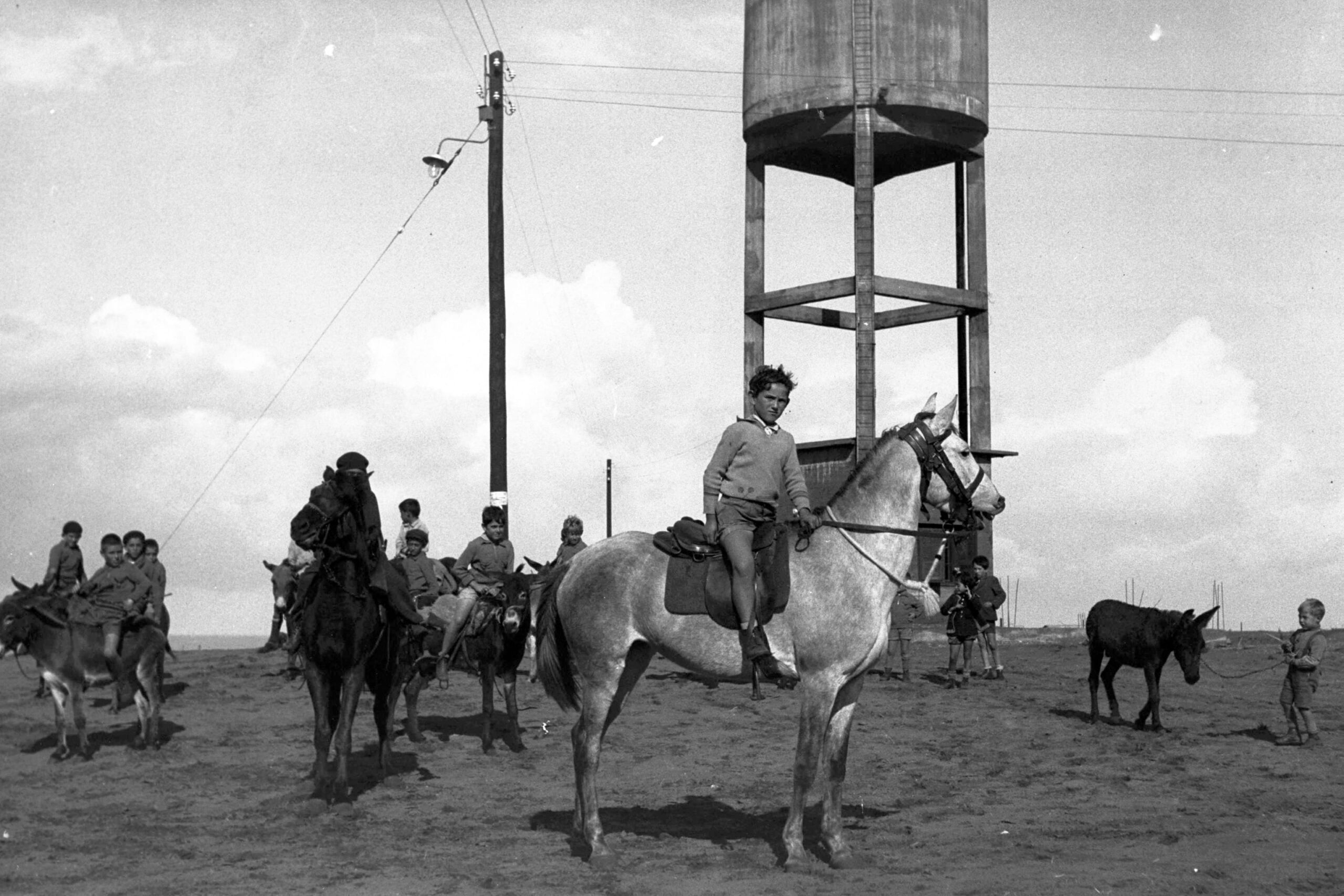
In the land of Israel, water towers were introduced in the late 1800s, along with the first Zionist colonies. As such, the towers swiftly became identified with Zionist settlement. Later, the lone water tower pointing bravely up from its surroundings was synonymous with small, isolated Jewish villages’ stubborn struggle for survival during Israel’s War of Independence.
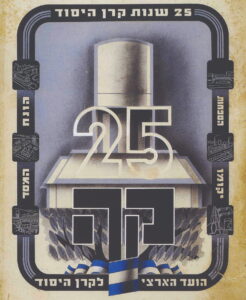
A booklet produced by the Jewish National Fund (JNF) in 1939 to commemorate its settlement achievements in pictures noted:
Soil and water – the two factors in the flowering of the Hebrew village. After the redemption of the soil by the Jewish National Fund, the Yishuv [the pre-state Jewish community in the land of Israel] began attending to the redemption of the water. When new settlements are founded, water towers are built, [which have] become one of the distinctive signs that differentiate the Hebrew village favorably from its Arab surroundings. (“Knowing the Land,” in Seeing Is Believing: A Series of Pictures from the Archives of the Jewish National Fund [Dubek Co. Ltd., 1939])
This passage encapsulates the Zionist ethos: after the acquisition of the land itself, water towers were the next stage in the ongoing development of Jewish national interests in the land of Israel. Running water symbolized permanence, a declaration of readiness to make long-term investments in homes and infrastructure. Furthermore, as a mark of modernization, water towers represented the technology and progress the Zionists hoped to bring to the country – in stark contrast to the primitive conditions in Arab villages. The towers were the Zionist answer to the Muslim minarets and church spires dotting both Ottoman Palestine and the Zionist pioneers’ countries of origin.
Double Duty
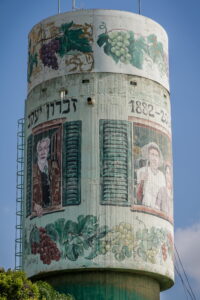
The first Zionist water tower was built in 1891 in Zikhron Yaakov. It was inscribed:
1881, Benjamin’s Pool, in memory of the famous philanthropist who rose up in his generosity and poured water from his well. And let his goodly representative, Mr. Yaakov Ben-Shmuel, also be mentioned in blessing. May God guard and protect them. (Rivka Nahmani Shusterman, “The Development of Water Towers in Eretz Israel,” in Water Towers in Israel 1891–1993, ed. Mordechai Omer, p. 11 [Hebrew])
The next towers were built in two more of Baron Rothschild’s colonies: Rishon Lezion, in 1898, and Mazkeret Batya, in 1905. Ahuzat Bayit, later to become Tel Aviv, erected its water tower at the hilltop intersection of three streets – the future Herzl, Nahalat Binyamin, and Rothschild Boulevard. Akiva Aryeh Weiss, founder of the local residents’ association, described the process:
I was informed by the Stein foundry that the motor ordered had already arrived in Jaffa. I hastened to receive it from the Customs House, and the day after the water news, the motor was already next to the well. Soon after this the pump was installed in the well and connected to the motor, and it became possible to obtain water beside the well.
The two tanks that had in the meantime been ordered from Mr. Stein were already ready, and the building of the tower of “ladkani” stones[,] which are very strong, was also complete. The tanks had a capacity of about 150 cubic meters of water and supplied the precious liquid to every house and garden. (Omer, p. 135 [English])
At the same time Tel Aviv was connected to running water, the technology also reached the Templar colony of Bethlehem in the Galilee, Kibbutz Merhavia (east of Afula), and the Technion campus in Haifa.
During the twenties and thirties, once World War 1 had spawned the British Mandate and the trickle of Zionist immigration became more of a flow, the country was literally inundated with water towers. Every new village and kibbutz in the Jezreel Valley, the coastal plain, and the Galilee had one – as did the cities.
Some of these towers were local initiatives supported by such Zionist institutions as the Histadrut labor union and the JNF, while others were built by the Mandate authorities. One example of the latter type was the water tower in Jerusalem’s modern Romema neighborhood, not far from where the Ottomans had surrendered to General Allenby.
The last pre-state towers went up in three kibbutzim: Yad Mordekhai (just south of Ashkelon), Be’erot Yitzhak (in the center of the country), and Revivim (in the Negev). Doubling as crucial lookout posts when these communities were under Egyptian siege in the War of Independence, the towers stood for bravery and victory against all odds.
Fewer water towers were built in the fifties and sixties, as new technologies began making these structures obsolete. Israel’s last two were erected in Kfar Saba in 1990 and in Bnei Brak in 1992.
Not yet a Segula subscriber?
Access our full archive online, have print issues delivered to your door, and moreFeel free to share