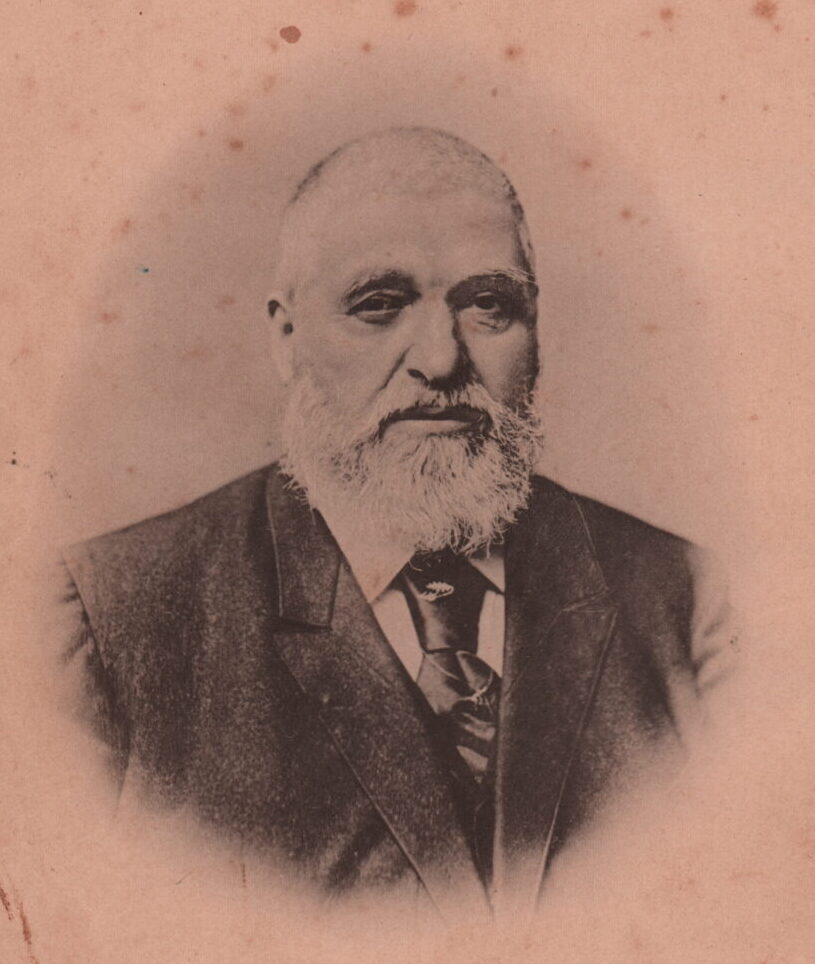
Tea’s popularity in Israel began not with the British Mandate but with Russian Jewish tycoon Kalonymus Wissotzky. Thanks to prudent business decisions and calculated risks, Wissotzky Tea outlived the Russian Revolution and reinvented itself in the very country this enterprising Jew had labored to create // Leonid Liflyand

Despite limited freedom, Russia’s Jews played a surprisingly significant role in their country’s rise to world prominence in the late 19th and early 20th centuries.
It does not matter whether one likes the Jews as a race. […] Jews make up more than a third (35%) of the Russian commercial class. […] to a large extent, they are the ones running [our] commerce. Any checks imposed on the expression of the free commercial spirit of the Jews cause pain to the nationaleconomic body of Russia. (Mikhail Bernatzky, “The Jews and the Russian National Economy,” The Shield: A Literary Collection, ed. L. Andreyev, M. Gorky, and F. Sologub, 3rd expanded ed. [Moscow, 1916], p. 39)
One key player in Russian commerce was Kalonymus Ze’ev Wissotzky, founder of Wissotzky & Co. and a leading Russian tea producer. How did a poor Jew from the Pale of Settlement become a major industrialist, a prominent Zionist (before the term was even coined), as well as a philanthropist and patron of the arts? That amazing yet little-known story deserves to be told in detail.
Kalonymus Ze’ev Wissotzky was born in 1824 into a struggling Jewish family in the town of Starye Zhagory, in the Kovno Governorate (nowadays Žagarė, Lithuania). The era was particularly difficult for Russian Jews, with Czar Nicholas I evicting them from parts of the Pale of Settlement and conscripting boys (known as “cantonists”) into decades of military service. (As Jewish farmers were exempt from this draft, many Jews turned to agriculture.)
By 1914, Jews constituted 57 percent of Wissotzky’s hometown, pop. 14,000. Yet this Jewish community too was virtually annihilated in World War II.
Information about Wissotzky’s family and early years is relatively scant. Survived by two sisters, he probably had many siblings. As was customary in Jewish families, Kalonymus received a traditional education and upbringing; in addition, he knew Russian, Jewish history, and arithmetic.
Young Wissotzky joined the Love of Zion (Hibbat Zion) movement (whose Russian name translated as “Palestinophiles”). All his life, he remained an observant Jew. Grandson Mikhail Tsetlin, a famous Russian poet writing under the pseudonym Amari, described him in a poem entitled “The Menorah”:
It’s Passover, the party is thrown; Sheets are clean, and our faces are bright. For my grandpa, the chair is a throne; He will feast, sing, and pray through the night. (The Jewish World [Yevreiskiy Mir], book 1 [Moscow, 1918], p. 202)
Not yet a Segula subscriber?
Access our full archive online, have print issues delivered to your door, and moreFeel free to share