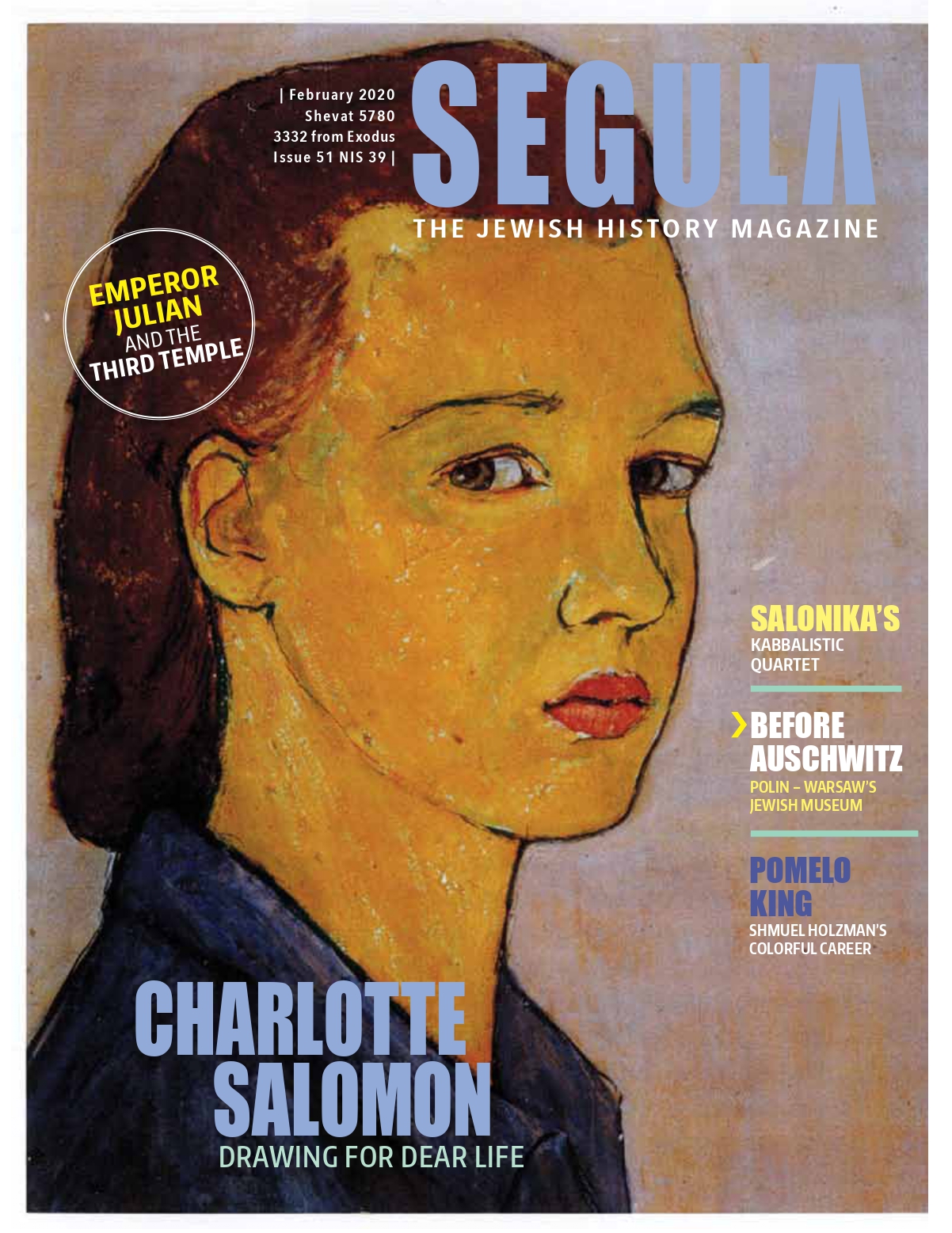
When Charlotte Salomon discovered that her mother, aunt, and grandmother had all committed suicide – among other women in her family – she refused to succumb to their fate. As the Nazi noose tightened around her, she clung to life, immortalizing her own story in passionate gouache

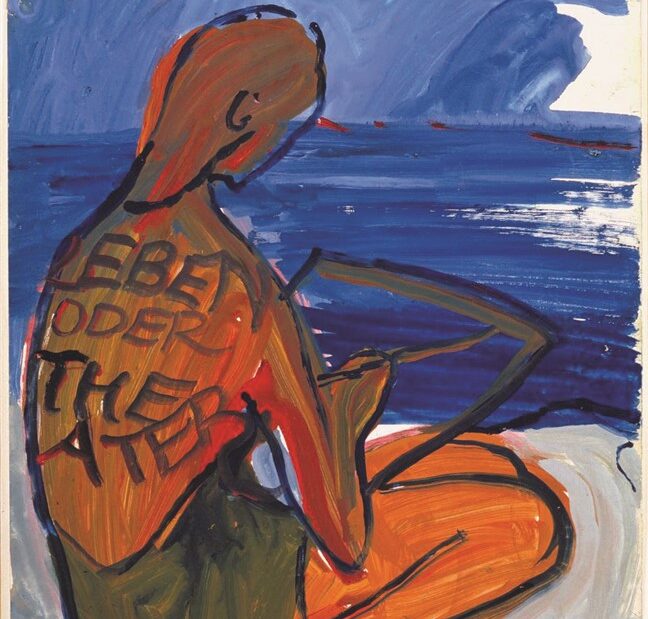
What could be more innocent than a young woman sketching on the beach on the French Riviera? Yet beneath the artist’s serene exterior, bitter turmoil reigns.
The last few weeks have been an unending purgatory. First, her grandmother’s suicide attempt; by some miracle, she managed to save the old woman from the rope by which she hung. Then her grandfather’s outburst, revealing the secret concealed from her all these years: this wasn’t the first suicide in the family. There’ve been so many, culminating in her own mother’s. (Sheltered, the girl thought influenza killed her.) Suddenly, her world is tottering. Who is she, if all her life has been a lie?
As if all this weren’t enough, catastrophes pursue her one after another: her grandmother’s next attempt to kill herself succeeds; then weeks confined to the Gurs detention camp, in the French Pyrenees. France falls to the Nazis; next comes a perilous journey to Nice, and finally – the crisis: If generations of family members – especially women – have chosen to end to their lives, why should she be any different?
An overwhelming emptiness threatens to tip her, too, into the abyss. But her physician’s gaze pierces her soul. “You have to paint,” he tells her. Suddenly everything clears. She’ll paint.
Meanwhile, war rages. Monsters rule the world, determined to wipe out her people. But she is sketching on the beach. And writing to her future viewers:
The origin of the present set of pages is to be imagined as follows: A person is sitting at the sea. And painting. A melody suddenly comes to mind. Starting to hum it, the person notices that the melody exactly resembles what needs to go down on paper. A text takes form in thought, and now in a loud voice, the melody begins to be sung, countless times, along with the text being painted, until the page appears ready. Often, several pages are painted, and a duet arises, or it even happens that all the characters have different texts, from which emerges a chorus. (Mary Lowenthal Felstiner, To Paint Her Life: Charlotte Salomon in the Nazi Era], p. 143)
With suicide the only alternative, Charlotte Salomon chooses to recast her own life – through art.

Winged Angel
In many ways, Charlotte Salomon’s story begins with the death of another Charlotte – her aunt, Charlotte Grunwald. The Grunwalds were a typical bourgeois German Jewish family of intellectuals, keeping their Judaism under wraps. Dr. Ludwig Grunwald and his wife, Marianne Benda, gave their daughters, Charlotte and Franze, the best European education, and the results did them proud. But something was wrong. In 1913, when she was eighteen, Charlotte jumped off a bridge and drowned. Suicides were common among middle-class German families, and Jewish women were at greatest risk. But Charlotte’s death wasn’t just an unfortunate statistical probability.

Franze, the elder sister, buried her grief deep within and slowly rebuilt her life. In 1915, as a volunteer nurse on the killing fields of World War I, she found herself working alongside a young surgeon. Albert Salomon was Jewish in name only; culturally, he was as German as they come. Fiercely ambitious, he hoped to become a professor of medicine. Salomon wasn’t particularly interested in Franze, until circumstances intervened. In words and pictures, daughter Charlotte later immortalized the moment the couple’s fatal attraction began:
Mid-operation, the surgeon had a sneezing fit. While his hands groped for shrapnel inside the stomach of the wounded soldier before him, the young nurse wiped his nose with her handkerchief. The rest is history.
Albert and Franze married a year later, much to her parents’ chagrin. An orphan with no means to speak of, he seemed beneath them. They attended the wedding – at least as far as their granddaughter subsequently portrayed them – looking as if it were a funeral.
The Salomons bought an apartment in western Berlin’s lively Charlottenburg neighborhood. Franze spent most of her first and only pregnancy alone, as Albert was still at the front. Even after the war ended, he was preoccupied by ever greater professional goals. Franze stayed home with baby Charlotte, born in 1917, who grew up amid her mother’s mood swings.
Franziska … often took the child into bed and told her of an afterlife in heaven that would be just splendid and that she had a terrible yearning for. And she used to ask Charlotte, wouldn’t it be beautiful if her mother turned into an angel with wings? Charlotte did think it would be beautiful, but asked her mother not to forget to deliver a letter – in person like an angel – to Charlotte’s windowsill, saying what it looked like up there. (ibid., p. 9)
When “Lotte” was eight, her mother tried to transform herself into just such an angel – by swallowing poison. Transferred to her parents’ home under strict supervision, Franze nonetheless found her way to the window, and from there to heaven.
Not yet a Segula subscriber?
Access our full archive online, have print issues delivered to your door, and moreFeel free to share